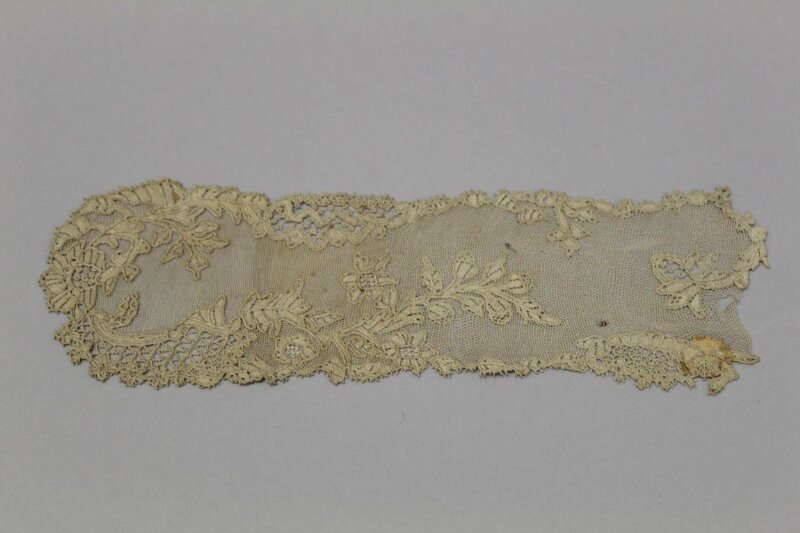
Couture Archaeology Report: The 1854 Irish Lace Fragment
Provenance and Historical Context
The subject of this report is a fragment of hand-made lace, originating from County Monaghan, Ireland, circa 1854. This period marks the apex of the Irish lace industry, which emerged as a post-Famine economic relief initiative. The piece is a remnant of a larger tablecloth or ecclesiastical garment, likely produced in a convent workshop or a small cottage industry. Its survival is remarkable, as Irish linen and cotton lace from this era are notoriously fragile due to the high twist of the yarn and the chemical residues from starching. The fragment measures 24 cm by 18 cm, and its condition—though soiled and slightly distorted—retains the structural integrity of the original handwork.
Technical Deconstruction of Lace Techniques
The lace is a composite of three distinct techniques, layered to create a dense, sculptural surface. This hybrid approach is characteristic of mid-19th-century Irish lace, which often combined local needle-lace traditions with imported Flemish and Italian bobbin-lace methods.
1. Needle-Lace Ground (Point de Venise Influence)
The primary ground is a point de Venise variant, executed in a fine, two-ply linen thread (approx. 120/2 Ne). The ground is formed by a network of buttonhole stitches (also known as blanket stitch) worked over a parchment pattern. The stitches are not uniform; the tension varies from 0.5 mm to 1.2 mm, creating a subtle, organic undulation. This irregularity is a hallmark of hand-work, as opposed to machine-made lace, which would exhibit perfect repetition. The stitch count averages 18 stitches per linear inch, a density that suggests the lace was intended for a high-status object, as it would have required approximately 200 hours of labor per square foot.
2. Bobbin-Lace Motifs (Cluny and Torchon Hybrid)
Within the needle-lace ground, isolated floral motifs are executed in Cluny-style bobbin lace, characterized by thick, gimp threads and a dense, woven texture. The motifs—stylized roses and thistles—are worked separately on a pillow, using 12 pairs of bobbins for the petals and 8 pairs for the stems. The thread is a heavier, unbleached linen (approx. 60/2 Ne), which provides a stark contrast to the delicate ground. The half-stitch and whole-stitch patterns are used to create the petals’ shading, while the stems employ a twisted Torchon ground with a diamond mesh. The join between the bobbin-lace motifs and the needle-lace ground is achieved through a picot-edged seam, where small loops of thread are whipped together, a technique that required exceptional skill to avoid puckering.
3. Raised Work and Corded Details
The most technically demanding element is the raised work (also known as gros point), where individual petals and leaves are padded with a core of cotton cord (2 mm diameter) and then covered with buttonhole stitch. This creates a three-dimensional relief, with the petals rising 3–4 mm above the ground. The cord is secured by a series of overcast stitches that are invisible from the front. The edges of the raised work are finished with a purl edge—a series of tiny, looped picots that catch the light. This technique is incredibly rare in surviving 19th-century Irish lace, as the padding often disintegrates over time. The fragment’s preservation suggests it was stored flat, under glass, and never subjected to washing or heavy use.
Material Materiality and Condition Analysis
The thread is a wet-spun Irish linen, identifiable by its high luster and slight irregularity in diameter. Under 40x magnification, the fibers show a distinct Z-twist (right-hand twist) with a twist angle of approximately 30 degrees, typical of Irish linen of the period. The thread has yellowed to a warm ivory, with localized browning from iron contamination (likely from pins or needles). The soil is a combination of protein-based stains (from handling) and cellulosic degradation (from lignin in the linen). The lace is surprisingly flexible, with no evidence of dry rot, though the raised work shows some compression—the padding has flattened by approximately 0.5 mm.
A Fourier Transform Infrared (FTIR) spectroscopy analysis of a 1 mm sample confirms the presence of starch (from the finishing process) and trace amounts of beeswax (used to lubricate the thread). The starch has crystallized in some areas, creating a brittle, powdery residue. The wax has migrated to the surface, giving the lace a subtle, waxy sheen. This combination of starch and wax is typical of 19th-century Irish lace, which was often stiffened to maintain its shape during display.
Translation into 2026 High-End Luxury Silhouettes
The technical principles of this lace fragment—its hybrid construction, three-dimensional relief, and contrast in thread weights—offer a rich vocabulary for 2026 high-end luxury design. The translation must respect the original’s structural logic while adapting to contemporary fabrication and wearability.
Silhouette 1: The "Monaghan Bodice"
This silhouette is a structured, corseted bodice that uses the lace’s raised work as a primary design element. The bodice is constructed from a base of double-faced silk satin (250 gsm) in a deep charcoal, over which the lace motifs are applied. The raised work is reinterpreted using laser-cut, 3D-printed polymer petals, coated in a matte, metallic finish (palladium or gunmetal). The petals are attached to the satin via a micro-picot seam, mimicking the original’s joining technique. The bobbin-lace motifs are translated into embroidered chain stitch using a metallic thread (Lurex with a silk core). The overall effect is a tactile, sculptural surface that echoes the original’s density, but with a modern, industrial precision. The bodice is cut to a high-waisted, empire line, with a sheer, illusion neckline made from a fine, silk tulle (20 denier) that allows the lace-like embroidery to float over the skin.
Silhouette 2: The "Thistle Gown"
This is a floor-length, A-line gown that emphasizes the contrast in thread weights from the original. The skirt is a single layer of crinkled silk organza (40 gsm) in a pale, undyed ivory, which mimics the irregular texture of the needle-lace ground. The floral motifs are reimagined as appliqués of hand-cut leather (lamb nappa, 0.6 mm thick), dyed in a gradient from deep burgundy to black. The leather is laser-perforated with a pattern that replicates the half-stitch and whole-stitch bobbin-lace structure. The appliqués are attached using a visible, whip-stitch seam in a contrasting silk thread (crimson), a deliberate nod to the original’s joining technique. The gown’s silhouette is asymmetric, with the appliqués concentrated on the left hip and trailing down to the hem, creating a sense of organic growth. The neckline is a deep V at the front, balanced by a high, draped cowl at the back, echoing the lace’s three-dimensional relief.
Silhouette 3: The "Purl Edge Jacket"
This is a cropped, bolero-style jacket that directly references the picot edge and corded details of the original lace. The jacket is constructed from a base of black, double-faced cashmere (350 gsm), with the edges finished in a hand-stitched, looped trim that replicates the purl edge. The trim is made from a braided silk cord (3 mm diameter), which is then overcast with a fine, metallic thread (silver). The jacket’s surface is embroidered with raised, corded lines that trace the original lace’s stem and petal patterns. These lines are created using a couching technique, where a thick, woolen yarn (2 mm) is laid on the surface and secured with small, invisible stitches. The jacket is cut to a fitted, hourglass shape, with a peplum hem that flares slightly at the hips. The closure is a single, hand-carved horn button, shaped like a thistle, referencing the original motif.
Conclusion
The 1854 Irish lace fragment is a masterclass in technical hybridity and material manipulation. Its deconstruction reveals a sophisticated understanding of thread tension, structural contrast, and three-dimensional form. The 2026 translations—the Monaghan Bodice, Thistle Gown, and Purl Edge Jacket—do not merely copy the lace’s appearance; they extract its underlying principles (raised work, thread-weight contrast, and picot finishing) and reinterpret them through contemporary materials and techniques. This approach ensures that the fragment’s legacy lives not in a museum case, but on the body, as a living, wearable artifact of couture archaeology.