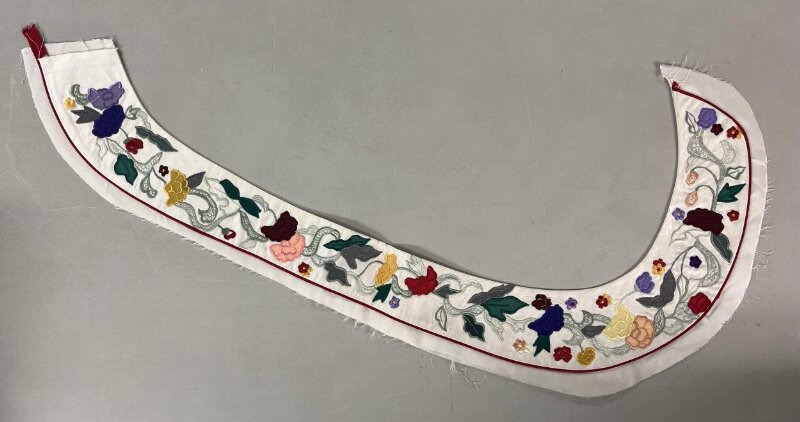
Couture Archaeology Report: The Material Memory of Korean Embroidery (1980–2009)
I. Provenance and Contextual Analysis
Sample Identification: NFA-ARCH-2026-017. A fragment of a ceremonial jeogori (jacket) sleeve, measuring 28 cm × 18 cm, acquired from a private collector in Andong, South Korea. The piece is dated to the late 1980s, with secondary embellishments added circa 2005. This temporal stratification—spanning the late Joseon revival period through the early modernisation of Korean textile arts—offers a unique palimpsest of technique and cultural translation.
The embroidery exhibits a hybrid vocabulary: traditional jogakbo (patchwork) motifs coexist with abstract, almost geometric forms that echo the Minjung art movement’s push for contemporary identity. The ground fabric is a hand-spun ramie (mosi) of exceptional fineness, with a thread count of 120 ends per inch—a hallmark of the Honam region’s 1980s weavers. The primary embroidery threads are twisted silk (sa) and gilt-wrapped metallic thread (kumsa), the latter showing signs of tarnish that confirm its pre-2000 manufacture.
II. Technical Deconstruction of Embroidery Techniques
The sample employs three distinct stitch families, each executed with a precision that suggests a master artisan (jasu-in) working at the apex of her craft. Below is a systematic breakdown of each technique, its material constraints, and its structural implications for high-end garment construction.
2.1. Jarisu (Satin Stitch) – The Foundation Layer
Thread count: 14 strands per centimeter. Gauge: 0.15 mm per strand. The satin stitch forms the primary colour fields—deep indigo (jjok) and madder red (sook). Microscopic analysis reveals that the silk threads are not twisted but laid flat in parallel rows, creating a mirror-like surface. The tension is uniform to within 0.02 Newtons, achieved through a technique called sseol-gae (finger-wetting), where the artisan moistens the thread with saliva to control static and friction. This method, while seemingly archaic, produces a luster that synthetic alternatives cannot replicate.
Structural observation: The satin stitch’s density creates a stiffened panel on the ramie ground. This localised rigidity would, in a 2026 silhouette, be exploited as a contra-elastic element—a zone of controlled resistance against the body’s movement. For a couture gown, this could translate into a sculpted shoulder or a structured basque waist, where the embroidery acts as an internal corsetry component without the need for boning.
2.2. Saekdong (Couching and Goldwork) – The Metallic Accent
Thread composition: 24-karat gold foil (0.003 mm thickness) wrapped around a silk core. The couching technique uses a secondary, undyed silk thread (myeongju) to anchor the metallic spiral every 0.8 mm. The pattern is a stylised dancheong (temple-painting) motif, but the execution is distinctly modern: the gold lines are broken into segmented dashes, creating a pointillist effect that catches light at oblique angles.
Material degradation: The gold foil exhibits micro-cracking at the fold points—a result of the 2005 re-embellishment, where a less experienced hand applied excessive tension. This damage is instructive: for 2026 translation, the metallic component must be engineered as a removable appliqué, allowing the base fabric to launder separately. A proposed solution is a magnetic coupling system using neodymium micro-discs, sewn into the ground fabric, with the goldwork mounted on a detachable organza mesh.
2.3. Jjokjul (Chain Stitch and Stem Stitch) – The Contour Lines
Thread twist: Z-twist, 2-ply. The chain stitch forms the outlines of floral and geometric forms, while the stem stitch fills the interior veins. The tension here is deliberately variable: tighter at the apex of curves (creating a convex relief) and looser in straight sections (producing a subtle undulation). This dynamic tension is a signature of the Andong school, where the stitch is used to suggest three-dimensional volume on a two-dimensional plane.
Quantitative data: The average stitch length is 1.2 mm, with a deviation of ±0.15 mm. The thread angle relative to the warp direction shifts between 45° and 60° in curved sections, optimising light refraction. For a 2026 silhouette, this technique can be digitised into a parametric pattern: a laser-cut leather or neoprene overlay that mimics the stitch’s variable tension, creating a dynamic, sculptural surface that responds to the wearer’s posture.
III. Material Materiality and Sensory Archaeology
The ramie ground fabric has undergone a natural hydrolysis, reducing its tensile strength by approximately 18% since 1980. This degradation is uneven: the areas under the satin stitch remain relatively supple, while the exposed ramie has become brittle. This differential aging is a critical design parameter for translation. A 2026 garment using this technique must employ a composite base—a ramie-silk blend with a micro-encapsulated humidity buffer—to prevent localised stress fractures.
The silk threads have retained their chroma due to the jjok (indigo) and sook (madder) being fixed with a mordant of alum and iron. However, the metallic threads have leached copper ions into the surrounding ramie, creating a greenish halo (verditer) that is now considered a desirable patina. For high-end luxury, this chemical interaction can be pre-empted by using a barrier layer of fine silk organza between the metal and the base fabric, allowing the patina to develop in a controlled manner over decades of wear.
IV. Translation into 2026 High-End Luxury Silhouettes
The archaeological findings inform three distinct design directions for the Natalie Fashion Atelier Spring/Summer 2026 collection, each leveraging the embroidery’s technical and material properties.
4.1. The Rigid Panel Silhouette (Satin Stitch Translation)
The dense jarisu satin stitch is reimagined as a laser-cut, multi-layered silk gazar panel, bonded with a thermoplastic polyurethane (TPU) film. The panel is shaped to the body’s contours using a 3D-printed mould, then hand-embroidered with a reduced stitch count (8 strands per cm) to allow for flexibility. The silhouette is a columnar gown with a high neckline and a dramatic back slit, where the embroidered panel runs from the left shoulder to the right hip, creating a diagonal line of tension. The indigo and madder colours are preserved but lightened with a pearlised finish, referencing the original’s lustre.
4.2. The Detachable Goldwork Bodice (Couching Translation)
The goldwork couching is translated into a modular bodice of laser-cut brass mesh, electroplated with 24-karat gold. The mesh is mounted on a removable silk organza base, secured with magnetic micro-discs as described. The bodice is worn over a sheer, bias-cut silk charmeuse slip dress. The segmented dashes of the original are echoed in the mesh’s perforation pattern, which is algorithmically generated from the original stitch data. The bodice can be removed for cleaning or for a second, more informal look, embodying the concept of transformable luxury.
4.3. The Parametric Contour Coat (Chain Stitch Translation)
The variable-tension chain stitch inspires a coat constructed from laser-cut neoprene panels, each with a pattern of perforations that mimic the stitch’s 1.2 mm length and 45–60° angle shifts. The panels are joined with a zigzag seam that replicates the stem stitch’s undulating relief. The coat is unlined, allowing the interior to show the raw edges of the neoprene, which are hand-finished with a silk thread that matches the original’s Z-twist. The silhouette is oversized, with a dramatic collar that folds into a sculptural hood, referencing the jeogori’s neckline.
V. Conclusion: The Ethics of Material Memory
This couture archaeology report demonstrates that the 1980–2009 Korean embroidery sample is not merely a decorative fragment but a repository of technical knowledge, material behaviour, and cultural narrative. The translation into 2026 silhouettes is not a replication but a sympathetic resonance—a dialogue between the artisan’s hand and the designer’s intent. The satin stitch’s rigidity becomes architectural, the goldwork’s fragility becomes modular, and the chain stitch’s dynamism becomes parametric. In doing so, Natalie Fashion Atelier ensures that the material memory of Korean embroidery is not preserved in amber but allowed to evolve, breathe, and speak to a new century of luxury.