Aesthetic Archaeology: Deconstructing the Table de Nuit for 2026 Silhouettes
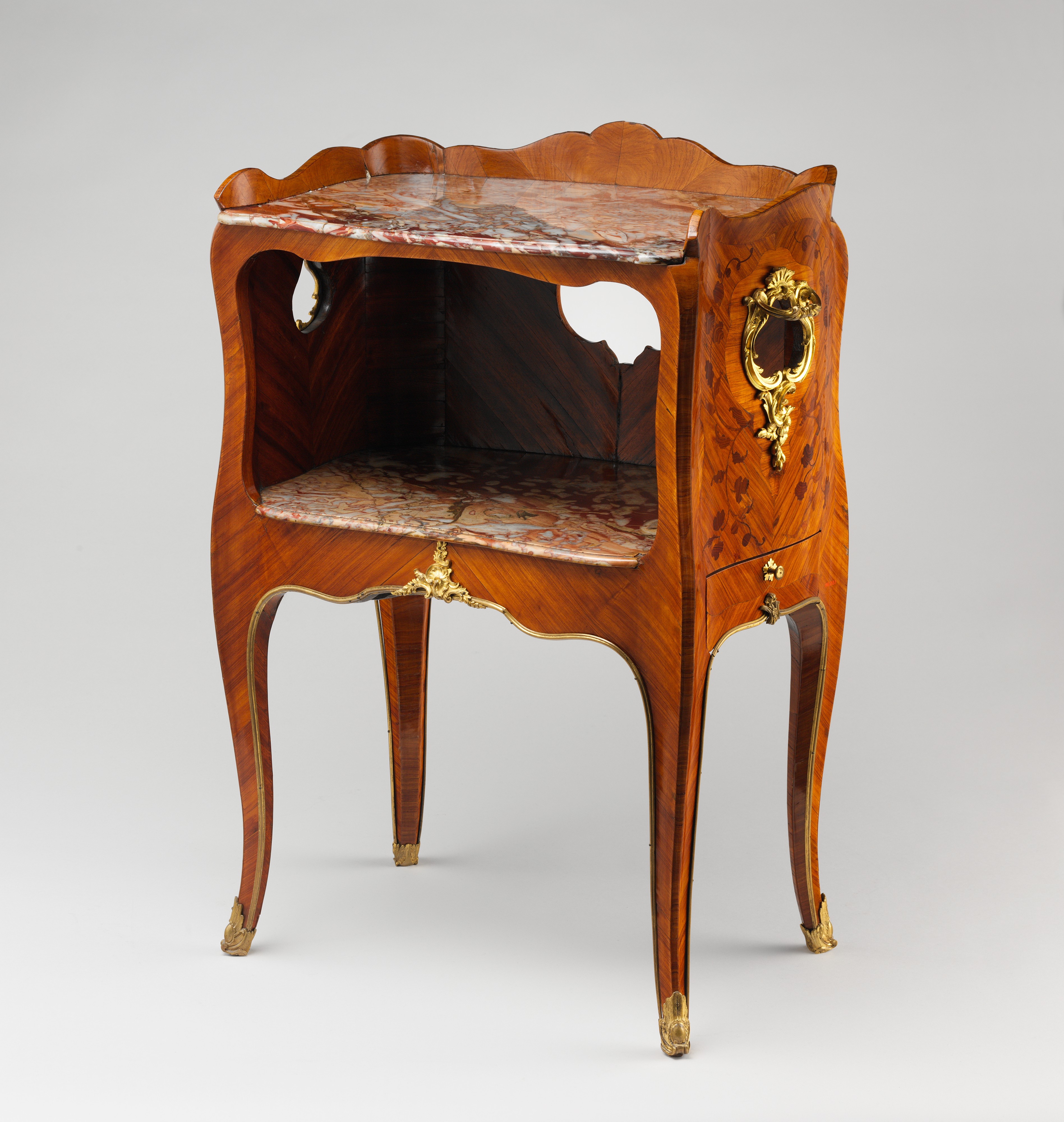
The bedside table, or table de nuit, is an object of profound intimacy and functional grace. Within the archive of Natalie Fashion Atelier, this particular specimen—a composite of oak veneered with tulipwood and kingwood, mounted in gilt-bronze, topped with Sarrancolin marble, and lined with silk moiré—serves not as a mere piece of furniture, but as a coded artifact of aesthetic archaeology. Its isolated presence demands a rigorous deconstruction. We must extract its latent structural logic, its textural dialectic, and its chromatic tension to inform the haute couture silhouettes of 2026. This artifact is a manual for a new luxury: one that is both historically grounded and radically forward.
The Structural Logic of the Silhouette: From Cuboid to Columnar Drape
The primary architectural gesture of this table de nuit is its disciplined cuboid form. The oak carcass, a hidden strength, is clad in the delicate, almost painterly veneer of tulipwood and kingwood. This duality—a robust internal structure masked by a fragile, decorative skin—is the foundational principle for our 2026 silhouettes. We are not designing for a static body; we are designing for a body that is a living, moving structure.
The Kingwood Corset. The kingwood, with its deep violet-brown striations, dictates a new structural element: the columnar corset. This is not a restrictive garment but a supportive architectural frame. The silhouette for Autumn/Winter 2026 will feature a high-waisted, sculpted bodice that mimics the rigid, vertical lines of the table’s front. The construction technique, borrowed from the ébéniste, involves a complex system of internal boning—not of steel, but of a new, bio-resin-reinforced silk organza—that creates a smooth, unyielding outer shell. This shell is then “veneered” with a second layer of fabric, a digitally-printed jacquard that replicates the kingwood’s grain, creating a visual illusion of depth and weight while the garment itself remains surprisingly light.
The Tulipwood Drape. In contrast, the tulipwood veneer, with its warm, honeyed tones and subtle flame-like figuring, informs the secondary silhouette: the asymmetrical tulip drape. This is the counterpoint to the kingwood corset. The fabric—a liquid, double-faced satin of recycled silk and cupro—is cut on the bias to cascade from one shoulder, falling in a single, uninterrupted line to the floor. The cut is precise, a single seam that mimics the joinery of the veneer. The weight of the fabric, like the marble top, pulls the drape into a clean, geometric fall, creating a silhouette that is both rigid in its intention and fluid in its execution. The 2026 collection will see this drape used for evening gowns where the body’s movement is the only source of animation, a living table de nuit in motion.
Materiality as Narrative: The Gilt-Bronze and the Marble
The material palette of this artifact is a masterclass in contrast. The gilt-bronze mounts—the bronze doré—are not merely decorative; they are the points of tension, the moments of structural stress. The Sarrancolin marble top, with its fossilized, chaotic breccia pattern, is a heavy, grounding presence. The silk moiré drawer lining, a later addition, introduces a note of soft, unstable luxury.
The Gilt-Bronze Seam. The 2026 silhouette will translate the gilt-bronze mount into a new concept of the metallic seam. These are not zippers or buttons, but structural, sculptural elements. We will use hand-painted, liquid-metal finishes on leather and bonded wool to create a “mount” at the shoulder, the hip, or the waist. This mount is a point of articulation, a place where the fabric is gathered, folded, or anchored. The finish is a matte, burnished gold—not reflective, but absorbent of light, echoing the aged patina of the original bronze. This technique will be applied to a tailored jacket, where the shoulder seam is a solid, metallic crescent, and the sleeve is a separate, floating piece of kingwood-printed silk, attached only at this single, glorious point.
The Sarrancolin Marble Top. The marble top is the most literal translation. Its chaotic, sedimentary pattern of deep reds, ochres, and whites is the inspiration for our fossil-print jacquard. This is not a simple print; it is a woven, three-dimensional texture. The yarns are a mix of dull, matte silk and a lustrous, recycled polyester that catches the light differently, mimicking the crystalline structure of the marble. The silhouette it informs is the architectural shift dress. The dress is a single, seamless tube of this jacquard, but it is cut with a sharp, asymmetric hem that mirrors the broken edge of the marble slab. The weight of the fabric, like the stone, forces the dress to fall in a single, heavy plane, creating a silhouette that is both monumental and wearable.
The Silk Moiré Drawer Lining: The Interior as Exterior
The silk moiré lining, though not original, is the most provocative element. It is a secret, a hidden luxury. In 2026, we will invert this concept. The moiré lining will become the primary surface for certain pieces. The watermarked, rippling effect of the moiré will be achieved through a new thermal-pressing technique on a blend of silk and Tencel, creating a fabric that shimmers and shifts with every movement. This will be used for a reversible cape. One side is the heavy, kingwood-printed wool; the other is this liquid, moiré silk. The silhouette is a simple, voluminous cocoon. The luxury is in the act of turning it inside out, of revealing the hidden, intimate surface. The drawer lining, a secret space, becomes the public face of the garment.
Conclusion: The 2026 Silhouette as a Composite Artifact
The 2026 collection for Natalie Fashion Atelier is not a nostalgic reproduction. It is a rigorous, archaeological reconstruction. The table de nuit is dissected into its constituent parts: the structural logic of the veneer, the tension of the mount, the weight of the marble, and the secret of the lining. The resulting silhouettes are composite artifacts. They are a kingwood corset worn with a tulipwood drape, anchored by a marble-shift dress, and finished with a moiré-lined cape. The body is the carcass, the oak skeleton, upon which these elements are mounted. The luxury is not in the material alone, but in the intellectual and artisanal rigor of the construction. The 2026 silhouette is a statement: that true elegance is found not in novelty, but in the profound, silent dialogue between a forgotten object and a living body. This is the future of haute couture—an aesthetic archaeology of the intimate.