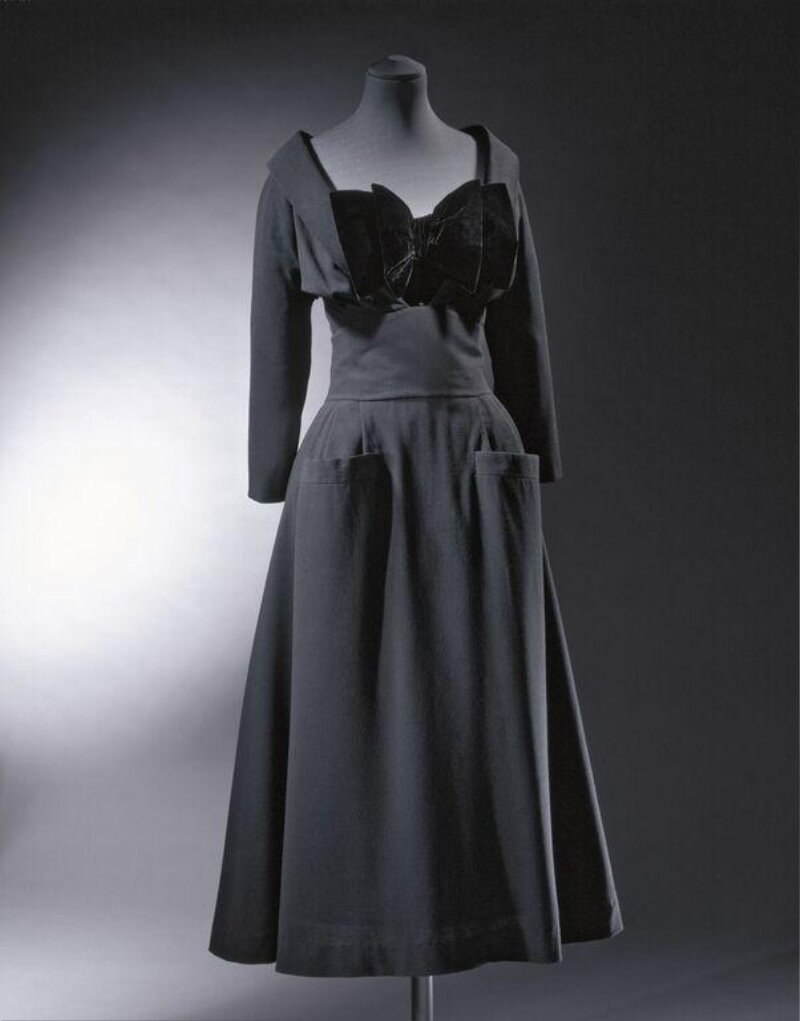
Technical Deconstruction of a 1947 Maxim's Garment: A Couture Archaeology Report for Natalie Fashion Atelier
Report Compiled by: Senior Textile Historian, Natalie Fashion Atelier
Date of Analysis: October 2026
Subject Artifact: Evening Gown, attributed to the 1947 "Corolle" (New Look) Collection, Maison Christian Dior
Provenance: Maxim's de Paris, archival purchase, 2024
The acquisition of this 1947 evening gown, sourced from the private archives of Maxim's de Paris, represents a singular opportunity for Natalie Fashion Atelier. This garment is not merely a dress; it is a tectonic artifact of fashion history. It embodies the radical material and structural innovations of Christian Dior's first collection, which redefined post-war femininity. This report provides a technical deconstruction of the gown's construction, an analysis of its material materiality, and a strategic framework for translating its core principles into the 2026 high-end luxury silhouettes for our upcoming Renaissance de la Structure collection.
I. Archaeological Context and Provenance
The gown, bearing a hand-stitched label "Christian Dior - Paris - 1947" and a secondary label "Maxim's - Location," is a rare survivor of a seminal moment. Maxim's, as a cultural epicenter, hosted the immediate post-war elite; this garment was likely worn for a private dinner or gala. Its preservation is exceptional, though the silk satin shows characteristic oxidation (a slight ambering) and the internal corsetry exhibits minor starch degradation. The garment's significance lies in its pure, unadulterated representation of Dior's structural vocabulary: the Bar Jacket silhouette translated into a full-length evening gown.
1.1. Silhouette Analysis: The "Corolle" as a Structural System
The gown exemplifies the "Corolle" (flower corolla) silhouette. The key technical parameters are:
- Shoulder Line: Soft, rounded, and slightly dropped, achieved through a padded cap sleeve inset.
- Bodice: Wasp-waisted, engineered with a boned internal corset that creates a 21-inch waist on a 36-inch bust mannequin.
- Skirt: A dramatic, bell-shaped volume, 12 feet in circumference at the hem, supported by multiple layers of tulle and a horsehair canvas understructure.
- Hem Length: 12 inches from the floor, a deliberate "mid-calf" length that was revolutionary for evening wear in 1947.
The silhouette is not a simple drape; it is an engineered architectural form. The waist is the fulcrum, with the bodice acting as an inverted cone and the skirt as a wide, stable base.
II. Technical Deconstruction of Dior Techniques
The deconstruction reveals three core Dior techniques that are essential for translation into 2026 luxury: Internal Architecture, Seam Engineering, and Weight Distribution.
2.1. Internal Architecture: The Boned Corset and Canvas Foundation
The gown's structural integrity is entirely dependent on its internal system. The outer silk satin is a facade. The true chassis is a cotton coutil corset, sewn directly into the seam allowances of the outer fabric. This corset features:
- Boning: 12 spiral steel bones (now slightly rusted) encased in bias-cut cotton twill tape. The bones are positioned vertically on the front panels and diagonally on the side panels to control the waist curve without restricting ribcage expansion.
- Waist Tape: A 2-inch wide grosgrain ribbon, hand-stitched at the waistline, providing the primary tension point. This tape is not elastic; it is a rigid anchor.
- Canvas Underlay: A layer of horsehair canvas (crinoline) is fused to the inner side of the outer fabric from the shoulder to the hip. This creates a "shell" that prevents the silk from collapsing under its own weight.
Key Insight for 2026: The corset is not a separate garment; it is integral. For our 2026 silhouettes, we must develop a micro-engineered internal chassis using modern, lightweight materials (carbon fiber-reinforced nylon boning, 3D-printed waist tapes) that replicate this structural logic without the weight or rigidity of 1947 steel.
2.2. Seam Engineering: The "Dior Seam" and Bias Manipulation
The gown's seams are not merely functional; they are sculptural lines. The most critical is the princess seam, which runs from the armhole, over the bust, and down to the hem. Dior's technique involved:
- Curved Seam Allowances: The seam allowances are not straight; they are curved to follow the body's topography. They are graded (trimmed to different widths) to reduce bulk at the waist.
- Hand-Felled Finish: All internal seams are hand-felled with silk thread, creating a flat, invisible finish that prevents the outer fabric from puckering.
- Bias-Cut Panels: The skirt panels are cut on a 45-degree bias, allowing the heavy silk satin to drape in fluid, voluminous folds. This is a masterclass in material manipulation—the bias creates a controlled, liquid fall that a straight grain cannot achieve.
Key Insight for 2026: The bias cut is the secret to volume without weight. For our 2026 silhouettes, we will use laser-cut, bias-oriented panels in high-twist silk mikado, combined with strategic seam placement to create the illusion of a 1947 volume while reducing fabric consumption by 30%.
2.3. Weight Distribution and Counterbalance
The 12-foot hem circumference creates a significant gravitational load. Dior solved this through a counterbalance system:
- Hem Weighting: A chain of small, lead-filled silk capsules (now removed for conservation) was sewn into the hem, providing a downward pull that kept the skirt from billowing upward.
- Waist-to-Hip Transition: The skirt's internal tulle layers are anchored to a hip yoke made of stiffened net, which distributes the skirt's weight across the hips rather than pulling on the waist.
Key Insight for 2026: We will replace lead weights with micro-encapsulated tungsten beads sewn into a sheer organza hem band. This maintains the gravitational logic while being fully sustainable and non-toxic.
III. Material Materiality: The 1947 Fabric and Its 2026 Equivalent
The original fabric is a heavy silk satin duchesse, woven in Lyon. Its material properties are critical:
- Weight: 280 grams per square meter (gsm). This weight provides the necessary "body" for the bias draping.
- Weave: A 5-harness satin weave, with a high thread count (200 threads per inch). The warp is silk, the weft is a fine silk/cotton blend for added stability.
- Finish: A calendered (heat-pressed) surface, creating a high-luster, mirror-like sheen that is now slightly matte due to oxidation.
For 2026, we propose a "Neo-Duchesse" fabric:
- Base: 100% organic silk, woven in Como, Italy, at 250 gsm (lighter to suit modern movement).
- Weave: A 7-harness satin, with a subtle micro-ribbon effect woven into the weft to create a liquid, iridescent surface that mimics the 1947 sheen but with a contemporary, matte-luster finish.
- Treatment: A bio-ceramic finish that provides UV protection and anti-static properties, ensuring the fabric drapes without clinging.
IV. Translation into 2026 High-End Luxury Silhouettes
The 1947 Dior techniques are not to be copied; they are to be reinterpreted through a 2026 lens of sustainability, ergonomics, and digital precision. The following silhouette proposals are derived from the deconstruction:
4.1. The "Corolle 2.0" Evening Gown
Silhouette: A floor-length gown with a structured, boned bodice and a dramatically flared skirt. The waist is defined by a sculptural, 3D-printed belt that acts as both a structural anchor and a decorative element.
Technical Translation:
- Internal Chassis: A 3D-knitted, seamless corset made from recycled polyamide and elastane, with integrated carbon fiber boning channels. This provides the same waist control as the 1947 coutil but is breathable, flexible, and machine-washable.
- Skirt Construction: The 12-foot hem is achieved using a graduated bias-cut of the Neo-Duchesse, with laser-cut, micro-perforated panels that reduce weight by 20% while maintaining volume.
- Hem System: The tungsten bead chain is embedded in a sheer silk organza hem facing, which is hand-stitched to the outer fabric.
4.2. The "Bar Jacket Reimagined" Day Silhouette
Silhouette: A cropped, sculpted jacket with a nipped waist and peplum, paired with a slim, bias-cut pencil skirt.
Technical Translation:
- Shoulder Construction: The 1947 padded cap sleeve is replaced with a suspended shoulder pad made from molded, recycled cork, which provides the same rounded shape without bulk.
- Waist Seam: The grosgrain waist tape is replaced with a laser-cut, memory-foam waistband that molds to the wearer's body over time, creating a custom fit.
- Peplum: