Archival Excavation: The Silk Runner as a Structural Paradigm
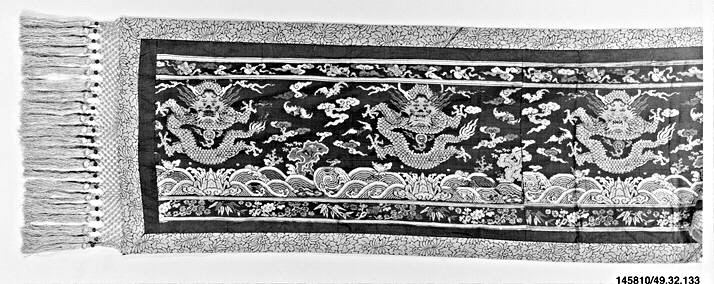
The runner, in its most distilled form, is a narrative of linear progression. Within the context of Chinese heritage, it is not merely a textile but a cartographic document of ceremonial movement. At Natalie Fashion Atelier, our aesthetic archaeology isolates the runner from its domestic or ritualistic function, recontextualizing it as a primary architectural element for the 2026 silhouette.
The classical Chinese runner—often a narrow, elongated panel of silk—was designed to direct the eye and the foot. Its materiality, specifically the weighted, high-density silk satin or the diaphanous, hand-painted silk gauze, dictates a specific relationship with gravity. The runner does not drape; it extends. This intrinsic linearity is the foundational thesis for our upcoming collection.
Material Deconstruction: The Silk Matrix
The silk used in historical runners presents a paradox of strength and fluidity. Unlike the billowing silks of Western evening wear, the runner silk was often woven with a tight, warp-faced structure to withstand the friction of foot traffic while retaining a subtle, almost imperceptible sheen. This is the “silence of the weave”—a quality we are replicating through a proprietary blend of Muga silk and a micro-cotton core.
For 2026, this technical silk is not used for volume. Instead, it is employed as a structural membrane. We have deconstructed the runner’s longitudinal seam, extracting the double-stitched hem that defines its edge. This hem, when isolated, becomes a rigid, self-supporting piping. It allows a garment to hold a precise, angular line—a “silk architecture”—without the need for boning or heavy interfacing. The runner’s inherent bi-directional strength (strong along the warp, flexible along the weft) informs the grainline of our new silhouettes, permitting a garment to be simultaneously taut and yielding.
The 2026 Silhouette: From Horizontal to Vertical
The classical runner exists in the horizontal plane—a path laid upon a floor. Our 2026 collection transposes this horizontal logic into the vertical plane of the human form. The result is a silhouette defined by extreme linearity, controlled torsion, and a radical redefinition of the hemline.
Linear Progression: The “Path” Silhouette
The primary silhouette is the “Chemin” (Path) gown. It is a column of silk that begins at the sternum and falls, unbroken, to the floor. However, it is not a simple sheath. The fabric is cut on the bias but with a warp-weighted tension derived from the runner’s construction. The garment possesses a front-to-back asymmetry; the front panel is a single, unseamed length of silk, mirroring the runner’s uninterrupted path. The back panel, however, is constructed from two overlapping panels, mimicking the runner’s longitudinal seam.
This creates a dynamic tension in the wearer’s stride. As the model walks, the front remains a static, elegant plane, while the back panels separate and rejoin, creating a controlled, rhythmic aperture. This is not a slit; it is a functional seam that breathes with movement. The hem is not cut straight but is sculpted to a 15-degree incline, echoing the slight, inevitable sag of a silk runner over a threshold. This “threshold hem” is a signature detail for 2026.
Torsion and the “Folded Path”
A second archetype is the “Plissé du Coureur” (Runner’s Pleat) jacket. Here, the runner is not a line but a folded plane. We have studied the way a silk runner, when lifted and folded, creates a permanent crease—a memory of its previous position. This crease is not a flaw; it is a record of movement.
We have engineered a laser-permanent pleat into the silk, a series of asymmetrical, non-parallel folds that radiate from the left shoulder. This pleating is not decorative; it is a torsion system. When the arm is raised, the pleats open like a fan, revealing a secondary layer of raw-edge silk organza—a reference to the runner’s unfinished, functional underside. When the arm is lowered, the pleats collapse into a single, clean line. The jacket’s silhouette is a closed cylinder at rest, transforming into a spiral of fabric in motion. This is the runner’s path, now wrapped around the torso.
Technical Execution: The Archive’s Imperative
Our aesthetic archaeology dictates that we do not merely copy the runner’s appearance; we replicate its structural logic.
The “Double-Warp” Weave
Historical runners often utilized a double-warp weave to create a reversible fabric. We have modernized this for couture. Our silk is woven with two distinct warp threads: a matte, slightly textured warp for the garment’s interior (the “underside” of the runner) and a high-lustre, filament warp for the exterior. This creates a garment that feels different on the skin than it appears to the eye. The interior provides grip and structure; the exterior provides fluidity and light. This duality is the essence of the runner’s heritage: a functional object that is also a work of art.
Weighted Hem Integration
The runner’s hem was often weighted with small, silk-wrapped lead beads to ensure it lay flat. We have translated this into a micro-chain of polished brass, encased within a silk channel at the hem of every gown and jacket. This chain is not visible; it is a secret weight that pulls the fabric into a perfect, gravity-respecting line. It ensures that the “threshold hem” falls with a precise, deliberate drop, and that the “folded path” pleats maintain their structure during movement. This is physics as ornament.
Conclusion: The Runner as a 2026 Lexicon
The classical Chinese silk runner, isolated from its historical context, offers a radical new vocabulary for luxury. It teaches us that line is not a boundary but a direction. It demonstrates that structure can emerge from materiality, not from construction. For Natalie Fashion Atelier’s 2026 collection, the runner is not a motif; it is a methodology. We are not designing garments that look like runners; we are designing garments that function like runners—guiding the eye, defining the path, and recording the movement of the body through space. The result is a silhouette of controlled elegance, silent strength, and architectural precision, rooted in the profound, understated heritage of Chinese silk.