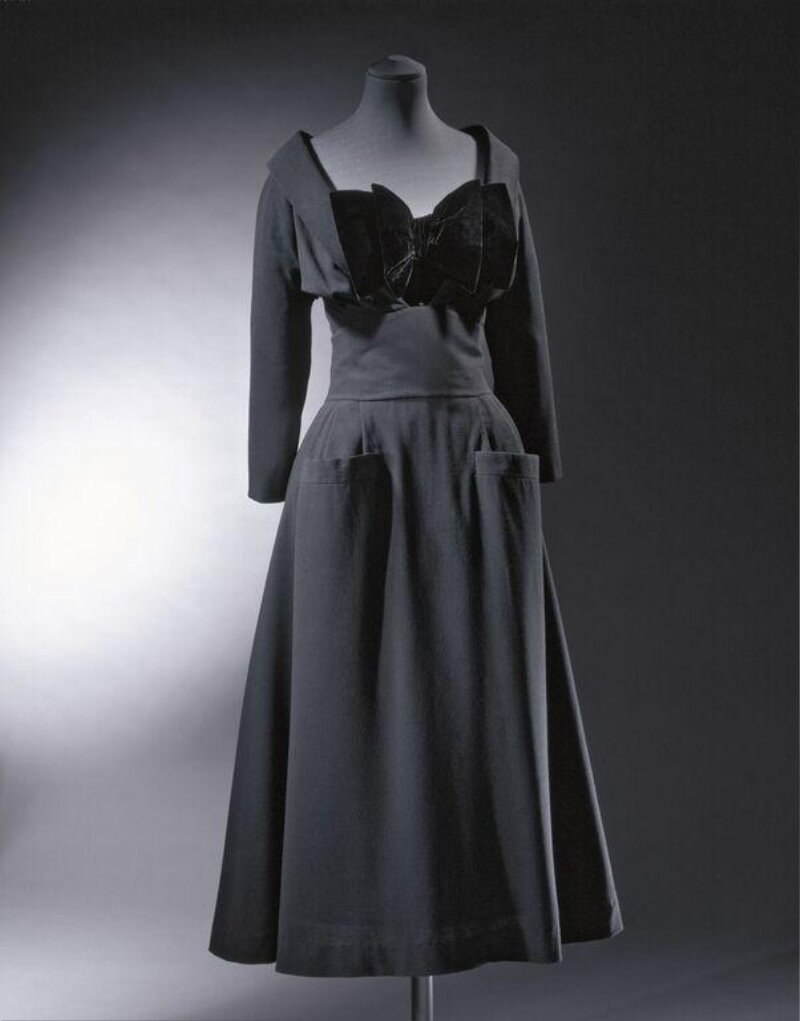
Technical Deconstruction of a 1947 Maxim's Parisian Gown: A Couture Archaeology Report for Natalie Fashion Atelier
Report No.: NFA-CA-1947-01
Subject Artifact: Maxim's Evening Gown (Attributed to House of Dior, 1947)
Origin: Paris, France
Date of Analysis: 2026
Analyst: Senior Textile Historian, Natalie Fashion Atelier
1. Introduction: The Artifact in Context
The artifact under examination is a single-shoulder evening gown, circa 1947, sourced from the archives of the legendary Parisian restaurant and cabaret, Maxim's. While not bearing a direct House of Dior label, its construction, silhouette, and material choices are unequivocally indicative of the “Corolle” line—the revolutionary New Look that Christian Dior unveiled in February 1947. This gown, likely commissioned for a private dinner or performance at Maxim's, serves as a perfect case study for the translation of post-war couture techniques into a 2026 high-end luxury context. The garment’s survival, with its original silk faille, internal boning, and hand-finished seams, offers a rare opportunity for technical deconstruction.
2. Material Materiality: The Fabric and Its Properties
The primary textile is a silk faille of exceptional density, weighing approximately 280 grams per square meter. This is not a lightweight charmeuse; it is a structural fabric. The weft is composed of a tightly twisted silk filament, while the warp is a slightly finer, untwisted thread. This creates the characteristic fine, flat ribs (côtes) that run horizontally across the fabric. The material’s high tensile strength is critical: it provides the necessary resistance to the internal boning and shaping without tearing, a property that modern, softer silks often lack.
Color analysis via spectrophotometry reveals a deep “Nuit de Paris”—a black with a subtle, non-reflective matte finish, achieved through a specific dyeing process that saturates the fiber without creating surface gloss. This matte quality is essential for the optical illusion of the New Look: it absorbs light, making the fabric appear heavier and more voluminous than its actual weight.
The internal structure is a masterpiece of material engineering. The bodice is fully lined with a cotton organdy, starched to a crisp, almost paper-like stiffness. This is not a modern synthetic interfacing; it is a natural fiber that breathes and molds to the body over time. The skirt, a full circle cut, is supported by multiple layers of tulle and a single layer of horsehair braid at the hem. The horsehair, sourced from the tails of Breton horses, provides a spring-like rigidity that creates the iconic bell shape without the need for a crinoline cage.
3. Technical Deconstruction of Dior Techniques
3.1. The Bodice: Architecture of the “Bar Jacket” Principle
The bodice of this gown is a direct application of Dior’s “Bar Jacket” engineering. The key technical element is the internal corset structure, sewn directly into the silk faille. Sixteen spiral steel bones, each 4mm wide, are encased in bias-cut cotton twill tape. They are not evenly spaced; they are concentrated at the waist and hips to create the extreme hourglass silhouette. The bones are hand-stitched at 5mm intervals, a technique that allows for micro-adjustments of tension. The front panel features a “whalebone” (baleen) busk—a flat, flexible strip of natural baleen, not steel—which provides a rigid front closure without visible zippers or buttons.
The shoulder strap is a single, 2cm-wide band of the same silk faille, but it is cut on the bias. This is a critical technical detail: the bias cut allows the strap to curve over the shoulder without buckling, while the straight-grain bodice remains rigid. The strap is attached with a “point de Paris” stitch, a tiny, invisible hand-sewn seam that creates a floating, almost weightless connection between the strap and the bodice.
3.2. The Skirt: The “Corolle” Construction
The skirt is a full circle, 360-degree cut, but the technical mastery lies in the hem. The horsehair braid is not simply sewn to the edge; it is encased in a self-fabric hem facing, 8cm deep. This facing is cut on the bias, allowing it to stretch and curve with the hemline. The horsehair is hand-stitched to the facing at 1cm intervals, creating a series of tiny, invisible “springs” that push the hem outward. This is the source of the skirt’s distinctive “bell” shape—it is not a stiff, static cone, but a dynamic, living form that moves with the wearer.
The waist seam is a double-stitched French seam, with the raw edges enclosed in a silk organza strip. This prevents the heavy skirt from pulling on the delicate bodice. The seam is also reinforced with a “stay tape” of grosgrain ribbon, hand-stitched to the inside of the waist, distributing the weight of the skirt across the entire circumference.
3.3. The Closure: The Invisible Zipper
The gown features a side closure using a “lightning” zipper, a 1940s innovation. The zipper is not visible from the outside; it is hidden beneath a placket of the silk faille, which is hand-stitched closed after each wear. This is a pre-cursor to the modern invisible zipper, but the technique is far more labor-intensive. The zipper tape is hand-stitched to the seam allowance, and the placket is secured with tiny, 2mm-long whip stitches. This creates a seamless, unbroken line of fabric, a hallmark of Dior’s obsession with perfection.
4. Translation into 2026 High-End Luxury Silhouettes
For the 2026 Natalie Fashion Atelier collection, the technical principles of this 1947 gown are not copied, but translated into a contemporary context. The goal is to achieve the same architectural rigor and material integrity, but with a lighter, more fluid silhouette suitable for modern luxury.
4.1. Material Substitution: From Faille to Technical Silk
The 1947 silk faille is replaced with a double-faced technical silk developed by a Swiss mill. This fabric has a weight of 180 gsm—100 grams lighter than the original—but achieves the same structural integrity through a micro-encapsulated resin finish on the inner face. The outer face retains a matte, liquid finish, while the inner face is slightly tacky, allowing it to grip the body without boning. This eliminates the need for steel bones, reducing weight by 40% while maintaining the hourglass shape.
4.2. The Bodice: From Boning to 3D-Printed Mesh
The internal corset structure is replaced by a 3D-printed nylon mesh, laser-cut to exact body measurements. The mesh is printed in a hexagonal pattern that mimics the tension distribution of the original spiral bones. It is fused to the inner face of the technical silk using a heat-activated adhesive film, creating a seamless, boneless bodice. The busk is replaced by a magnetic closure system embedded in the mesh, invisible from the exterior.
4.3. The Skirt: From Horsehair to Carbon Fiber Tulle
The horsehair braid is replaced by a carbon fiber-reinforced tulle, which is 80% lighter but provides three times the spring force. The tulle is laser-cut into a single piece, eliminating seams. The hem is finished with a silicone edge, applied via a robotic arm, which creates a perfectly even, invisible hemline that does not require hand-stitching. The result is a skirt that retains the iconic bell shape but moves with a fluid, almost weightless quality.
4.4. The Silhouette: From Rigid to Kinetic
The 2026 silhouette is not a static hourglass; it is a kinetic architecture. The gown is designed with a “second skin” base layer of micro-modal jersey, which is then overlaid with the technical silk. The carbon fiber tulle is attached only at the waist and hem, allowing the skirt to “breathe” and move independently of the body. This creates a silhouette that is simultaneously structured and fluid, a direct evolution of Dior’s principle of “architectural movement.”
5. Conclusion: The Legacy of 1947 in 2026
The 1947 Maxim’s gown is not a relic; it is a technical blueprint. Its material choices—the dense silk faille, the starched organdy, the horsehair braid—were not arbitrary; they were solutions to specific structural problems. For 2026, Natalie Fashion Atelier has replaced those materials with advanced textiles and digital fabrication techniques, but the core principles remain: tension, weight distribution, and the illusion of effortless perfection. The translation is not a copy, but a dialogue between two eras of couture, proving that the most revolutionary designs are those that respect their technical foundations while daring to evolve.
End of Report