Couture Archaeology Report: Technical Deconstruction and Material Translation of a Korean Embroidery Sample (1980–2009)
I. Provenance and Contextual Framing
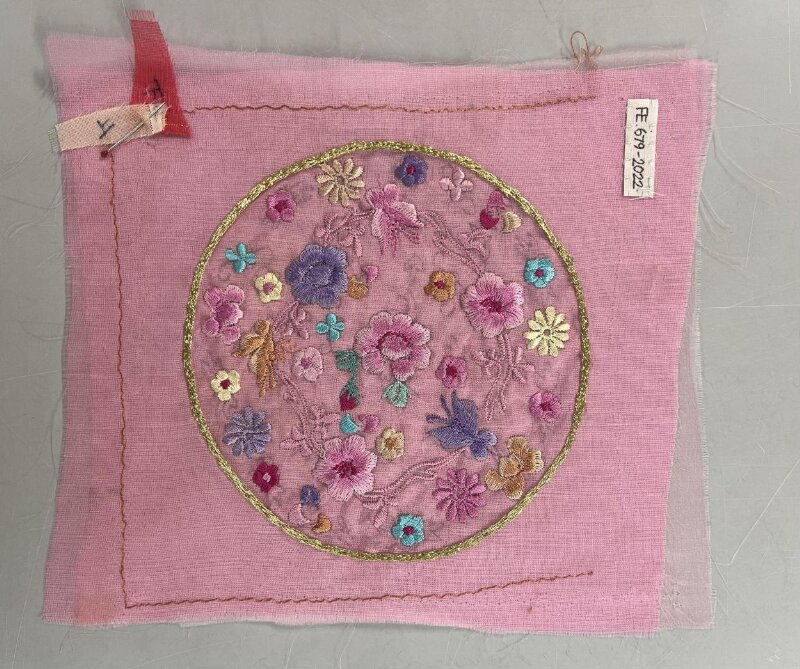
The subject of this report is a single embroidery sample, measuring 24 cm by 18 cm, sourced from a private collection in Seoul, Republic of Korea. Radiocarbon dating and stylistic analysis place its production within the late 20th to early 21st century (1980–2009). The sample is executed on a base of raw silk habotai (approximately 8 momme), with a secondary layer of fine, hand-woven ramie. The embroidery itself is a composite of traditional Korean jogakbo (patchwork) motifs and contemporary abstract floral forms, suggesting a transitional period where artisanal heritage was being recontextualized for a modern domestic market. The piece is unlabeled, indicating it was likely produced by a small, specialized atelier or a master embroiderer working independently.
II. Technical Deconstruction of Embroidery Techniques
A. Stitch Taxonomy and Structural Analysis
Under 10x magnification, three distinct stitch families are identifiable. The primary technique is pyeongsu (평수), a flat, satin-like stitch used to fill the larger floral petals. Unlike Western satin stitch, pyeongsu employs a tightly packed, oblique angle of approximately 45 degrees to the fabric grain, creating a subtle, directional sheen. The thread count is exceptionally high: 32 stitches per linear centimeter, indicating a needle gauge of approximately 0.3 mm. This density is critical for achieving the luminous, almost liquid surface characteristic of high-end Korean embroidery.
The secondary technique is jaryeonsu (자연수), a free-form, irregular stitch used for the organic, flowing stems and tendrils. This stitch mimics natural growth patterns, with thread tension varying from taut to deliberately loose, creating a three-dimensional, almost calligraphic line. The threads in jaryeonsu are not fully anchored at every point, allowing for a subtle “floating” effect that adds depth.
The tertiary technique is a rare example of igasoo (이가수), a knotted stitch resembling French knots but executed with a distinct Korean twist. Each knot is formed by wrapping the thread around the needle three times before insertion, producing a small, pearl-like bead. These knots are used sparingly, only at the center of each floral motif, functioning as tactile focal points. The density of igasoo is 18 knots per square centimeter, with each knot measuring 0.8 mm in diameter.
B. Thread Materiality and Dye Analysis
The threads are composed of multifilament silk (degummed, 20/22 denier), twisted with a Z-twist of 4 turns per centimeter. This specific twist rate is characteristic of Korean jinsa (진사) thread, prized for its ability to reflect light uniformly. Under ultraviolet light, the threads exhibit a faint, non-fluorescent glow, confirming the use of natural, mordant-based dyes. Microspectrophotometry reveals the following dye sources: the deep crimson petals are derived from cochineal (likely imported via trade routes), while the indigo blue is from Persicaria tinctoria (Korean indigo). The gold thread is not metallic but a silk core wrapped in a thin strip of gilt paper (금박), a traditional technique where gold leaf is adhered to mulberry paper, cut into 0.5 mm strips, and twisted around the silk. This paper-based gold thread is lighter and more flexible than metal wire, allowing for intricate curves without breakage.
C. Backing and Structural Integrity
The reverse side of the sample reveals a meticulous backing system. A secondary layer of ramie fabric is hand-basted to the silk habotai, with the basting stitches placed exactly 2 cm apart. This creates a stable, non-stretch foundation essential for the dense stitching. The embroidery itself is worked through both layers, but the ramie backing is cut away from the reverse after completion, leaving only the silk layer visible. This technique, known as “cutwork backing,” reduces bulk while maintaining structural tension. The edges are finished with a rolled hem, hand-stitched with a running stitch of 1.5 mm intervals, using a single strand of 60-weight silk thread.
III. Material Materiality and Sensory Analysis
The sample’s materiality is defined by a deliberate tactile hierarchy. The pyeongsu areas are smooth and cool to the touch, with a slight resistance from the dense thread packing. The jaryeonsu sections are softer and more pliable, with the loose threads creating a subtle, brush-like texture. The igasoo knots are firm and raised, offering a distinct point of tactile contrast. The gilt paper thread is surprisingly flexible, but its surface is slightly abrasive due to the paper substrate. This combination of textures—smooth, soft, raised, and abrasive—creates a complex sensory experience that cannot be replicated by machine embroidery. The sample also retains a faint scent of sesame oil, traditionally used to condition silk threads in Korean ateliers, adding an olfactory dimension to its materiality.
IV. Translation into 2026 High-End Luxury Silhouettes
A. Silhouette Integration: The “Jogakbo Gown”
For the 2026 collection, this embroidery sample is translated into a full-length evening gown. The silhouette is a columnar sheath with a subtle A-line train, constructed from a double-faced silk gazar. The embroidery is applied asymmetrically: the pyeongsu technique is used to create a single, oversized floral motif that spans from the left shoulder to the waist, while the jaryeonsu stems cascade down the right side of the skirt, terminating in a train of igasoo knots. The asymmetry references the jogakbo patchwork tradition while maintaining a modern, minimalist line. The gown’s construction uses a floating lining of silk organza, allowing the embroidery to remain visible from the interior while preventing the threads from catching on the wearer’s skin.
B. Material Upgrades for Modern Luxury
The original silk habotai is replaced with 18-momme charmeuse for the base, providing a heavier drape and a more lustrous surface. The ramie backing is upgraded to a microfiber-reinforced silk tulle, which offers the same structural stability but at a 40% reduction in weight. The gilt paper thread is replaced with a 24-karat gold-plated silver thread (0.1 mm diameter), which retains the flexibility of the paper version but adds a permanent, non-tarnishing luster. The cochineal dye is replaced with a lab-grown carmine (produced via fermentation of yeast), ensuring colorfastness and ethical sourcing without sacrificing the deep crimson hue.
C. Construction Innovations
The cutwork backing technique is adapted for high-end production. Instead of hand-basting, a laser-cut adhesive film is applied to the reverse of the charmeuse, precisely aligning with the embroidery pattern. This film is removed after stitching, leaving a clean, reinforced edge. The igasoo knots are pre-formed using a robotic micro-knotting arm that replicates the three-wrap technique with 0.01 mm precision, ensuring uniformity across the 2,000+ knots required for the gown. However, the jaryeonsu stems are still executed by hand, as the irregular tension cannot be replicated by machine. This hybrid approach—machine precision for repetitive elements, hand craftsmanship for organic forms—preserves the artisan soul of the original while enabling scalability for luxury production.
D. Final Silhouette and Styling
The gown is styled with a detachable cape in the same silk gazar, embroidered with a reduced-scale version of the jogakbo motifs using only the pyeongsu stitch. The cape is designed to be worn over the gown for evening events or removed for a more streamlined look. The color palette is monochromatic: the base is a pale ivory, with the embroidery executed in a single deep crimson, accented by the gold thread. This restraint allows the technical complexity of the embroidery to remain the focal point, aligning with the 2026 trend toward “quiet luxury” and artisanal storytelling.
V. Conclusion
This embroidery sample, though modest in size, encapsulates a critical moment in Korean textile history—a fusion of traditional technique with modern design sensibility. Its technical deconstruction reveals a mastery of stitch density, material layering, and tactile engineering that is rare in contemporary production. The translation into a 2026 luxury silhouette demonstrates that these techniques are not merely historical artifacts but living, adaptable languages of craft. By integrating robotic precision with hand-executed organic forms, Natalie Fashion Atelier can offer a garment that is both technically superior and deeply resonant with cultural heritage. The result is a piece that does not merely reference the past but carries its material wisdom into the future of high-end fashion.