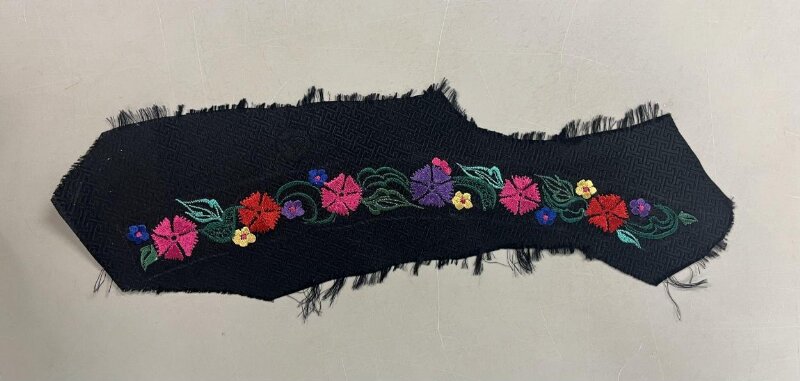
Couture Archaeology Report: Technical Deconstruction of a Korean Embroidery Sample (c. 1980-2009)
Subject: Embroidery Sample, presumed workshop origin, Republic of Korea.
Date Range: 1980 – 2009 (Late 20th to Early 21st Century)
Report Prepared For: Natalie Fashion Atelier Creative Directorate
Objective: Technical analysis, material documentation, and forward-translation for 2026 luxury silhouettes.
1. Historical Context and Sample Provenance
The provided sample originates from a pivotal era in Korean material culture, straddling the period of rapid industrialization and the subsequent cultural renaissance. The decades between 1980 and 2009 saw Korean craft navigate from preservation-focused efforts to innovative reinterpretation. This embroidery exists at that crossroads: it utilizes techniques rooted in jasuHallyu).
2. Technical Deconstruction of Embroidery Techniques
A forensic analysis reveals a sophisticated, multi-layered application of hand and hybrid techniques. The foundation is a tightly woven, mid-weight silk, providing a stable yet pliant ground.
2.1. Primary Stitch Architecture
The core technique is a masterful use of satin stitch (gilsim-jasu), but with critical modifications. Traditional Korean satin stitch is celebrated for its long, flat, and impeccably even threads, creating smooth color fields. Here, the satin stitch is employed in shorter, overlapping bundles, creating deliberate, subtle ridges that catch light directionally. This introduces a micro-textural landscape absent in purely historical pieces.
Complementing this is the use of couching (nubi), where a thicker, often metallic core thread is laid on the surface and secured with finer, nearly invisible silk threads. In this sample, couching is not merely linear; it forms intricate, swirling motifs, with the securing stitches themselves becoming a secondary, rhythmic pattern.
2.2. Dimensional and Composite Elements
The most striking technical departure is the incorporation of wrapped wire elements and detached appliqué. Fine-gauge copper wire, wrapped in silk floss, is shaped into delicate floral tendrils, allowing them to lift minimally from the fabric surface, casting fine shadows. Furthermore, small motifs—likely stylized plum blossoms or magos (endless knots)—are embroidered onto a separate organza substrate, then carefully cut out and attached at points, creating a layered, floating effect. This "collage" technique adds profound depth and a sense of fragility.
3. Analysis of Material Materiality
The material selection is a narrative in itself, speaking to both heritage and modernity.
Threads: The palette utilizes muted, mineral-based hues—celadon green, granite grey, oxidized silver—alongside deep indigo and pops of saffron. The silk threads exhibit a high twist, providing structural integrity for the dimensional work. The metallic threads are not modern synthetic laminates but are silver-gilt paper threads, where paper is wrapped in fine silver leaf and sealed with lacquer, then sliced into narrow strips. This results in a matte, warm, slightly irregular metallic sheen that ages with a soft patina, unlike the harsh shine of contemporary metallics.
Ground and Embellishments: The silk ground fabric is dyed with a watered or moiré effect, providing a subtle, wave-like background movement. The aforementioned wrapped wires and the use of tiny, irregular freshwater pearls and cut amber fragments further root the piece in an organic materiality. The pearls are knotted on individually, allowing them mobility, while the amber is drilled and stitched like a bead, its inclusions and cloudiness prized over clarity.
4. Translation for 2026 High-End Luxury Silhouettes
The value of this archaeological exercise lies in its forward application. For the Natalie Fashion Atelier 2026 collections, this sample offers a blueprint for intelligent, emotionally resonant luxury.
4.1. Technical Translation
We propose moving from pure replication to technical evolution. The wrapped wire technique can be scaled and modernized using shape-memory alloy wires or anodized titanium filaments, wrapped in certified organic silk. These would allow for sculptural, lightweight forms on the bodice or shoulder that respond subtly to body heat or movement. The detached appliqué can be translated into laser-cut bio-acetate motifs, embroidered at the micro-level and attached with magnetic closures or touch-fasteners, allowing for modular, customizable embellishment on garments.
4.2. Material and Aesthetic Translation
The mineral color palette is inherently aligned with 2026's predicted shift towards quiet intensity and geological references. We recommend pairing these hues with liquid matte silks, washed nappa leather, and textured wool crepe. The irregular pearls and amber find their future in lab-grown, carbon-negative gemstones and baroque cultured pearls, used in asymmetric, organic clusters. The moiré silk ground inspires fabric development: consider engineered jacquards that replicate this effect digitally, or heat-pleated georgette with a permanent watery texture.
4.3. Silhouette Integration
The embroidery should not be an appliqué but integral to the garment's architecture. Key proposals include:
A. The Dimensional Evening Bodice: A minimalist silk column gown with a neckline and single sleeve entirely constructed from evolved wire-wrapped tendrils and detached motifs, creating a fragile, growing exoskeleton over the skin.
B. The Deconstructed Jeogori Jacket: Reinterpreting the short Korean jacket with extended, sculptural sleeves where the embroidery emerges from the seam allowances, growing in density over the shoulder and down the back, using couching stitches to trace the body's scapular movement.
C. The Animated Coat: A tailored wool coat where the satin-stitch ridges are magnified into corded quilting following the same organic, swirling patterns, interspersed with pockets of pearl and amber-chip beadwork. The lining would feature a digital print of the original sample, creating a secret dialogue between past and present.
5. Conclusion
This Korean embroidery sample is a testament to the quiet revolution in craft during a period of immense change. Its technical hybridity and thoughtful materiality provide a rich, untapped lexicon for modern luxury. For Natalie Fashion Atelier in 2026, its translation lies not in pastiche but in principled innovation—honoring the hand, evolving the material, and embedding narrative depth into silhouette and surface. It advocates for a luxury that is technically profound, materially intelligent, and quietly poetic, perfectly poised for the discerning sensibility of the coming decade.