Aesthetic Archaeology: Deconstructing the Classical Elegance of Page 23 (Recto)
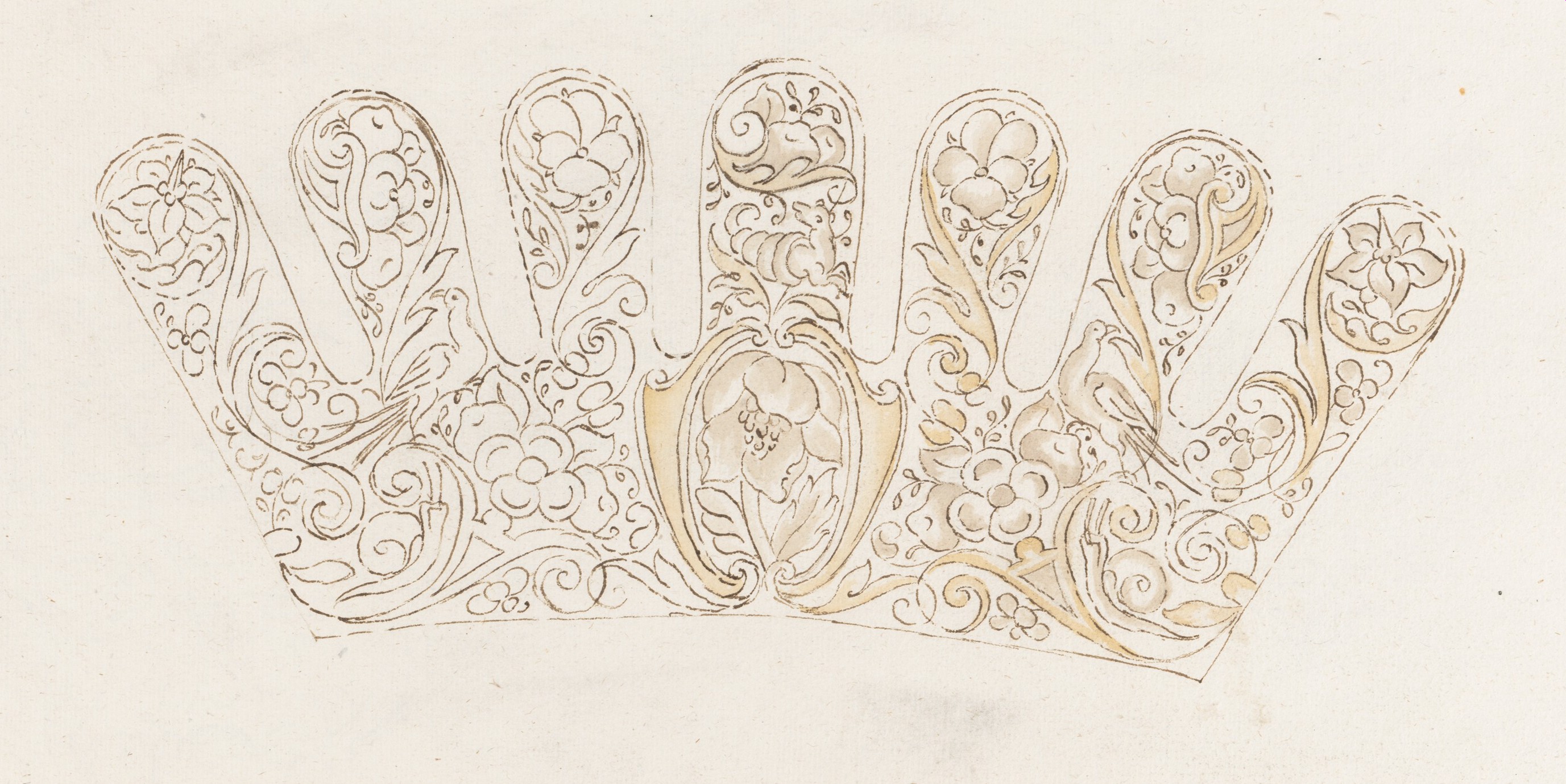
The artifact under examination—Album of designs for embroidery: bodices, gauntlets, caps, bags, page 23 (recto)—represents a singular moment in the history of ornamental luxury. Executed in pen and ink; some with wash, this page is not merely a catalog of motifs but a cartography of gesture. The fluidity of the ink, contrasted with the deliberate opacity of the wash, creates a dialogue between precision and atmosphere. For the 2026 silhouette, this tension becomes a foundational principle: structure softened by suggestion, line interrupted by shadow. The hand-drawn quality resists the sterility of digital precision, offering instead a textural intelligence that haute couture must reclaim.
Materiality as Narrative: Pen, Ink, and the Wash of Time
The choice of pen and ink; some with wash is not incidental but intentional. In the context of global heritage, this technique is both universal and deeply personal. The pen delivers the architectonic skeleton—the bodice’s boning, the gauntlet’s seams, the cap’s structure. The wash introduces a temporal dimension: it is the patina of age, the softness of wear, the memory of light. For 2026, this duality translates into silhouettes that are simultaneously rigorous and ephemeral. Think of a bodice that appears carved from marble yet dissolves into a watercolor gradient at the hem. The gauntlet, once a rigid accessory, becomes a sculptural extension of the arm, its ink-drawn lines suggesting a lattice of tendons beneath the skin. The cap, historically a marker of status, is reimagined as a soft volume—a wash of fabric that frames the face without dominating it.
This materiality also informs the surface treatment of luxury textiles. The ink’s capillary action—its tendency to bleed and feather—inspires a new approach to embroidery. Instead of precise, machine-perfect stitches, the 2026 atelier will employ irregular, hand-guided threads that mimic the organic spread of ink on paper. The wash, meanwhile, suggests a gradient of opacity achieved through layered organza, tulle, or silk chiffon. The result is a garment that reads as a living drawing, each movement altering its composition.
Silhouette as Syntax: Bodice, Gauntlet, Cap, Bag
Page 23 (recto) presents four distinct yet interrelated forms: bodices, gauntlets, caps, bags. Each is a sentence in the larger grammar of elegance. The bodice—the torso’s architecture—is reimagined as a corset of lines. In 2026, this translates to a silhouette that is not constrictive but contoured by optical illusion. The ink-drawn seams, when translated into boning or piping, create a visual corsetry that shapes the body without physical pressure. The wash suggests a second skin, a translucent overlay that blurs the boundary between garment and flesh.
The gauntlet—historically a glove extending to the forearm—becomes a transitional volume. In the 2026 silhouette, it is no longer an accessory but a connective tissue between sleeve and hand. The pen-and-ink detailing suggests a lattice of straps or ribbons, allowing the gauntlet to be worn as a detachable element. This modularity is key: luxury in 2026 is defined by transformation, not stasis. The cap, often dismissed as a minor form, is elevated to a sculptural object. Its wash-like softness invites draping techniques that produce asymmetrical volumes, reminiscent of a turban or a hood, yet executed in the finest silk or cashmere. The bag, the most utilitarian of the four, is reimagined as a pocket of line. Its ink-drawn contours become structural seams, while the wash suggests a patina of use—a deliberate aging that marks the object as heirloom.
Global Heritage: The Universal Language of Ornament
This album, though isolated in its archive, speaks to a global heritage of embroidery. The motifs—whether floral, geometric, or abstract—are not bound by geography. The pen-and-ink technique, found in Mughal miniatures, Chinese ink paintings, and European botanical studies, becomes a transcultural signifier. For the 2026 silhouette, this means a departure from regional clichés. Instead of referencing a specific culture, the design absorbs the logic of ornament itself: repetition, scale, contrast, and rhythm. The bodice’s embroidery, for example, might echo the fractal patterns of Islamic geometry or the organic flow of Japanese sumi-e, but it does so through the universal language of line and wash.
This approach allows for a new kind of luxury: one that is intellectually rigorous yet emotionally resonant. The 2026 client is not seeking a costume but a philosophical garment—one that carries the weight of history without being burdened by it. The pen-and-ink aesthetic, with its simultaneous precision and spontaneity, offers a visual metaphor for this balance. The silhouette is composed, yet it breathes. It is structured, yet it moves.
2026 Silhouette: The Synthesis of Line and Atmosphere
The final synthesis for 2026 is a silhouette that oscillates between drawing and painting. The bodice, gauntlet, cap, and bag are no longer discrete items but fragments of a larger composition. The pen provides the contour—the sharp shoulder, the cinched waist, the precise hem. The wash provides the atmosphere—the soft drape, the translucent layer, the shadow that defines volume. This is not a return to historical dress but a re-reading of its syntax. The classical elegance of page 23 (recto) is deconstructed into its constituent elements: line, tone, texture, and form. These are then reassembled according to the logic of contemporary luxury, where craftsmanship is visible, materiality is celebrated, and silhouette is a statement of intent.
In practice, the 2026 collection will feature bodices with ink-drawn seams that appear to float above the skin, supported by invisible structures. Gauntlets that extend into gloves, their ink lines suggesting a second skeleton. Caps that are both hood and headpiece, their wash-like fabric pooling at the nape. Bags that are soft sculptures, their contours defined by the same hand-drawn logic. The palette will be monochromatic—blacks, grays, and whites—to emphasize the graphic quality of the design. Accents of metallic thread or beadwork will mimic the glint of ink on paper.
This is the aesthetic archaeology that Natalie Fashion Atelier practices: not the preservation of the past but its translation into the future. Page 23 (recto) is not a relic but a blueprint for elegance. Its pen and ink; some with wash is not a limitation but a language of possibility. For 2026, the silhouette is not a shape but a sentence—one that speaks of history, materiality, and the enduring power of the hand-drawn line.