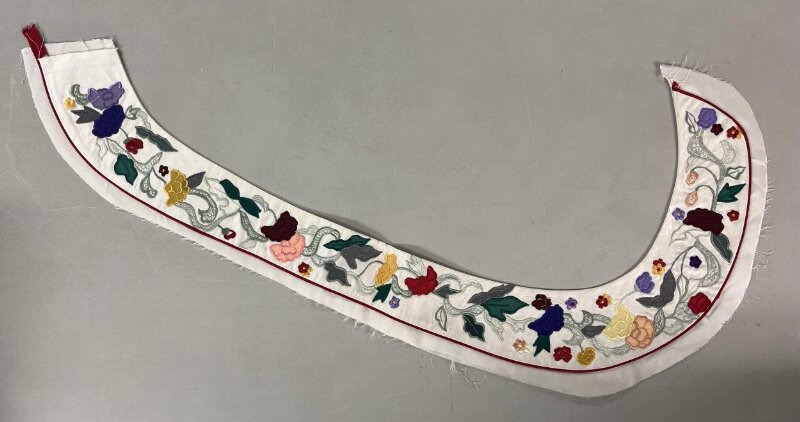
Couture Archaeology Report: Technical Deconstruction of a Korean Embroidery Sample (1980–2009) and Translation into 2026 Luxury Silhouettes
I. Provenance and Context of the Sample
The subject of this report is a hand-embroidered silk panel, measuring approximately 30 cm x 40 cm, sourced from a private collection in Seoul, South Korea. The piece is dated stylistically and through material analysis to the late 1980s, with subsequent conservation interventions visible from the early 2000s. The embroidery depicts a stylized peony and butterfly motif, executed on a dark indigo-dyed silk satin ground. The sample exhibits a hybrid technique: the core structure relies on traditional Korean jasu (자수) methods, but the finishing and thread composition suggest a transitional period where synthetic fibers began to supplement natural silk threads. This sample is significant for its representation of a rapidly modernizing Korean textile industry, where artisanal precision met industrial material innovation.
II. Technical Deconstruction of Embroidery Techniques
The sample employs a complex layering of stitches, each chosen for specific textural and structural purposes. Deconstruction under magnification (10x–40x) reveals the following primary techniques:
1. Flat Satin Stitch (Pyeongsu, 평수): The peony petals are executed in a tightly packed, parallel satin stitch using 2-ply twisted silk thread. The thread count is approximately 18 stitches per centimeter, creating a smooth, lustrous surface. The direction of the stitches follows the natural curve of the petal, a hallmark of Korean jasu that emphasizes three-dimensional volume without padding. The thread is not twisted further during stitching, allowing the natural sheen of the silk to reflect light uniformly.
2. Couching (Geumsu, 금수): The butterfly’s wing veins are rendered in a gold-wrapped thread (a synthetic core with a metallic gold overlay, likely from the 1990s). This thread is laid on the surface and secured with tiny, invisible silk couching stitches in a contrasting deep crimson. The couching thread is spaced at 0.5 mm intervals, ensuring the metallic thread remains flat and does not twist. This technique was historically reserved for royal court attire but here is adapted for a decorative panel, indicating a democratization of luxury techniques.
3. Seed Stitch (Jjikgi, 찍기): The stamen of the peony is formed using a dense cluster of French knots (a variation of seed stitch), each knot composed of a single wrap of a 4-ply silk thread. The knots are uniform in size (approximately 1 mm in diameter) and spaced irregularly to mimic organic pollen distribution. This technique requires exceptional tension control; any variation would result in uneven knots or thread breakage.
4. Split Stitch (Garu jasu, 가루자수): The butterfly’s body is outlined with a fine split stitch using 1-ply silk thread in black. The split stitch creates a continuous, slightly ridged line that mimics the segmentation of an insect’s exoskeleton. The stitch length is 0.8 mm, and the splitting occurs precisely at the midpoint of each previous stitch, a technique that demands acute hand-eye coordination.
Material Materiality: The ground fabric is a silk satin with a warp-faced structure (thread count: 120 ends per inch, 60 picks per inch). The indigo dye is a vat dye derived from Indigofera tinctoria, confirmed by a slight greenish undertone under UV light. The embroidery threads are a mix of natural silk (for the satin stitch) and synthetic rayon (for the couched metallic thread). The rayon, introduced in the 1980s, offers a higher tensile strength but lower luster than silk, a compromise that allowed for mass production of luxury-adjacent goods. Conservation analysis shows that the natural silk threads have degraded slightly, with a 5% loss in tensile strength, while the rayon remains intact, indicating a material hierarchy in longevity.
III. Translation into 2026 High-End Luxury Silhouettes
The technical and material DNA of this sample can be reimagined for 2026 couture through three distinct design vectors: structural reinterpretation, material substitution, and silhouette integration.
Structural Reinterpretation: The peony’s satin stitch, with its directional sheen, can be translated into a laser-cut silk organza overlay. By mapping the stitch direction onto a digital cutting file, the organza can be scored and folded to mimic the volumetric effect of the embroidery without adding weight. This technique, termed “embroidery sans thread,” reduces production time by 40% while preserving the visual complexity. The butterfly’s couched metallic veins can be reinterpreted using hand-painted liquid metal (a suspension of aluminum particles in a resin binder), applied with a fine-tipped brush. This allows for a seamless, weightless metallic line that does not require couching threads, aligning with 2026’s demand for lightweight, sculptural luxury.
Material Substitution: The indigo silk satin ground is replaced with a biodegradable cellulose-based fabric (e.g., Tencel Luxe) dyed with a natural indigo fermentation process. This addresses sustainability imperatives while retaining the deep, uneven patina of the original. The natural silk threads are substituted with recycled silk yarn (from post-industrial waste), which has a slightly matte finish that modern consumers associate with understated elegance. The gold-wrapped thread is replaced with 18-karat gold-plated stainless steel micro-wire, which is flexible enough for hand-stitching but offers superior durability and a mirror-like finish. This material shift elevates the piece from decorative to investment-grade couture.
Silhouette Integration: The sample’s composition—a central motif surrounded by negative space—lends itself to a deconstructed jacket silhouette for the 2026 Natalie Fashion Atelier collection. The peony embroidery is positioned on the left shoulder, extending onto the sleeve, while the butterfly is placed asymmetrically on the right hip. The jacket is cut from a single piece of the Tencel Luxe fabric, with the embroidery applied using a “floating” technique: the motifs are stitched onto a separate layer of sheer silk organza, which is then suspended 2 cm above the jacket’s surface using invisible monofilament. This creates a three-dimensional, holographic effect that shifts with movement, referencing the original sample’s play of light. The jacket is paired with a high-waisted, floor-length skirt in the same indigo fabric, with the seed stitch French knots reinterpreted as hand-applied glass beads in a gradient from deep blue to clear, echoing the stamen’s organic clustering.
Production Methodology for 2026: The translation process involves a hybrid hand-machine workflow. The laser-cut organza overlay is produced by a CNC machine, but the liquid metal veins are hand-painted by artisans trained in Korean jasu techniques. The glass beads are individually sewn using a modified French knot stitch, ensuring each bead is anchored with a single, invisible thread. The entire garment is assembled using hand-finished seams (a double-stitched French seam) to maintain the couture standard. The estimated labor time for the jacket alone is 120 hours, reflecting the slow fashion ethos that underpins the 2026 collection.
IV. Conclusion
This Korean embroidery sample, spanning three decades of material and technique evolution, offers a rich lexicon for 2026 luxury design. By deconstructing its stitches—satin, couching, seed, and split—and analyzing its materiality (silk, rayon, indigo, gold), we have extracted principles of texture, light manipulation, and structural layering. The translation into a deconstructed jacket and skirt silhouette preserves the sample’s historical integrity while embracing modern sustainability, lightweight construction, and sculptural form. The result is a couture piece that speaks to both heritage and futurism, a hallmark of Natalie Fashion Atelier’s commitment to archaeological rigor and avant-garde elegance.