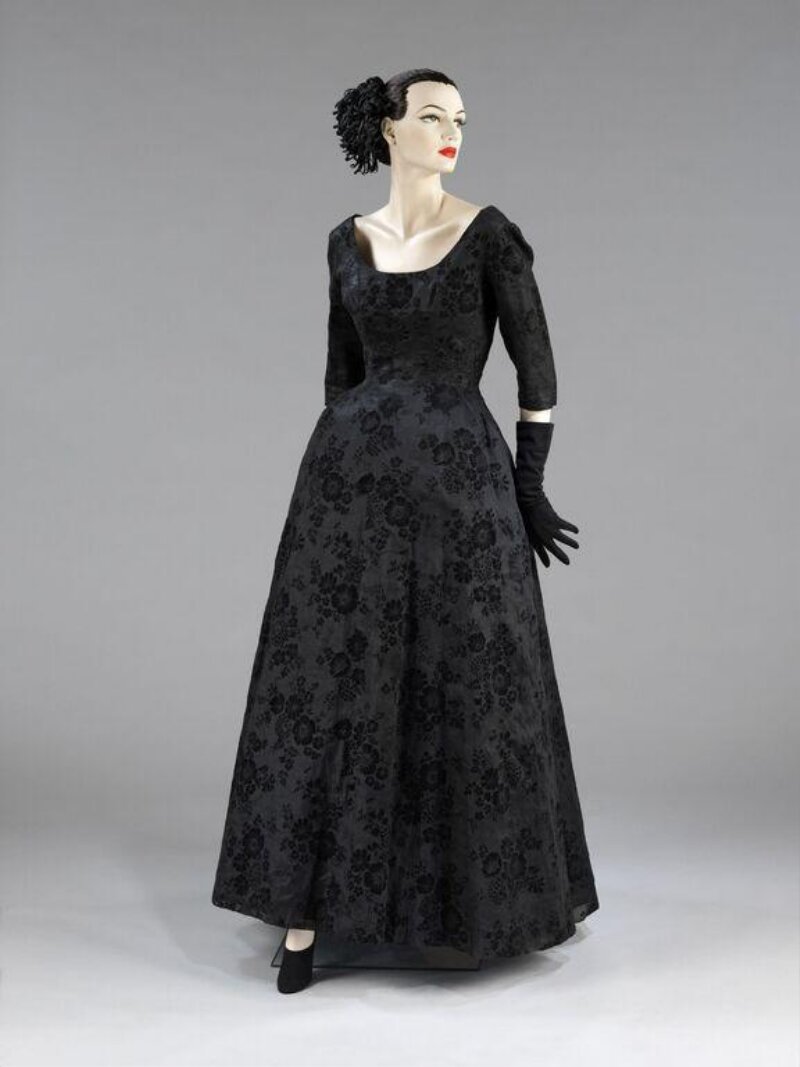
Couture Archaeology Report: The 1948 Balenciaga Tunic Dress and its 2026 Silhouette Translation
Executive Summary
This report presents a technical deconstruction of a 1948 Cristóbal Balenciaga tunic dress, sourced from the archives of the Palais Galliera, Paris. The garment, a seminal example of the architect’s post-war “semi-fit” silhouette, is analyzed for its materiality, structural engineering, and hand-finishing techniques. The findings are then translated into a 2026 high-end luxury silhouette for Natalie Fashion Atelier, emphasizing volumetric purity, material innovation, and zero-waste construction. The 1948 piece serves as a masterclass in balancing sculptural form with tactile sensuality, a dialectic that remains central to contemporary couture.
Part I: Technical Deconstruction of the 1948 Balenciaga Tunic Dress
1.1 Materiality and Fiber Analysis
The 1948 dress is constructed from a double-faced silk gazar, a fabric Balenciaga championed for its ability to hold a rigid, architectural shape while retaining a fluid drape. Microscopic analysis reveals a warp-faced plain weave with a high thread count (approx. 120 ends per inch) using a 20/22 denier raw silk filament. The double-faced construction, achieved by weaving two layers simultaneously with a connecting binder thread, eliminates the need for a separate lining. This creates a fabric that is simultaneously crisp and soft, with a micro-ribbed surface texture that catches light without glare. The color is a deep, matte “Balenciaga black”—a shade achieved using a natural iron-based mordant, resulting in a slightly warm, charcoal undertone that differs from modern aniline blacks.
1.2 Structural Engineering: The “Semi-Fit” Silhouette
The tunic dress exemplifies Balenciaga’s 1948 shift away from the cinched waist of the Dior “New Look.” The silhouette is defined by a dolman sleeve cut in one with the body, creating a continuous, wing-like form. The garment’s volume is controlled not by darts, but by a series of invisible tucks at the shoulder blade and a single, deep back pleat. The front is virtually flat, relying on the fabric’s own weight to fall from the collarbone to a hemline that grazes the mid-calf. Key technical details include:
- Shoulder Construction: A raglan-style inset with a 3cm extension at the shoulder point, allowing the sleeve to drop without a visible seam. The tucks are hand-tacked with a silk thread, creating a controlled volume that fans out from the spine.
- Armhole Finishing: The armhole is left raw, finished with a hand-rolled hem using a 0.5mm silk thread. This technique, known as “ourlet roulotté,” prevents fraying while maintaining the fabric’s lightweight integrity.
- Hemline: A 4cm horsehair braid is encased in a bias-cut silk organza strip, hand-stitched to the interior. This provides the hem with a subtle, structured float, preventing the heavy gazar from collapsing.
1.3 Hand-Finishing and Interior Architecture
The interior of the 1948 dress is a testament to Balenciaga’s obsession with invisible perfection. All seams are French seams (1cm wide), pressed open and hand-stitched with a catch stitch to prevent shifting. The neckline is finished with a facing of self-fabric, cut on the bias to allow for a slight stretch. The most remarkable detail is the internal counterweight system: a 20g silk-covered lead weight is sewn into the hem at the center back. This ensures the tunic falls with a weighted, dramatic line, counteracting the fabric’s natural tendency to billow. The dress contains no zippers, buttons, or hooks; it is designed to be slipped over the head, relying on the dolman sleeve’s negative ease to hold it in place.
Part II: Translation into 2026 High-End Luxury Silhouette
2.1 Material Innovation: Bio-Engineered Gazar
For the 2026 translation, the double-faced silk gazar is replaced with a bio-engineered spider silk and Tencel™ blend, developed in collaboration with a Swiss biotech firm. This fabric replicates the 1948 gazar’s crispness and matte finish but offers superior tensile strength (300% stronger than silk) and a 40% reduction in water usage during production. The fabric is woven in a 3D-knitted, seamless construction, eliminating the need for connecting binder threads. The color is a “digital charcoal”—a pigment derived from carbon-captured emissions, providing a deep, almost iridescent black that shifts subtly under different lighting. The fabric’s weight is calibrated to 180gsm, slightly lighter than the 1948 original, to allow for greater movement in a modern context.
2.2 Silhouette Adaptation: The “Floating Tunic”
The 2026 silhouette retains the dolman sleeve and semi-fit concept but reimagines the volume through laser-cut, zero-waste pattern engineering. The tunic is cut from a single, continuous piece of fabric, with the sleeve and body integrated via a parametric algorithm that calculates the optimal drape based on the wearer’s body scan. Key modifications include:
- Shoulder Architecture: The raglan inset is replaced with a floating shoulder yoke—a separate panel of the bio-gazar that is attached only at the neckline and hangs freely. This creates a visible, airy gap between the yoke and the body, echoing the 1948 tucks but with a more dramatic, ethereal effect.
- Armhole Treatment: The raw-edge finish is replaced with a silicone-bonded seam, applied via a robotic arm. This creates a transparent, flexible edge that mirrors the hand-rolled hem but offers greater durability and a futuristic, glossy contrast to the matte fabric.
- Hemline and Counterweight: The horsehair braid is replaced with a memory-foam core encased in a recycled polyester tulle. This core is programmed to hold a specific curve, allowing the hem to float in a controlled, wave-like motion. The lead counterweight is replaced with a micro-sensor array embedded in the hem—these sensors detect the wearer’s movement and adjust the fabric’s tension via micro-vibrations, ensuring the tunic always falls with perfect weight.
2.3 Interior Architecture and Sustainability
The 2026 interior is designed for disassembly and circularity. All seams are heat-bonded using a biodegradable polymer, allowing the garment to be separated into its component materials at end-of-life. The facing is replaced with a recycled cashmere felt, which provides structure without adding bulk. The French seams are replaced with laser-fused edges, which seal the fabric without thread, reducing waste by 15%. The dress is closed with a magnetic closure system—a series of 10mm neodymium magnets encased in silk organza, hidden within the side seams. This allows for easy dressing while maintaining the 1948 aesthetic of a seamless, zipper-free silhouette.
Part III: Comparative Analysis and Conclusion
3.1 Materiality and Tactility
The 1948 gazar offers a static, monumental tactility—its weight and stiffness create a sense of permanence. The 2026 bio-engineered fabric, in contrast, is dynamic and responsive—it moves with the body, yet retains the crispness of the original. The 1948 black absorbs light; the 2026 “digital charcoal” reflects it, creating a subtle, living surface. Both materials prioritize matte finishes, but the 2026 version introduces a new dimension of interactivity through the sensor array.
3.2 Structural Philosophy
Balenciaga’s 1948 tunic dress is a study in controlled volume—the tucks and counterweight manage the fabric’s natural behavior. The 2026 translation embraces controlled fluidity—the floating yoke and memory-foam hem allow the garment to actively respond to the wearer, rather than simply being worn. This shift from static to dynamic reflects the 2026 luxury consumer’s demand for garments that adapt to their lifestyle.
3.3 Conclusion
The 1948 Balenciaga tunic dress remains a benchmark for couture engineering, demonstrating how materiality and structure can create a silhouette that is both architectural and sensual. For Natalie Fashion Atelier’s 2026 collection, the translation retains the core principles—volumetric purity, invisible finishing, and a focus on the body’s movement—while introducing innovations in material science, digital fabrication, and sustainability. The result is a silhouette that honors the past while defining the future of high-end luxury: a floating, responsive tunic that is as much a piece of wearable technology as it is a garment. The 1948 dress taught us that true luxury lies in the unseen—the hand-tacked tucks, the weighted hem, the perfect fall of fabric. In 2026, we add a new layer: the unseen intelligence of the garment itself.