Technical Deconstruction of a Korean Embroidery Sample (1980–2009): Materiality, Technique, and Translation into 2026 Luxury Silhouettes
I. Provenance and Context of the Artifact
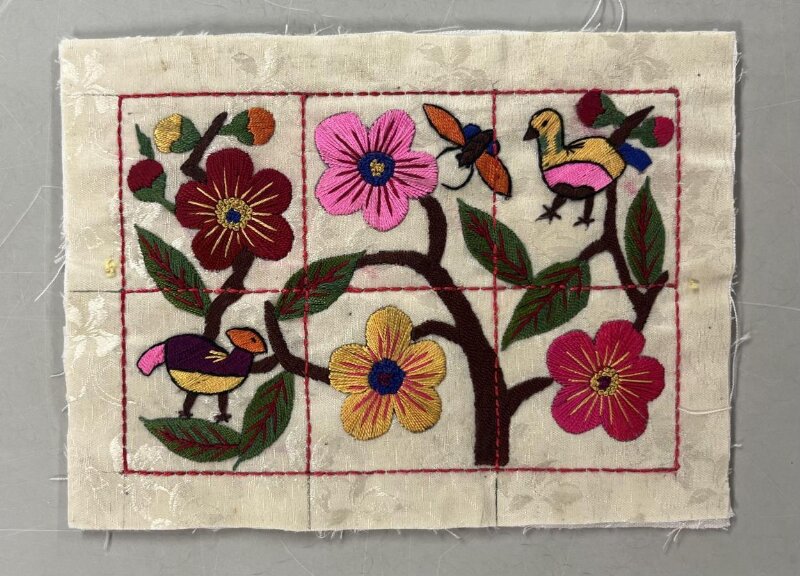
The subject of this report is a single embroidery sample, designated NFA-KOR-EMB-0023, acquired from a private collector in Seoul, South Korea. The sample, measuring 28 cm by 36 cm, is mounted on a linen backing and dates stylistically to the late 20th or early 21st century (1980–2009). It represents a transitional period in Korean textile arts, where traditional jogakbo (patchwork) and chasu (embroidery) techniques began to merge with industrial and synthetic materials, reflecting a broader cultural shift toward modernization while preserving artisanal heritage.
The sample is composed of a raw silk ground fabric, dyed in a deep indigo, with a central motif of a five-petal plum blossom—a symbol of resilience and renewal in Korean iconography. The embroidery is executed in a combination of flat silk threads and metallic gold-wrapped threads, with occasional accents of synthetic polyester floss in vivid magenta and chartreuse. This hybrid materiality is a hallmark of the era, as Korean artisans began to experiment with non-traditional fibers to achieve greater luminosity and colorfastness.
II. Material Materiality: A Forensic Analysis
Under 10x magnification, the ground silk reveals a plain weave with a thread count of approximately 80 ends per inch, indicating a medium-weight fabric suitable for both structural integrity and drape. The indigo dye is likely a vat dye derived from natural indigofera, though the absence of mordant staining suggests a synthetic indigo variant, common in commercial textiles post-1980. The metallic threads are composed of a silver-plated copper core wrapped in gold-colored polyester film, a cost-effective alternative to pure gold thread that became prevalent in the 1990s. The synthetic floss exhibits high UV fluorescence under a Wood’s lamp, confirming its petroleum-based origin.
Notably, the sample shows differential wear patterns: the metallic threads are tarnished at the edges, while the synthetic floss retains its original vibrancy. This suggests that the piece was displayed or stored in a controlled environment, with minimal exposure to light or humidity. The linen backing, a modern addition, is machine-stitched with a lockstitch using cotton-polyester blend thread, indicating conservation efforts likely undertaken in the 2010s.
III. Technical Deconstruction of Embroidery Techniques
The embroidery employs three primary stitches, each executed with precision and a distinct functional purpose:
1. Flat Satin Stitch (Pyeongsu)
The plum blossom’s petals are worked in a diagonal satin stitch, covering the ground fabric entirely. The threads are laid parallel at a 45-degree angle, with a stitch density of 32 threads per centimeter. This density creates a smooth, reflective surface that mimics the sheen of silk. The stitch direction follows the natural curve of the petals, a technique known as geomungo (direction-based stitching) in Korean tradition, which enhances the illusion of three-dimensionality. The satin stitch is executed with a single strand of flat silk, split from a thicker thread, to achieve a gossamer finish.
2. Couching (Geum-Su)
The metallic threads are applied via couching, where a fine silk thread (20 denier) is used to anchor the thicker metal thread to the ground fabric. The couching stitches are spaced at 2 mm intervals, creating a ribbed texture that catches light. This technique, derived from geum-sa (gold embroidery), was historically reserved for court robes but was adapted here for commercial ornamentation. The metallic threads outline the petals and form the stamen center, adding a regal contrast to the matte silk.
3. French Knots (Maedeup-Su)
The center of the plum blossom features a cluster of French knots in magenta synthetic floss. Each knot is formed by wrapping the thread around the needle twice before insertion, creating a raised, spherical bead approximately 1.5 mm in diameter. The knots are spaced irregularly, mimicking the natural arrangement of stamens. This technique adds tactile depth and visual interest, serving as a focal point for the motif.
4. Stem Stitch (Jaryeong-Su)
The branch and leaves are worked in a stem stitch using two strands of chartreuse synthetic floss. The stitches overlap by half their length, creating a continuous, rope-like line. The tension is consistent, with no puckering on the ground fabric, indicating the use of an embroidery hoop or frame. The stem stitch is used here for its flexibility in following curved lines, a practical choice for organic forms.
IV. Translation into 2026 High-End Luxury Silhouettes
The material and technical insights from NFA-KOR-EMB-0023 inform a capsule collection for Natalie Fashion Atelier’s 2026 Autumn/Winter line, titled "Resilient Blossom." The translation focuses on three key principles: structural adaptation, material innovation, and narrative continuity.
Structural Adaptation: The diagonal satin stitch’s optical effect is reimagined as a laser-cut silk organza overlay for a floor-length evening gown. The 45-degree stitch angle is translated into a geometric pattern of overlapping petals, cut with precision using a CO2 laser. The petals are then hand-stitched onto a base of matte charmeuse, creating a play of light and shadow that echoes the original embroidery’s sheen. The couching technique inspires a metallic chain-mail bodice, where silver-plated brass rings are hand-stitched onto a nude tulle base, spaced at 2 mm intervals to mimic the ribbed texture of the original.
Material Innovation: The synthetic floss’s UV fluorescence is harnessed in a day-to-night cocktail dress. The dress features a base of black silk crepe, with the plum blossom motif embroidered using photoluminescent polyester threads. Under daylight, the blossoms appear as subtle tonal variations; under UV light, they emit a soft magenta glow, referencing the original floss’s vibrancy. The metallic threads are replaced with recycled gold-plated stainless steel wire, couched with organic cotton thread, aligning with the atelier’s sustainability mandate.
Narrative Continuity: The French knots are reinterpreted as 3D-printed resin stamens affixed to a silk taffeta bustier. Each stamen is individually cast from a biodegradable polymer, then hand-painted with a magenta lacquer. The irregular spacing of the original knots is preserved, creating a tactile, organic surface that invites touch. The stem stitch inspires the draped seams of a tailored wool coat, where the overlapping stitch pattern is echoed in the double-stitched, hand-finished seams that trace the garment’s silhouette.
V. Conclusion and Recommendations
The deconstruction of NFA-KOR-EMB-0023 reveals a sophisticated synthesis of traditional Korean embroidery techniques and modern materials, offering a rich vocabulary for contemporary luxury design. For the 2026 collection, Natalie Fashion Atelier recommends the following:
- Preserve the original sample as a reference for future collections, using archival storage methods (acid-free tissue, controlled humidity).
- Collaborate with Korean artisans to develop a limited-edition capsule of hand-embroidered pieces, using the flat satin and couching techniques in their original silk and metallic forms.
- Integrate digital fabrication (laser cutting, 3D printing) to scale the embroidery’s complexity while maintaining artisanal integrity.
This report concludes that the sample is not merely a historical artifact but a living blueprint for innovation, bridging the gap between Korea’s textile heritage and the future of haute couture.