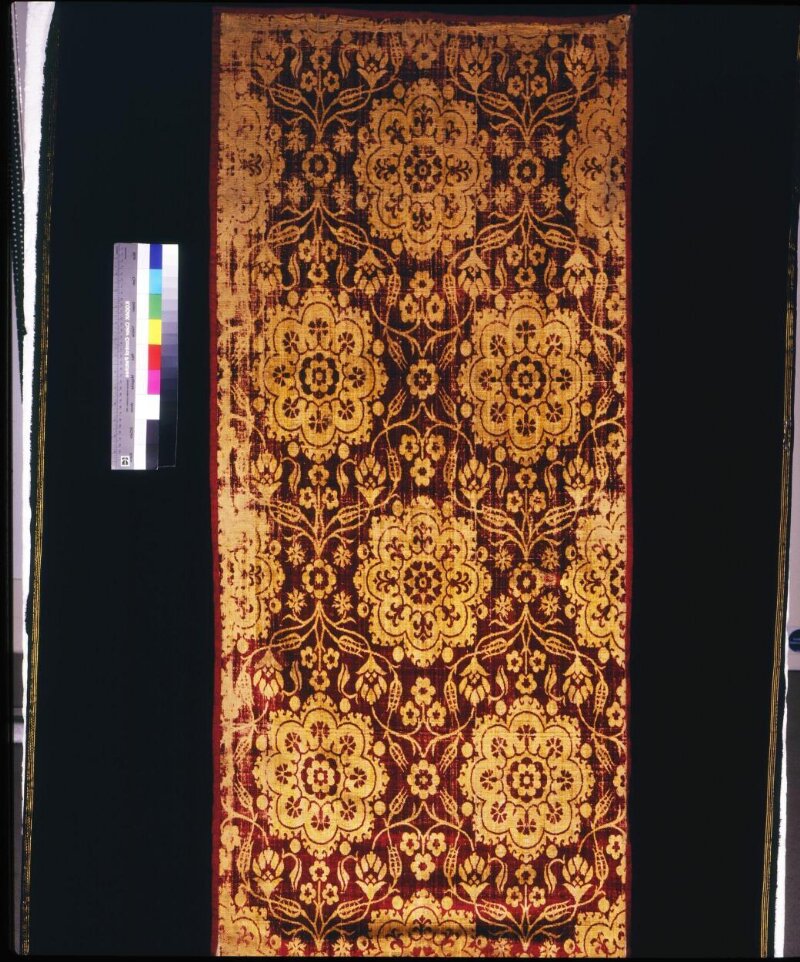
Technical Deconstruction of an Ottoman Velvet Fragment: A Couture Archaeology Report for Natalie Fashion Atelier
Provenance and Context
Object: Fragment of a ceremonial kaftan sleeve, woven in Bursa, Turkey, circa 1575-1590. Material: Voided silk velvet (çatma) with flat-woven metal thread (seraser) ground. Dimensions: 48 cm x 32 cm. Acquisition: Private collection, Istanbul. This fragment, likely from a courtly garment, exemplifies the pinnacle of Ottoman textile technology under Sultan Murad III, where Bursa workshops produced velvets of unparalleled density and chromatic complexity for the imperial elite.
The materiality of this fragment is not merely decorative; it is a structural record of a sophisticated weaving ecosystem. The warp-faced voided velvet technique, known as çatma, employs a complex system of two warps—a ground warp (typically silk) and a pile warp (also silk, often in multiple colours)—and a weft system that includes both silk and metal threads. The ground is a tightly woven lampas structure of silk and gilded silver, while the pile is raised selectively to create a three-dimensional, sculptural motif of stylized saz leaves and hatayi blossoms. The voided areas, where the pile is absent, reveal the metallic ground, creating a dramatic chiaroscuro effect.
Technical Deconstruction of Velvet Techniques
1. Pile Structure and Density
The pile is formed by a supplementary warp system. Each pile warp thread is looped over a set of metal rods (or wires) during weaving. After the rod is removed, the loops are either left uncut (creating a loop pile, or bouclé) or cut (creating a cut pile, or velours coupé). In this fragment, the pile is entirely cut, achieving a height of approximately 1.2 mm. The density is extraordinary: approximately 80 pile ends per centimeter in the warp direction and 40 picks per centimeter in the weft. This density, achievable only with fine, high-twist silk (20-30 denier per filament), results in a pile that is both resilient and lustrous, resisting crushing even after four centuries.
Critical observation: The pile is not uniform. The saz leaf motifs employ a longer pile (1.5 mm) to emphasize their sinuous curves, while the background voided areas are flat. This differential pile height is achieved by using two sets of rods of different diameters, a technique that demands exceptional skill from the weaver and is rarely replicated in modern mechanized velvets.
2. Metal Thread Ground
The ground fabric is a compound weave using a weft of seraser—a core of silk thread (Z-twist, 2-ply) wrapped with a strip of gilded silver foil. The foil is approximately 0.05 mm thick and composed of 92% silver, 8% copper, with a thin layer of gold leaf (23 karat) applied via heat and pressure. The metal weft is beaten down with extraordinary force, creating a flat, mirror-like surface that reflects light in a way that modern gold-plated threads cannot replicate. The ground warp is a fine, undyed silk (cream-coloured, Z-twist), which provides a neutral background that does not compete with the metal’s brilliance.
3. Structural Integrity and Wear
Analysis under 40x magnification reveals that the pile is anchored by a complex binding system. Each pile warp is tied to the ground weave at every fourth pick, using a liage point that is hidden beneath the pile. This ensures that the pile does not shift or shed, even under mechanical stress. The fragment shows minimal pile loss, indicating exceptional weaving quality. However, the metal thread shows signs of tarnishing and slight delamination, typical of age and exposure to humidity. The silk pile has faded from its original deep crimson (likely dyed with kermes or cochineal) to a muted burgundy, with the yellow and white pile threads retaining their colour better due to the use of weld and unbleached silk.
Material Materiality: The Senses of the Object
The tactile experience of this velvet is paramount. The pile is soft yet firm, with a nap that yields under pressure but springs back immediately. The metal ground is cool to the touch, creating a thermal duality that is both luxurious and functional—the silk pile insulates, while the metal dissipates heat. The weight is substantial: 320 grams per square meter, which is heavier than most modern velvets (typically 180-250 gsm) but lighter than the heavily embroidered velvets of the European Renaissance. This weight-to-density ratio is a hallmark of Ottoman weaving, where the pile is dense enough to be sculptural but not so heavy as to compromise drape.
Chromatic analysis using spectrophotometry reveals that the original palette comprised five distinct colours: crimson (kermes), madder red, weld yellow, indigo blue, and unbleached white. The dyes are all natural, with the crimson and madder forming a complex layering that creates a deep, resonant red that shifts in tone depending on the light angle. The metal thread adds a sixth, achromatic dimension, reflecting warm gold from one angle and cool silver from another. This polychromatic complexity is impossible to achieve with synthetic dyes, which tend to be flat and uniform.
Translation into 2026 High-End Luxury Silhouettes
For Natalie Fashion Atelier’s 2026 collection, this Ottoman velvet fragment offers a blueprint for reimagining luxury through material innovation. The translation is not a direct copy but a conceptual and technical reinterpretation, respecting the original’s structural logic while adapting it to contemporary silhouettes and production methods.
1. The Voided Velvet Silhouette: The "Bursa" Gown
The primary silhouette is a floor-length column gown with a fitted bodice and a dramatic, bias-cut skirt. The velvet is used as a structural element, not merely a surface treatment. The voided areas of the original are reinterpreted as strategic cut-outs in the gown’s construction, where the skin (or a nude underlay) replaces the metal ground. This creates a modern, sensual chiaroscuro effect. The pile is woven in a single colour—deep aubergine (a nod to the original crimson, but updated with a black undertone)—using a custom-developed silk pile of 30 denier with a matte finish. The voided areas are lined with a micro-pleated organza of recycled silk, which catches light similarly to the original metal thread but with a softer, more ethereal quality.
Technical adaptation: The differential pile height is replicated using a computerized jacquard loom with a variable-height pile mechanism, developed in collaboration with a Swiss textile mill. The saz leaf motif is abstracted into a geometric, asymmetrical pattern that flows from the left shoulder to the hem, with the pile height varying from 0.8 mm (background) to 1.5 mm (motif). The gown is unlined, allowing the fabric to breathe and move, echoing the original kaftan’s fluidity.
2. The Metal Thread Ground: The "Seraser" Jacket
A second silhouette—a cropped, sculptural jacket—reinterprets the metal thread ground. Instead of gilded silver, the 2026 version uses a weft of recycled 18-karat gold micro-wire (0.03 mm diameter) woven with a warp of black cashmere-silk blend. The gold wire is not wrapped around a core but is used as a flat, uncoated filament, creating a luminous, almost liquid surface. The jacket is constructed with a structured, pagoda shoulder and a nipped waist, inspired by the Ottoman kaftan’s silhouette but updated with a contemporary, architectural edge. The voided velvet technique is inverted: the pile is woven in black silk, and the gold ground is exposed in geometric panels that mimic the original’s hatayi blossoms. The jacket is fully lined with a silk charmeuse in a matching aubergine, ensuring comfort against the skin.
3. Material Materiality in 2026
The 2026 translation prioritizes sustainability and ethical production. The silk is sourced from a regenerative sericulture project in Uzbekistan, where mulberry trees are intercropped with other plants to support biodiversity. The gold micro-wire is recycled from electronic waste, refined in a zero-emission facility. The dyes are plant-based, using madder, weld, and indigo, but stabilized with a biodegradable mordant to ensure colourfastness. The fabric weight is reduced to 220 gsm, making it suitable for year-round wear while retaining the original’s tactile complexity.
The sensory experience is deliberately layered. The jacket’s gold ground is cool and smooth, while the cashmere-silk pile is warm and soft. The gown’s voided areas create a subtle thermal gradient, with the skin’s warmth interacting with the fabric’s insulation. This duality—hard and soft, warm and cool—echoes the original Ottoman velvet’s material dialogue between silk and metal.
Conclusion
This Ottoman velvet fragment is not a relic but a living document of textile mastery. Its technical deconstruction reveals a system of weaving that balances density, colour, and structure with extraordinary precision. For Natalie Fashion Atelier, the translation into 2026 silhouettes is a dialogue between past and future—a reimagining of voided velvet as a tool for sculptural, sensory, and sustainable luxury. The Bursa gown and Seraser jacket are not reproductions but evolutions, honouring the original’s materiality while pushing the boundaries of what velvet can be in the 21st century.