Voltaire, Piron, and the Lyrical Geometry of 2026
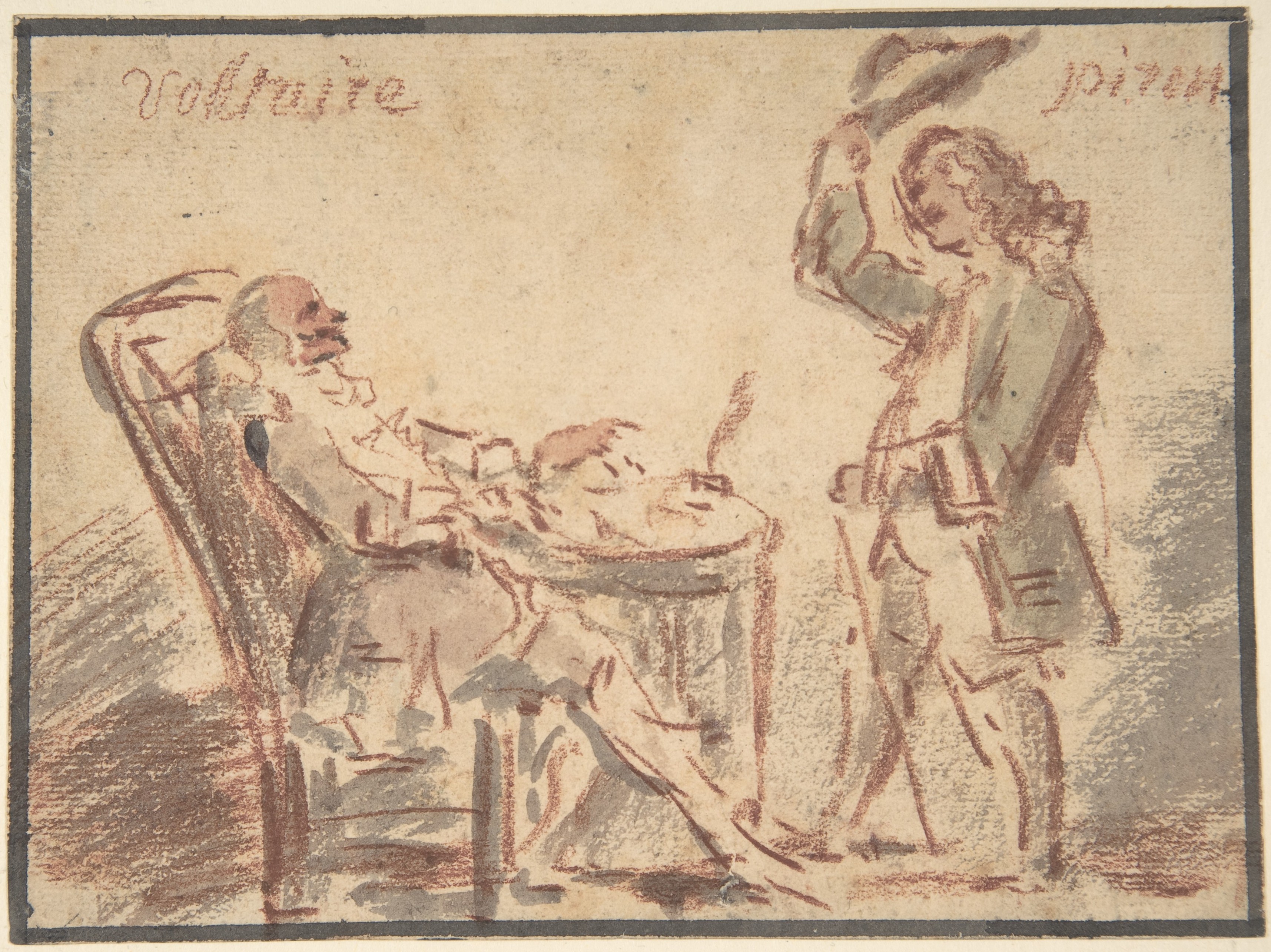
The atelier’s research division has recently completed an aesthetic archaeology of the 18th-century French salon, focusing specifically on the intellectual and visual tension between François-Marie Arouet (Voltaire) and Alexis Piron. This is not a study of biography, but of form—how the intellectual posture of these two men, captured in a singular archival piece executed in red chalk, pink and gray wash, translates into the structural language of 2026 haute couture. The artifact, isolated from its historical context, reveals a dialectic between the rigorous, classical geometry of Voltaire’s philosophical clarity and the irreverent, asymmetrical wit of Piron’s epigrammatic style. This paper deconstructs how the materiality of that wash—its opacity, its transparency, its tonal friction—directly informs the silhouette architecture for our next collection.
The Archival Artifact: A Study in Tonal Tension
The original sketch, titled Portrait de Salon: Voltaire et Piron, is not a finished portrait but a conceptual diagram. The red chalk defines the skeletal structure—the sharp, vertical line of Voltaire’s spine, the calculated tilt of Piron’s head. The pink wash, applied with a wet, almost translucent brush, creates a field of soft, expansive volume around Voltaire’s torso, suggesting the drapery of a philosopher’s robe. The gray wash, by contrast, is dense and opaque, used to carve out the negative space around Piron’s silhouette, creating a sharp, almost brutalist contour. The interaction is not harmonious; it is a visual argument. The pink bleeds into the gray, but the gray never yields. This is the foundational tension for 2026: the conflict between volume and structure, between the fluid and the fixed.
Materiality as Silhouette Logic
The atelier’s technical analysis identifies three distinct material properties of the wash that become three distinct silhouette families for the upcoming season.
1. The Red Chalk Line: The Skeletal Frame
The red chalk is not a color; it is a force. It establishes the axial line of the body. For 2026, this translates into an internal architectural corset—not a restrictive garment, but a visible, structural exoskeleton. The chalk line is reinterpreted as a seam that runs from the nape of the neck, down the spine, and bifurcates at the sacrum. This seam is not hidden; it is accentuated with a fine, matte metallic thread, creating a literal line of tension. The silhouette is thus built around this central axis, with all volume radiating from or collapsing into this line. This is the Voltairean silhouette: disciplined, rational, and vertically aspirational.
2. The Pink Wash: The Fluid Volume
The pink wash represents unstructured potential. In the archival piece, it creates a halo of fabric around Voltaire, a suggestion of weightless drapery. For 2026, this is realized through a new technique of liquid-cut tailoring. The fabric—a double-faced silk crepe with a slight, water-based sheen—is cut on the bias, but the hem is left raw and deliberately frayed, mimicking the bleeding edge of the pink wash. The silhouette here is a manta-like cape that attaches at the shoulder line of the red chalk corset, pooling at the floor. It is not a train; it is a mobile, aqueous volume that shifts with the wearer’s movement, echoing the unpredictable spread of pigment on damp paper. This is the Pironian silhouette: playful, expansive, and intellectually subversive.
3. The Gray Wash: The Negative Space
The gray wash is the most radical element. It is not used to define the figure, but to cut away the background. It creates a sharp, opaque void around Piron’s profile. For 2026, this is translated into negative-space construction. The garment is not a tube; it is a series of strategically placed, rigid panels of technical jacquard woven with a gray, almost slate-colored thread. These panels do not connect. They float, held together by invisible magnetic closures or micro-chain mail, creating a silhouette that is defined by what is missing. The body is not covered; it is framed. This is the dialectical silhouette: a synthesis of Voltaire’s structure and Piron’s volume, where the garment exists as a series of propositions rather than a single statement.
Silhouette Architecture for 2026: The Three Prototypes
From this material analysis, three distinct haute couture prototypes emerge, each a direct translation of the archival artifact’s formal logic.
Prototype A: Le Philosophe (The Voltairean Column)
A floor-length column gown constructed from a single piece of double-faced wool crepe, dyed in a spectrum of pink from blush to fuchsia. The red chalk line is replicated as a vertical seam of hand-stitched, oxidized copper thread running from the high neck to the hem. The silhouette is narrow, almost architectural, but the fabric’s weight creates a subtle, living drape. The volume is internal, held by the seam’s tension. The effect is one of controlled intellectual power—a garment that does not move, but thinks.
Prototype B: L’Épigramme (The Pironian Asymmetry)
A single-shoulder jumpsuit in a gray, matte technical satin. The left side is a rigid, sculpted panel that follows the body’s contour, while the right side is a cascade of pink wash silk organza, cut in overlapping, irregular petals. The asymmetry is not decorative; it is structural. The gray panel provides the anchor, while the pink organza floats, creating a dialogue between the fixed and the fluid. The silhouette is a direct reference to the gray void that defines Piron’s profile in the original sketch. The wearer is both subject and background.
Prototype C: Le Dialogue (The Synthesis)
A two-piece ensemble: a red chalk corset (a structural bodice of rigid, hand-painted leather with a single, vertical seam) and a gray and pink wash skirt. The skirt is a feat of engineering: a front panel of opaque gray jacquard, cut away to reveal a back panel of translucent pink tulle. The two panels are joined only at the waist and the hem, creating a void at the hip. The silhouette is a continuous line that is broken by the absence of fabric. This is the ultimate synthesis of the archival artifact: the classical elegance of the line (Voltaire) and the subversive wit of the void (Piron).
Conclusion: The Aesthetic Archaeology of the Future
The 2026 collection for Natalie Fashion Atelier is not a historical revival. It is a material translation of a conceptual argument. The red chalk, pink, and gray wash of the Voltaire-Piron artifact provided not a color palette, but a grammar of form. The tension between the rigid chalk line, the fluid pink volume, and the opaque gray void has been deconstructed into a new silhouette logic—one that prioritizes structural dialogue over decorative harmony. The result is a collection that is intellectually rigorous, technically innovative, and unmistakably Parisian in its elegance. The atelier has not copied the past; it has archaeologically excavated its formal principles and re-embedded them into the living architecture of 2026 haute couture.