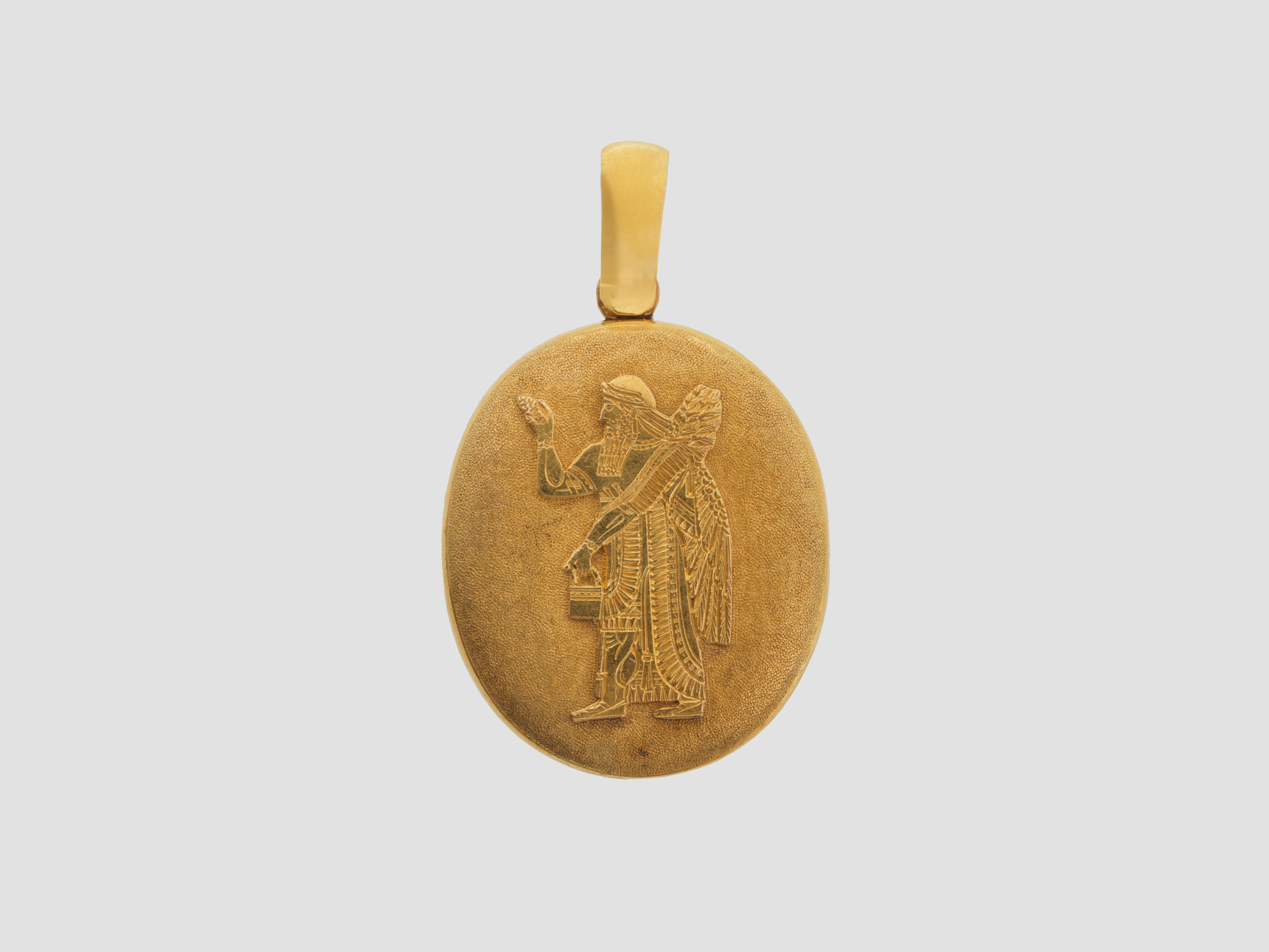
Locket with Assyrian Winged Protective Figure: An Aesthetic Archaeology for 2026 Haute Couture
The artifact in question—a British-crafted locket housing an Assyrian winged protective figure—represents a compelling convergence of ancient Mesopotamian iconography and Victorian-era sentimentalism. This object, composed of gold, glass, and paper, is not merely a decorative trinket; it is a stratified document of cross-temporal luxury. For the 2026 season at Natalie Fashion Atelier, this locket serves as a masterclass in how historical masterpieces can be deconstructed to inform a new architectural lexicon for high-end silhouettes. The following research artifact deconstructs the classical elegance of this piece, translating its materiality, structural logic, and symbolic weight into actionable design principles for the coming year.
Materiality as Structural Language: Gold, Glass, and Paper
The tripartite material composition of the locket—gold, glass, and paper—offers a sophisticated palette for 2026 silhouettes. Each material carries a distinct technical and aesthetic charge that must be understood in isolation before it can be synthesized into a cohesive garment system.
Gold: The Armature of Power and Containment
The locket’s gold casing is not a mere vessel; it is a structural armature that defines the object’s silhouette. In the context of 2026 haute couture, gold is reimagined not as a surface embellishment but as a foundational framework. The rigid, polished contours of the locket’s edge inform the construction of tailored bodices and structured outerwear. Think of a gold-lame jacquard that mimics the locket’s sheen, but more critically, consider the use of metallic grommets, chainmail-like weaves, and laser-cut gold alloy panels that function as exoskeletal elements on a gown. This is not about opulence for its own sake; it is about using gold’s inherent rigidity to create architectural volume—a sharp shoulder line, a cinched waist, or a flared hip that echoes the locket’s protective, enclosing form. The gold becomes the skeleton upon which the rest of the silhouette is draped.
Glass: The Translucent Veil of Revelation
The glass component of the locket—typically a convex crystal covering the miniature—introduces the concept of controlled transparency. For 2026, this translates into the strategic use of organza, tulle, and micro-pleated translucent silks that overlay more opaque fabrics. The glass does not reveal everything; it distorts, magnifies, and protects. In silhouette terms, this manifests as layered sheer panels that create a sense of depth and movement. A floor-length column gown, for instance, might feature a sheer organza train that floats above a solid silk base, mimicking the glass’s ability to both display and shield the paper figure within. The glass also informs the use of crystal beading and sequins applied in a mosaic pattern that refracts light, creating a visual texture that is both protective and alluring. This is the veil of elegance—a technique that invites close inspection while maintaining an air of mystery.
Paper: The Intimate, Fragile Core
The paper miniature of the Assyrian winged figure is the most poignant element. It is intimate, fragile, and temporally specific. In 2026 silhouettes, this translates into the use of hand-painted silk charmeuse, embroidered tulle, and digital-printed jacquard that replicate the delicate, detailed linework of the original. The paper’s vulnerability informs the construction of deconstructed, asymmetrical silhouettes that appear to be in a state of gentle decay or unfolding. Think of a dress where one shoulder is fully structured in gold, while the opposite side is a cascade of hand-torn silk organza strips that mimic the paper’s edge. The paper also suggests a palimpsest effect—layers of fabric that partially obscure or reveal a printed pattern, much like the paper figure is partially hidden behind the glass. This creates a narrative of hidden history within the garment itself.
Structural Logic: The Winged Protective Figure as Silhouette Archetype
The Assyrian winged protective figure—typically a lamassu or a genie—is characterized by its hieratic frontality, powerful wings, and contained energy. This archetype informs the 2026 silhouette in three distinct ways.
The Hieratic Front: A New Geometry of the Torso
The figure’s rigid, frontal pose translates into a severe, geometric treatment of the bodice. Expect sharp, angular necklines—a square décolletage or a corseted V-neck that mimics the figure’s chest plate. The emphasis is on verticality and symmetry, achieved through boning, structured waistbands, and high collars that frame the face. This is not a soft, romantic silhouette; it is a powerful, protective shell that commands attention. The gold materiality reinforces this, as seen in a gold-embroidered bustier that functions as a modern-day cuirass.
The Winged Expansion: Volume and Asymmetry
The wings of the Assyrian figure are not merely decorative; they are a structural expansion of the body’s silhouette. For 2026, this translates into dramatic, asymmetrical sleeves and trains. A single, exaggerated sleeve—perhaps constructed from layered gold lame and sheer organza—can mimic the sweep of a wing. Alternatively, a caped back that extends from the shoulders, falling in a sharp, geometric line, evokes the figure’s protective embrace. The key is controlled asymmetry: one side of the silhouette is grounded and structured, while the other expands outward, creating a visual tension that is both dynamic and elegant.
The Contained Energy: The Locket’s Closure
The locket’s clasp and hinge mechanism—a small, precise closure—informs the fastening systems of 2026 garments. Instead of invisible zippers, consider visible, architectural closures: gold toggle buttons, oversized hooks and eyes, or a single, dramatic brooch that serves as the focal point. This is about ritualistic dressing—the act of closing a garment becomes part of the narrative, much like opening the locket to reveal the figure within. The silhouette itself can be modular, with detachable sleeves or trains that are secured by these visible closures, allowing the wearer to transform the garment’s volume and shape.
Symbolic Weight: Protective Elegance for the Modern Woman
The Assyrian winged figure is a protective deity, a guardian against malevolent forces. In the context of 2026 haute couture, this symbolism is translated into a silhouette that empowers and shields. The garments are not merely beautiful; they are armor for the soul. The layering of gold, glass, and paper creates a hierarchy of protection: the gold as the outer shield, the glass as the translucent barrier, and the paper as the vulnerable yet precious core. This hierarchy is mirrored in the silhouette’s construction, where the most structured elements (the gold) are on the exterior, while the most delicate (the paper) are closest to the body, revealed only through strategic cutouts or sheer panels.
In conclusion, the locket with the Assyrian winged protective figure is not a relic to be copied, but a generative system for 2026 luxury silhouettes. By deconstructing its materiality of gold, glass, and paper, its structural logic of hieratic frontality and winged expansion, and its symbolic weight of protective elegance, Natalie Fashion Atelier can produce a collection that is both historically informed and radically contemporary. The result is a silhouette that is architectural, intimate, and powerful—a true artifact of modern haute couture.