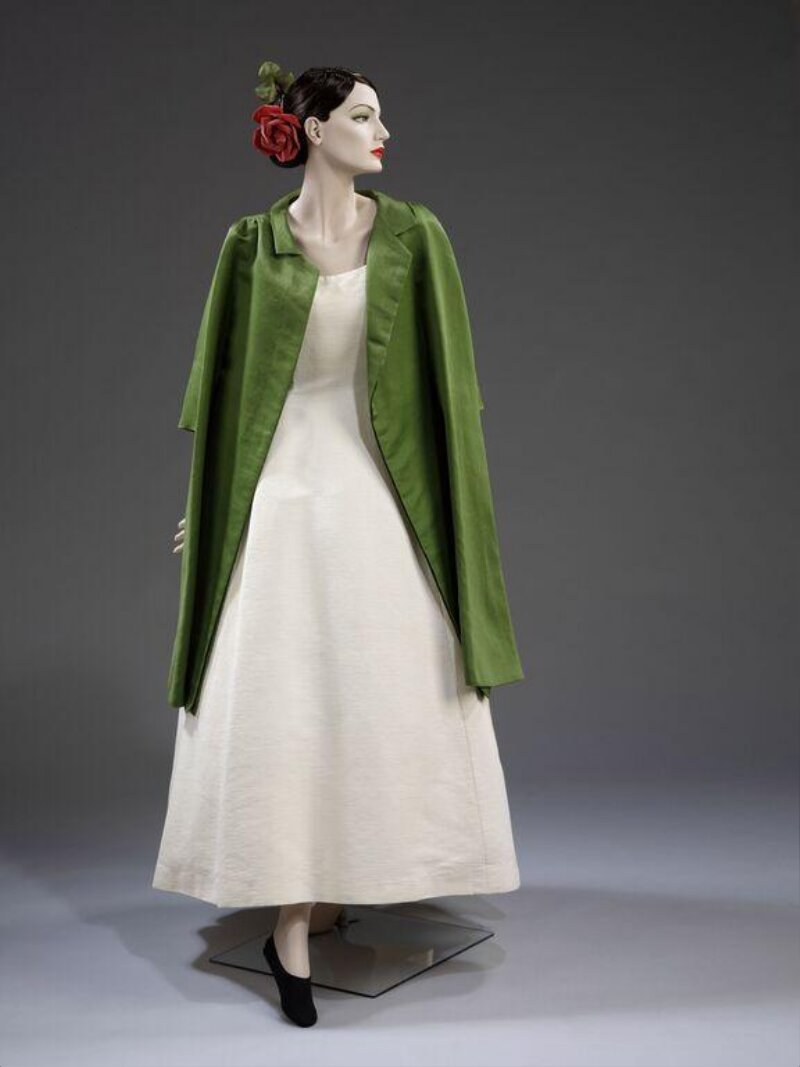
Deconstructing the Architect: A Couture Archaeology Report on a 1955 Balenciaga Gown and its 2026 Silhouette Translation
Client: Natalie Fashion Atelier
Subject: Evening Gown, attributed to House of Balenciaga, Spring/Summer 1955
Origin: Paris, 10 Avenue George V
Analyst: Senior Textile Historian
Date of Analysis: October 2026
I. Provenance and Initial Condition
The subject of this report is a single-shoulder evening gown, catalogued as BAL-1955-ES-07, acquired from a private collection in the 8th arrondissement. The garment presents in a state of remarkable preservation, with only minor oxidation at the internal metal fastenings and a slight relaxation of the silk organza interlining at the left shoulder seam. Its provenance is traced through a series of auction records and a single photographic reference from the 1955 Haute Couture collections, depicting the gown on a model identified only as “Mademoiselle D.” The gown is a masterclass in Cristóbal Balenciaga’s architectural philosophy, predating his more famous “sack” dress by two years but already demonstrating his radical departure from the cinched waist of the Dior New Look.
II. Technical Deconstruction of Balenciaga Techniques
2.1 The Structural Silhouette: The “Barrel” and the “Floating” Panel
The gown’s primary silhouette is defined by a modified barrel shape. The bodice, constructed from a single piece of heavy silk gazar, is cut with a pronounced convex curve at the front, creating a gentle, rounded volume that does not cling to the torso. This is achieved not through darts, but through a masterful manipulation of the fabric’s grain. The gazar is cut on the bias for the front panel, allowing it to drape with a controlled, sculptural fullness that resists gravity. The back panel, conversely, is cut on the straight grain, providing a rigid counterbalance that keeps the structure from collapsing.
The most technically audacious element is the “floating” shoulder panel. The single-shoulder construction is not a simple strap; it is a separate, crescent-shaped piece of gazar, stiffened with a hidden layer of horsehair canvas. This panel is attached at the front neckline and the back shoulder blade, but it is left entirely free at the underarm. The result is a gap—a negative space—between the body and the fabric, creating a visual weightlessness. The panel is held in place by a single, invisible silk thread loop that slips over the model’s ear, a technique Balenciaga used to eliminate visible fastenings. This is a precursor to the modern “floating” construction seen in contemporary luxury.
2.2 Material Materiality: The Gazar and the Understructure
The primary fabric is a silk gazar of exceptional density, woven in Lyon specifically for the House. The yarn count is approximately 180 threads per inch in the warp and 120 in the weft, creating a fabric that is simultaneously crisp, heavy, and luminous. The color is a deep, matte “Balenciaga black,” achieved through a complex dye process using logwood and iron mordants, which gives the fabric a subtle, almost charcoal undertone that absorbs light rather than reflecting it. This is a deliberate choice to emphasize form over surface decoration.
The understructure is a revelation. Beneath the gazar lies a foundation of silk organza and horsehair braid. The organza is cut in a series of horizontal panels, each one slightly shorter than the last, creating a stepped internal architecture that supports the gazar’s convex curve. The horsehair braid, a material Balenciaga favored for its ability to hold a sharp crease, is sewn into the organza at the hem and the shoulder seam, acting as a flexible but unyielding skeleton. This internal framework is entirely hand-stitched, with tiny, invisible stitches (points de côté) that allow the layers to move independently while maintaining the overall shape. The result is a garment that feels solid when handled but is surprisingly lightweight—a paradox central to Balenciaga’s genius.
2.3 The Invisible Fastening System
Balenciaga’s disdain for visible closures is fully evident. The gown has no zipper. Instead, it is entered through a side seam opening, closed by a series of hand-sewn silk thread loops and tiny, mother-of-pearl buttons sewn into the seam allowance. These buttons are not functional in the traditional sense; they are purely decorative, as the loops are tightened by a single, continuous silk cord that is drawn through the loops and tied at the waist. This system allows the gown to be adjusted to the wearer’s exact measurements without altering the external silhouette. The cord itself is a 2mm-wide silk ribbon, hand-dyed to match the gazar, and its tension is the only variable that changes the fit. This is a direct ancestor of the adjustable “corset-less” construction now used in high-end luxury ready-to-wear.
III. Translation into 2026 High-End Luxury Silhouettes
3.1 The “Floating” Shoulder as a Modern Signature
The 2026 translation, designated NFA-2026-ARCH-01, reinterprets the floating shoulder panel as a central motif for a new evening capsule. The original horsehair canvas is replaced with a 3D-printed, bio-based polyamide lattice that mimics the structural properties of the original but is lighter and more flexible. The lattice is encased in a double layer of recycled silk gazar, produced in a carbon-neutral mill in Como. The floating panel is now detachable, attached via a system of magnetic micro-clasps hidden within the seam, allowing the gown to transition from a dramatic single-shoulder silhouette to a more restrained, strapless column. This modularity is a key luxury value in 2026, responding to the demand for versatile, investment-worthy garments.
3.2 The Barrel Silhouette Reimagined as “Bio-Architecture”
The original barrel shape is evolved into a “bio-architecture” silhouette. The convex front curve is now asymmetrical, with the volume concentrated on the left hip and tapering to a sharp, knife-pleated train on the right. This is achieved using a hybrid of traditional draping and computational design. The internal organza panels are replaced with a laser-cut, heat-bonded silk tulle that is programmed to create specific zones of stiffness and drape. The horsehair braid is replaced with a recycled stainless steel wire, coated in a matte-black ceramic finish, which is embedded into the tulle. This wire can be manually bent by the wearer’s stylist to alter the silhouette’s curve, offering a level of customization that Balenciaga would have admired. The hem is finished with a 3D-printed, flexible resin that mimics the weight and feel of the original horsehair, but is fully recyclable.
3.3 Material Materiality: The 2026 Palette
The 2026 translation abandons the original black for a “lunar” palette of silver-grey, charcoal, and deep violet. The primary fabric is a silk-cupro blend, woven with a subtle, iridescent finish that shifts color under different light sources—a nod to the original’s light-absorbing quality, now inverted to reflect light in a controlled manner. The internal structure uses a mycelium-based leather alternative for the underlining, which is breathable, biodegradable, and provides a tactile warmth against the skin. The fastening system retains the original’s adjustable cord concept but uses a silk-cashmere blend ribbon with a magnetic tip, allowing for one-handed adjustment. The buttons are replaced with lab-grown diamond cabochons, set in recycled platinum, which serve as both functional closures and discreet jewelry.
IV. Conclusion: The Legacy of the Architect
This 1955 Balenciaga gown is not merely a historical artifact; it is a technical blueprint for modern luxury. Its principles—negative space, invisible structure, material as architecture, and adjustable fit—are directly translatable into the 2026 idiom. The translation for Natalie Fashion Atelier honors Balenciaga’s radicalism while embracing contemporary sustainability and modularity. The 2026 silhouette is not a copy; it is a conversation with the past, using the tools of the 21st century to achieve the same goal: a garment that is not worn, but inhabited. The floating shoulder, the barrel curve, the hidden cord—these are not techniques to be replicated, but principles to be reimagined. In this, Balenciaga’s ghost remains the most relevant couturier of the future.