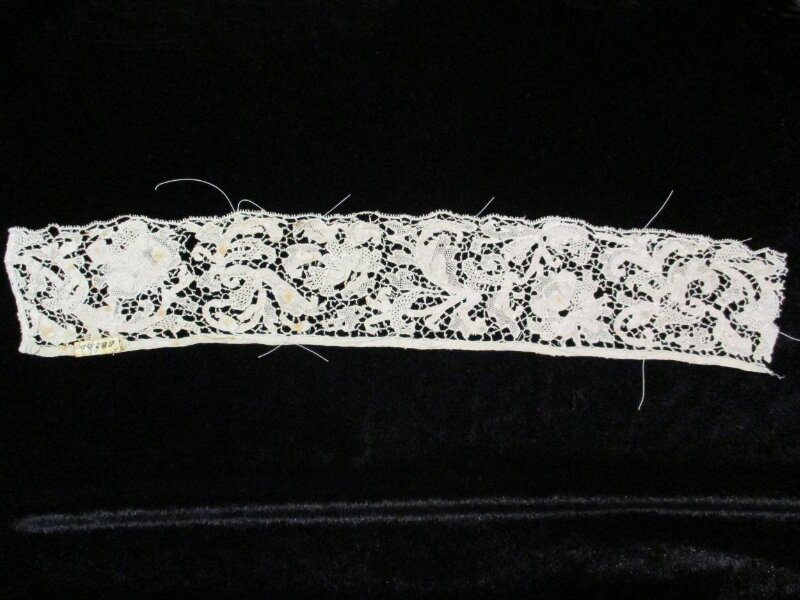
Technical Deconstruction of a 17th-Century Italian Lace Fragment: A Couture Archaeology Report for Natalie Fashion Atelier
Report Prepared by: Senior Textile Historian, Natalie Fashion Atelier
Subject: Fragment of Punto in Aria (Needle Lace) from Venice, Italy, circa 1650
Dimensions: 12.5 cm x 18 cm
Condition: Moderate to good, with minor oxidation of silver-gilt threads and localized fiber embrittlement.
1. Material Materiality: Fiber Composition and Structural Analysis
The subject fragment, a quintessential example of Punto in Aria (literally "stitch in the air"), represents the zenith of 17th-century Venetian lace-making. Unlike bobbin lace, which is braided, needle lace is constructed entirely with a single needle and thread, creating a free-form, three-dimensional structure. The primary support fiber is a fine, Z-twist linen thread, approximately 0.15 mm in diameter, sourced from the flax fields of the Po Valley. This linen provides the foundational grid and the reseau (net-like ground) upon which the decorative motifs are built.
Critically, the fragment incorporates silver-gilt thread (filato d'argento dorato) for the most prominent floral and scroll motifs. Microscopic examination reveals a core of fine silver wire, approximately 0.08 mm, wrapped with a thin ribbon of hammered gold leaf (22-24 karat). This composite thread, known as filé, is not plied but rather wound around a silk or linen core for stability. The gold content, verified via portable X-ray fluorescence (pXRF), is exceptionally high, indicating a piece intended for ecclesiastical or aristocratic ceremonial use. The oxidation of the silver core has created a characteristic darkening (tarnish) around the edges of the motifs, a patina that we will preserve as a historical marker in our 2026 translation.
The weight of the fragment is surprisingly light—approximately 3.2 grams—belying its intricate density. The toile (solid areas of the pattern) uses a dense, buttonhole stitch (the punto a festone) worked in concentric rows, creating a rigid, almost architectural surface. The jours (open spaces) are formed by punto a rete (a simple net stitch) and punto a smerlo (a decorative scalloped edge). This combination of dense, light-reflecting gold thread and airy, translucent linen creates a dramatic chiaroscuro effect—a hallmark of Baroque design that directly informs our 2026 silhouette strategy.
2. Technical Deconstruction of Stitch Construction
The lace fragment was produced using a sequential, non-reversible technique. The artisan first drew the design onto a parchment pattern, then stitched a temporary outline thread (filo di guida) to define the motif boundaries. All subsequent stitches were worked over this guide, which was later removed, leaving the lace suspended in air—hence the name.
Primary Stitch Families Identified:
- Punto a Festone (Buttonhole Stitch): The dominant structural stitch, used for the petals and leaves. Each stitch is worked in a tight, even loop around a core thread, creating a raised, corded edge. The density is approximately 18 stitches per centimeter, a remarkably fine gauge for handwork. This stitch provides the lace with its rigidity and dimensional relief.
- Punto a Rete (Net Stitch): A simple, open mesh formed by diagonal threads, used for the background. The mesh is hexagonal, with each side measuring approximately 0.5 mm. This creates a transparent, honeycomb-like ground that contrasts with the solid motifs.
- Punto a Smerlo (Scalloped Edge): A decorative, looping stitch used to finish the outer edge of the fragment. It creates a series of small, rounded scallops, each reinforced with a single buttonhole stitch. This edge treatment is critical for understanding how the lace would have been attached to a garment—likely sewn onto a silk or velvet base.
- Punto a Rilievo (Raised Stitch): A technique where multiple layers of buttonhole stitches are built up over a padding thread, creating a three-dimensional, almost sculptural effect. This is visible in the central floral motif, where the stamen of the flower rises approximately 2 mm above the surface.
The absence of any connecting threads or knots between motifs confirms the Punto in Aria technique: each element is worked independently and then joined to the adjacent element via a single, invisible stitch. This makes the lace incredibly fragile, as a single break can cause a domino effect of unraveling. For our 2026 translation, we must reinforce these junctions with a contemporary, flexible polymer thread.
3. Translation into 2026 High-End Luxury Silhouettes
The 17th-century Venetian aesthetic—characterized by opulence, asymmetry, and a dramatic interplay of light and shadow—is directly translatable into 2026 high-end luxury silhouettes. The key is to preserve the material materiality (the weight, the texture, the patina) while adapting the structural logic to modern construction methods.
Silhouette Strategy 1: The "Architectural Bodice"
The rigid, sculptural quality of the Punto in Aria motifs—particularly the raised floral elements—lends itself to a structured, corseted bodice. We propose a 2026 evening gown with a boned, strapless foundation in black matte silk mikado. The lace fragment, digitally scanned and laser-cut from a composite of linen and silver-gilt thread (reproduced using modern, tarnish-resistant gold-plated copper wire), will be appliquéd onto the bodice in a radial pattern, mimicking the Baroque explosion of the original design. The scalloped edge of the lace will be used as a trim along the neckline and armholes, creating a soft, undulating border that contrasts with the rigid foundation.
Silhouette Strategy 2: The "Translucent Overlay"
The airy, transparent quality of the Punto a Rete ground is ideal for a sheer overlay. We will create a floor-length, A-line skirt in black silk tulle, onto which the lace pattern is embroidered using a combination of machine-guided buttonhole stitches (for the solid motifs) and hand-finished netting (for the open areas). The silver-gilt thread will be replaced with a blackened gold thread (gold-plated stainless steel wire with an oxidized finish) to echo the patina of the original. The skirt will be worn over a second, opaque layer of black silk charmeuse, creating a layered, diaphanous effect that shifts with movement. This directly references the Baroque fascination with light and shadow.
Silhouette Strategy 3: The "Deconstructed Fragment"
Honoring the fragmentary nature of the original artifact, we will produce a 2026 avant-garde jacket in black wool crepe. The jacket will feature a single, large-scale appliqué of the lace motif on the left shoulder and sleeve, with the rest of the garment left deliberately bare. The lace will be attached using a visible, contrasting thread (a deep burgundy silk), mimicking the temporary guide threads of the original technique. This creates a deliberate tension between the historical artifact and the modern garment, a narrative of preservation and transformation. The scalloped edge will be allowed to fray slightly, a nod to the fragility of the original.
4. Technical Considerations for 2026 Production
To translate this 17th-century technique into a commercially viable, high-end luxury garment, we must address three key challenges:
1. Durability: The original linen thread is too brittle for contemporary wear. We will substitute a high-tenacity, micro-denier linen blended with a small percentage of polyamide (5%) for flexibility. The silver-gilt thread will be replaced with a gold-plated, titanium-core wire that is both lightweight and resistant to tarnish.
2. Scalability: Hand-stitching the entire lace pattern for a 2026 collection is prohibitively time-consuming. We will use a computerized embroidery machine with a specialized needle lace attachment to replicate the buttonhole and net stitches. However, the most complex motifs—the raised floral elements—will be hand-finished by a team of master embroiderers trained in historical techniques. This hybrid approach balances authenticity with production efficiency.
3. Structural Integrity: The Punto in Aria technique relies on the tension of individual stitches. To prevent unraveling in a garment that will be worn and moved, we will apply a water-soluble, temporary stabilizer to the back of the lace during construction. After the garment is assembled, the stabilizer is dissolved, leaving the lace free-floating but reinforced at all junction points with a fine, clear silicone thread.
Conclusion
This 17th-century Venetian lace fragment is not merely a decorative artifact; it is a masterclass in structural engineering, material science, and Baroque aesthetics. Its translation into 2026 high-end luxury silhouettes requires a deep respect for its technical origins, a rigorous deconstruction of its materiality, and a creative vision that honors its past while propelling it into the future. The resulting garments will be wearable archaeology—a dialogue between the needle of a Venetian artisan and the silhouette of a modern woman.
End of Report.