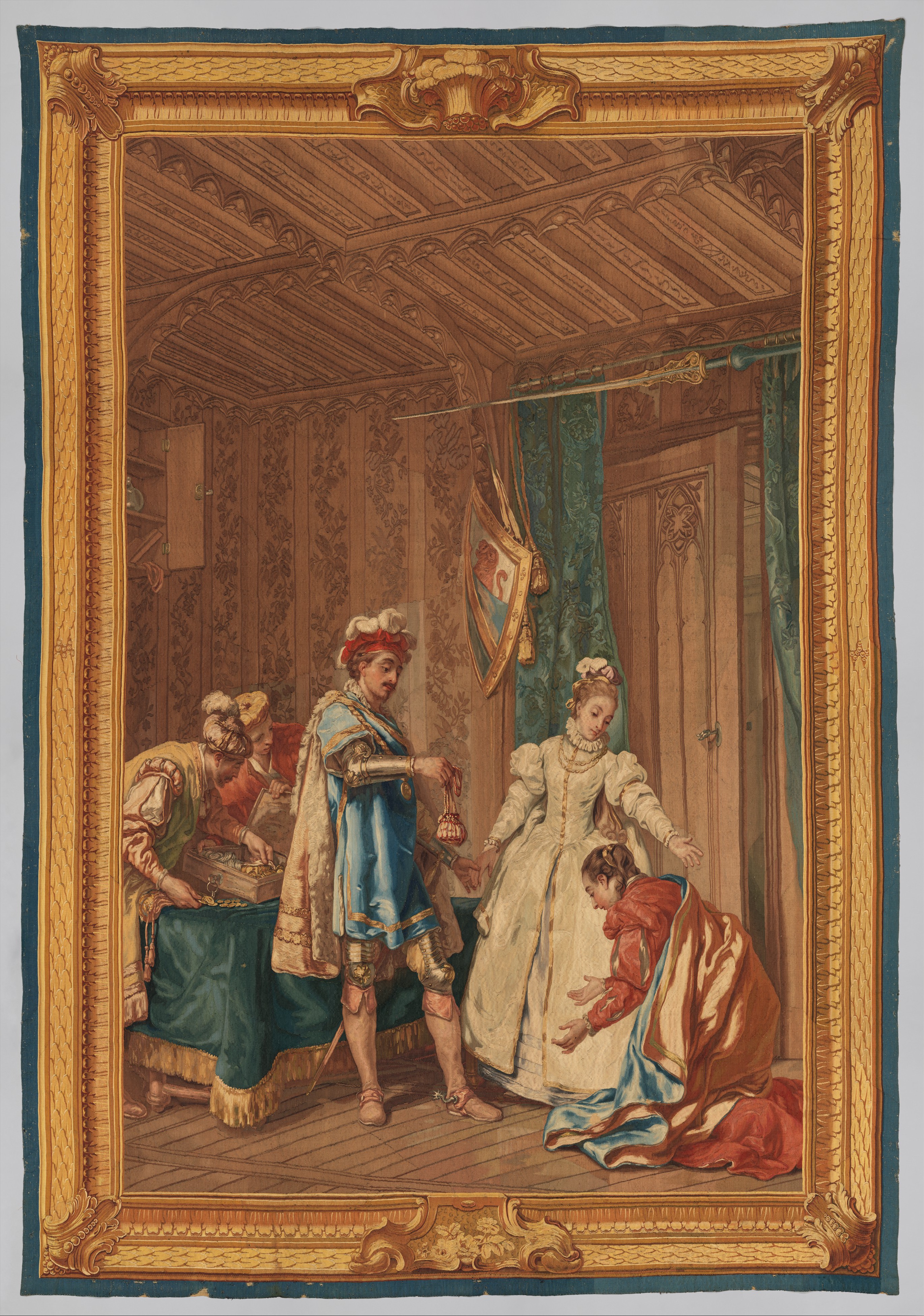
Deconstructing Chivalric Lineage: The Continence of Bayard as a Blueprint for 2026 Haute Couture Silhouettes
Archive Context: Isolated Aesthetic Archaeology
The artifact in question—The Continence of Bayard, from the tapestry series The History of France—presents a singular opportunity for aesthetic archaeology. Removed from its narrative continuum, the piece exists as a frozen fragment of 16th-century French courtly idealism. The scene depicts the legendary knight Pierre Terrail, seigneur de Bayard, demonstrating his celebrated restraint and honor. However, for the purposes of this research, the narrative is secondary to the structural grammar of the composition. The tapestry’s static, vertical registers, the precise drape of wool and silk, and the deliberate tension between armor and fabric provide a lexicon of classical elegance that is both rigid and fluid. This isolated viewing allows us to extract pure formal principles—balance, verticality, and the interplay of opulence and austerity—without the noise of historical context. These principles, when transposed into 2026 haute couture, inform a silhouette that is at once chivalric and avant-garde.
Materiality: The Dialectic of Wool and Silk (22-23 Warps per Inch)
The specific materiality of the tapestry is the cornerstone of this deconstruction. The warp count of 22-23 threads per inch (9-10 per cm.) is not a mere technical specification; it is a structural decision that governs the entire aesthetic. This high-density weave, typical of the finest Flemish and French ateliers of the period, creates a fabric with exceptional dimensional stability and a distinct, almost architectural hand. The wool, with its matte, absorbent quality, provides the foundation—a visual and tactile ground of sobriety and strength. The silk, woven in as weft highlights, introduces a lustrous, directional surface that catches light in a manner that is both subtle and deliberate. This dialectic between the matte and the sheen, the soft and the structured, is the key to the 2026 silhouette.
For the modern atelier, this materiality translates into a fabric that demands precision in construction. The high warp count prevents significant bias stretch, forcing the designer to work with the fabric’s inherent verticality. This is not a material for soft, draped jersey; it is a material for sculptural forms, tailored panels, and sharp, clean seams. The 22-23 warp count creates a surface that is resistant to puckering, allowing for intricate topstitching and structural boning to be integrated directly into the garment’s shell, rather than relying on internal linings. The wool provides the body, the silk provides the soul. In 2026, this translates to a silhouette that is defined by its architecture, not by its softness.
Deconstructing Classical Elegance: The Vertical Imperative
The classical elegance of The Continence of Bayard is not found in ornamentation, but in the rigorous organization of vertical space. The figures are arranged in a frieze-like composition, their elongated proportions emphasized by the narrow, vertical format of the tapestry itself. The armor of Bayard is rendered as a series of faceted, metallic planes, while the silk robes of the courtiers fall in heavy, unbroken columns of color. This is a visual language of restraint and hierarchy, where every line serves to elongate and define the human form. The elegance is derived from the absence of superfluous curvature; the body is presented as a vertical axis, clad in a second skin of structured fabric.
To deconstruct this for 2026, we must extract the principle of the vertical panel. The tapestry’s warp threads are a literal representation of this. The 2026 silhouette will be defined by long, uninterrupted lines that run from shoulder to hem, or from waist to floor. These are not simple A-line or column dresses; they are segmented vertical blocks, each panel cut on the straight grain to maximize the fabric’s structural integrity. The seams become architectural features, echoing the tapestry’s weft joins. The silhouette is monolithic yet segmented, a series of vertical planes that create a powerful, almost fortress-like presence. The classical elegance is found in the purity of this vertical line, a direct homage to the tapestry’s compositional grammar.
Informing the 2026 Silhouette: The Armored Silhouette and the Fluid Column
From this deconstruction, two distinct yet interrelated silhouettes emerge for 2026: the Armored Silhouette and the Fluid Column. The Armored Silhouette directly references the metallic, faceted planes of Bayard’s armor, translated into wool and silk. The high warp count allows for sharp, angular shoulder lines, reminiscent of the pauldron, and a defined, corseted waist that is not cinched but structured, using the fabric’s own stiffness. The sleeves are cut as separate, articulated panels, echoing the laminated construction of plate armor. The silk highlights appear as narrow, vertical bands of sheen along the seams, mimicking the polished edges of a blade. This is a silhouette of power and protection, a modern interpretation of chivalric presence. It is not aggressive, but authoritative and grounded.
The Fluid Column, in contrast, draws from the courtiers’ robes. Here, the wool and silk are used to create a continuous, unbroken surface that falls from a precise, architectural shoulder line. The key is the internal structure. The fabric’s density allows for the elimination of darts and complex shaping. The garment is constructed from a series of trapezoidal and rectangular panels, seamed vertically, that create a subtle, controlled flare. The silk weft catches light as the wearer moves, creating a liquid, metallic sheen that animates the otherwise static form. This is not a fluid dress in the traditional sense; it is a moving column, a vertical volume that retains its shape. The elegance lies in the tension between the rigid construction and the fluid movement of the silk highlights.
Technical Application: The 22-23 Warp Count as a Construction Mandate
For the 2026 atelier, the 22-23 warp count is not a suggestion; it is a construction mandate. This fabric requires a rethinking of traditional couture techniques. Seam allowances must be minimal, as the fabric does not easily compress. Pressing must be precise, using steam and weight, not heat and pressure, to set the wool’s memory. The silk weft requires directional cutting; all panels must be laid in the same orientation to ensure a consistent light reflection. The use of horsehair braid and organza interfacings is minimized, as the fabric’s own structure provides the necessary support. Instead, the designer works with exposed seam finishes, using the tapestry’s own logic of warp and weft as a decorative element. The silhouette is born from the material, not imposed upon it.
In conclusion, The Continence of Bayard offers a masterclass in structural elegance. The 2026 haute couture silhouette, informed by this isolated aesthetic archaeology, is one of vertical power, architectural precision, and material honesty. The wool and silk, at 22-23 warps per inch, are not mere fabrics; they are the primary structural components of a new, chivalric modernism. The classical elegance is not replicated, but re-engineered for a new era of discerning, powerful femininity.