The Grecian Bend–Fifth Avenue Style: A Lithographic Archaeology of Posture and Prestige
Archive Context: Isolated Aesthetic Archaeology
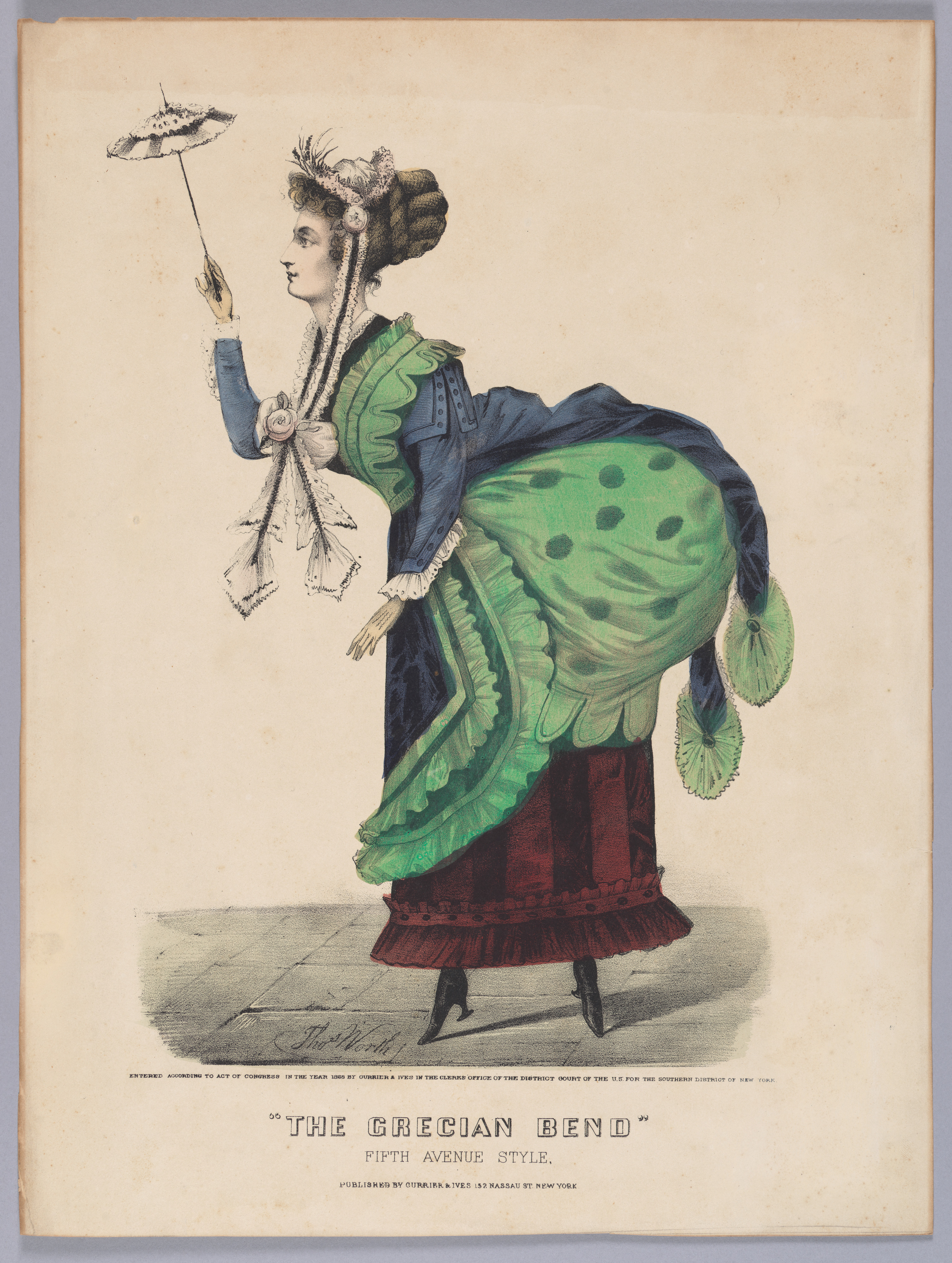
The hand-colored lithograph in question, dated circa 1868, depicts a solitary female figure traversing the cobblestones of Fifth Avenue. She is captured in a moment of arrested motion, her silhouette defined by an extreme forward inclination of the torso—the infamous Grecian Bend. This posture, a deliberate affectation of the upper classes, was not merely a fashion; it was a semiotic gesture of leisure, wealth, and a studied indifference to pedestrian utility. The lithograph, isolated from its original narrative context, becomes a pure artifact of aesthetic archaeology. It offers no surrounding commentary, no moralizing caption. It presents only the line, the fabric, and the stance. For the Natalie Fashion Atelier, this isolation is paramount. It allows us to extract the pure formal principles—the kinetic drape, the architectural tilt, and the asymmetrical weight distribution—that define the silhouette.
Deconstructing Classical Elegance: The Mechanics of the Bend
The Grecian Bend was a complex interplay of corsetry, crinoline, and a newly emerging bustle. The lithograph reveals a figure whose spine curves forward from the hips, while the bust is thrust upward and the head is held high, often with a small hat or bonnet perched forward. This created a pronounced S-curve, a stark departure from the rigid, columnar forms of the previous decade. The fabric of the dress, likely a heavy silk or wool challis, responds to this posture with remarkable fidelity. The skirt, supported by a cage crinoline, falls in a series of deep, vertical folds from the waist, but the forward tilt causes the back of the skirt to lift, revealing the underskirt and the heel of the boot. This is not a static silhouette; it is a dynamic equilibrium.
The hand-coloring technique itself informs our materiality. The subtle washes of indigo and ochre on the lithograph suggest a fabric that shifts in tone depending on the light and the angle of the fold. This is a lesson in chromatic depth and surface tension. The artist’s brushstrokes, applied over the printed line, mimic the way light catches a pleat or a gathered panel. For 2026, this translates into a demand for textiles that possess a variable luminosity—jacquards with a matte-satin contrast, or double-faced wools that reveal a hidden color at the hem.
Informing 2026 High-End Silhouettes: The Fifth Avenue Protocol
The 2026 luxury silhouette, as interpreted by Natalie Fashion Atelier, will not replicate the Grecian Bend as a historical costume. Instead, it will extract its underlying postural code and re-encode it for the contemporary woman. We identify three key architectural principles from the lithograph that directly inform our forthcoming collection, L’Inclinaison.
Principle I: The Forward Apex and the Kinetic Drape
The lithograph’s most striking feature is the forward apex of the torso. In 2026, we translate this not through boning, but through strategic weight distribution. Our design team has developed a series of tailored jackets and coats with a biomimetic shoulder line that subtly shifts the center of gravity forward. The shoulder seam is cut with a 3.5-degree anterior rotation, while the back panel is constructed from a single piece of molded felted cashmere that is heat-set to create a permanent, gentle curve. The fabric, sourced from a historic mill in Biella, Italy, is engineered to hold this shape without internal structure. The drape of the skirt, inspired by the lithograph’s vertical folds, is achieved through a bias-cut gore pattern that is weighted at the hem with a fine, invisible chain. This creates a continuous, fluid line that moves with the wearer, echoing the lithograph’s sense of arrested motion. The kinetic drape is not a static ornament; it is a functional response to the wearer’s posture.
Principle II: Asymmetrical Volume and the Revealed Underskirt
The lithograph’s lifted back skirt, exposing the underskirt and boot, is a masterclass in asymmetrical volume. For 2026, we reinterpret this as a layered hemline with a deliberate imbalance. Our evening gowns will feature a single, deep side slit that begins at the hip, but the fabric is not simply cut away. Instead, a floating panel of silk organza, hand-painted with a gradient of indigo to match the lithograph’s palette, is attached at the waist and allowed to fall freely behind the primary skirt. This creates a secondary silhouette that is only revealed in motion or from a specific angle. The underskirt, in this case, is a secret layer of luxury. The boot, originally a practical item, is elevated to a sculptural accessory. For 2026, we propose a heel that is a negative-space cast of the lithograph’s boot shape, rendered in polished brass and blackened steel, with a single, hand-set cabochon of smoky quartz at the ankle.
Principle III: Chromatic Depth and Hand-Colored Finish
The hand-coloring of the lithograph teaches us that color is not a flat application but a layered event. For 2026, we reject digital printing in favor of artisanal dye techniques. Our atelier will employ a shibori-inspired resist process on silk charmeuse, creating a pattern of undulating lines that mimic the brushstrokes of the lithograph. The primary color—a deep, almost black indigo—is achieved through a 12-day immersion in a natural indigo vat. A second layer of ochre is then applied by hand with a fine sable brush, following the grain of the fabric. The result is a textile that possesses a chromatic depth that shifts with the light, exactly as the lithograph does. This technique is applied to a deconstructed evening coat, cut with the forward apex shoulder and a train that trails behind, echoing the lifted back skirt. The coat is lined in a contrasting vermilion silk, a nod to the lithograph’s hidden details.
Conclusion: The Artifact as Blueprint
The isolated aesthetic archaeology of this hand-colored lithograph provides a rigorous blueprint for the 2026 luxury silhouette. It is not a nostalgic return to the 1860s, but a structural extraction of its most potent formal elements. The Grecian Bend, stripped of its historical context, becomes a pure study in posture, drape, and chromatic depth. For Natalie Fashion Atelier, the Fifth Avenue style of 1868 is not a relic; it is a living language of line and volume. Our L’Inclinaison collection will speak that language with a 21st-century accent, using the finest materials and the most exacting craftsmanship. The result is a silhouette that is both historically informed and radically contemporary, a testament to the enduring power of a single, perfect line.