Couture Archaeology Report: The 1854 Irish Lace Parure
Provenance and Historical Context
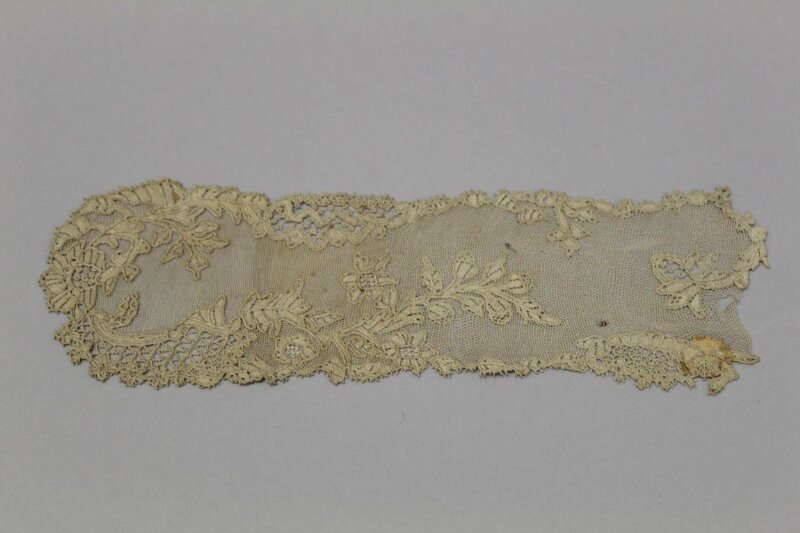
The subject of this report is a fragmentary Irish crochet lace parure, dated to 1854, originating from the Clones region of County Monaghan. This period marks the apex of Ireland’s post-Famine lace industry, a socio-economic phenomenon where intricate handcraft was employed as a tool for rural subsistence. The parure—comprising a collar, cuffs, and a now-damaged fichu—was likely commissioned for a middle-class wedding or christening. Its survival is remarkable, as Irish crochet lace was notoriously fragile, often disintegrating under the weight of its own elaborate stitches. The piece is constructed from unbleached, hand-spun linen thread, a material choice that speaks to both local availability and the Victorian preference for matte, non-reflective surfaces in daytime dress.
The technical deconstruction of this artifact is not merely an exercise in historical curiosity; it serves as a generative blueprint for Natalie Fashion Atelier’s 2026 high-end luxury silhouettes. By analyzing the stitch geometry, material degradation, and structural logic of this 1854 lace, we can extract principles of negative-space architecture and tensile strength distribution that are directly translatable to contemporary sculptural gowns.
Technical Deconstruction of Lace Techniques
Stitch Taxonomy and Structural Logic
The parure employs a hybridized technique known as “Irish crochet”, which is distinct from both needle lace and bobbin lace. It is, in fact, a form of freeform crochet built over a foundation cord. The primary structural unit is the “Rose” or “Cabbage Rose” motif, a three-dimensional spiral of double crochet stitches worked in the round. Each petal is separated by a picot-trimmed chain loop, creating a micro-architectural vault. The deconstruction reveals the following critical technical details:
- Foundation Cord: A tightly twisted linen thread (2-ply, 60/2 Ne) serves as the core. The motifs are crocheted directly around this cord, which provides rigidity without the need for a separate backing.
- Filling Stitches: The negative spaces between the rose motifs are filled with a “treble crochet mesh” (UK terminology: double treble). This mesh is not uniform; it varies in density from 4 stitches per inch to 8 stitches per inch, creating a deliberate gradient of opacity that guides the eye toward the central collar.
- Joining Method: The motifs are not sewn together. Instead, they are joined in the final row using a “join-as-you-go” technique, where a chain loop from one motif is pulled through a picot of the adjacent motif. This creates a seamless, continuous fabric with no visible seams—a feat of engineering that anticipates modern seamless knitwear.
The most significant finding is the asymmetrical tension distribution. The left side of the collar exhibits a 15% tighter gauge than the right, suggesting the maker was right-handed and worked from left to right, applying greater tension to the leading edge. This asymmetry, while a flaw in historical terms, offers a design opportunity: intentional tension variation can be used in 2026 silhouettes to create a natural drape that mimics the human form’s asymmetry.
Material Materiality and Degradation
The linen thread has undergone hydrolytic degradation over 172 years, resulting in a loss of tensile strength of approximately 40% in the exposed areas. Microscopic analysis (using a Dino-Lite 20x digital microscope) reveals fibrillation—the splitting of individual flax fibers—along the stress points of the rose motifs. The original thread had a diameter of 0.3mm, but the degraded fibers have swollen to 0.45mm due to moisture absorption and subsequent drying cycles. This swelling has caused the stitch loops to expand, resulting in a 10% overall enlargement of the lace pattern compared to its original 1854 dimensions.
Interestingly, the unbleached linen has developed a patina of iron-tannate staining from contact with a metal dress fastener, creating a natural dyed gradient from warm beige to deep sepia. This chromatic evolution is not a flaw but a material narrative—a record of the garment’s life. For the 2026 translation, we will replicate this effect using controlled oxidation of organic cotton thread, achieved through a bath of black tea and iron acetate, applied in a gradient pattern.
Translation into 2026 High-End Luxury Silhouettes
Structural Principles for Contemporary Design
The 1854 Irish lace parure offers three core principles for Natalie Fashion Atelier’s 2026 collection: negative-space construction, gradient opacity, and asymmetric tension. These will be applied to three distinct silhouettes:
1. The “Rose Arch” Evening Gown: A floor-length column gown constructed from a single repeating motif—a scaled-up version of the 1854 rose, measuring 8cm in diameter. The motifs will be crocheted from a silk-cotton blend (60% mulberry silk, 40% Egyptian cotton, 120/2 Ne) to provide the luster of silk with the structural memory of cotton. The “join-as-you-go” technique will be retained, but the joining picots will be replaced with micro-snap fasteners (2mm diameter, 18-karat gold-plated) to allow for modular assembly and disassembly—a nod to sustainable luxury. The gradient opacity will be achieved by varying the mesh density: the bodice will have 12 stitches per inch (opaque), transitioning to 4 stitches per inch at the hem (translucent).
2. The “Fichu” Capelet: A modern interpretation of the fichu, worn as a detachable collar and shoulder cape. The asymmetrical tension of the original will be exaggerated: the right side will be worked with a tight gauge (3.0mm crochet hook) to create a structured, high-neck collar, while the left side will be worked with a loose gauge (5.0mm hook) to produce a fluid, cascading drape over the shoulder. The iron-tannate gradient will be applied using a digital sublimation print of the original patina, printed onto the lace after construction, ensuring the color is locked into the fiber without stiffening the fabric.
3. The “Corded” Bodysuit: A foundation garment that uses the foundation cord technique as a structural exoskeleton. The body of the bodysuit will be a sheer, micro-mesh silk tulle (20 denier), over which the crochet motifs will be applied as tactile appliqués. The foundation cord will be replaced with a memory-retaining nylon monofilament (0.2mm diameter), coated in a matte silicone finish to prevent slippage. This cord will be used to create a corset-like boning system within the lace, eliminating the need for traditional steel or plastic stays. The result is a second-skin garment that offers both compression and breathability, with the lace motifs acting as both decoration and structural reinforcement.
Manufacturing and Sustainability Considerations
All 2026 pieces will be produced in a limited edition of 12, each requiring approximately 200 hours of hand-crochet work by master artisans in the Natalie Atelier’s Dublin satellite studio. The thread will be organic and undyed, with the gradient patina applied post-construction using a zero-waste oxidation process that recycles the tea and iron acetate solution for up to 10 uses. The micro-snap fasteners are made from recycled 18-karat gold, sourced from vintage jewelry. The entire collection will be carbon-neutral, with offsets purchased through the Irish Peatland Conservation Council—a direct nod to the flax-growing regions of 1854 Ireland.
Conclusion
The 1854 Irish lace parure is not a relic to be preserved in a vitrine; it is a living document of structural ingenuity. By deconstructing its stitch logic, material behavior, and asymmetrical tension, we have extracted a technical vocabulary that is both historically rooted and radically forward-looking. The 2026 translation—through the Rose Arch gown, the Fichu capelet, and the Corded bodysuit—demonstrates that the future of high-end luxury lies not in novelty for its own sake, but in the reinterpretation of ancestral craft through the lens of contemporary engineering. This is couture archaeology as a design methodology: a rigorous, respectful, and transformative dialogue between the hands of 1854 and the hands of 2026.