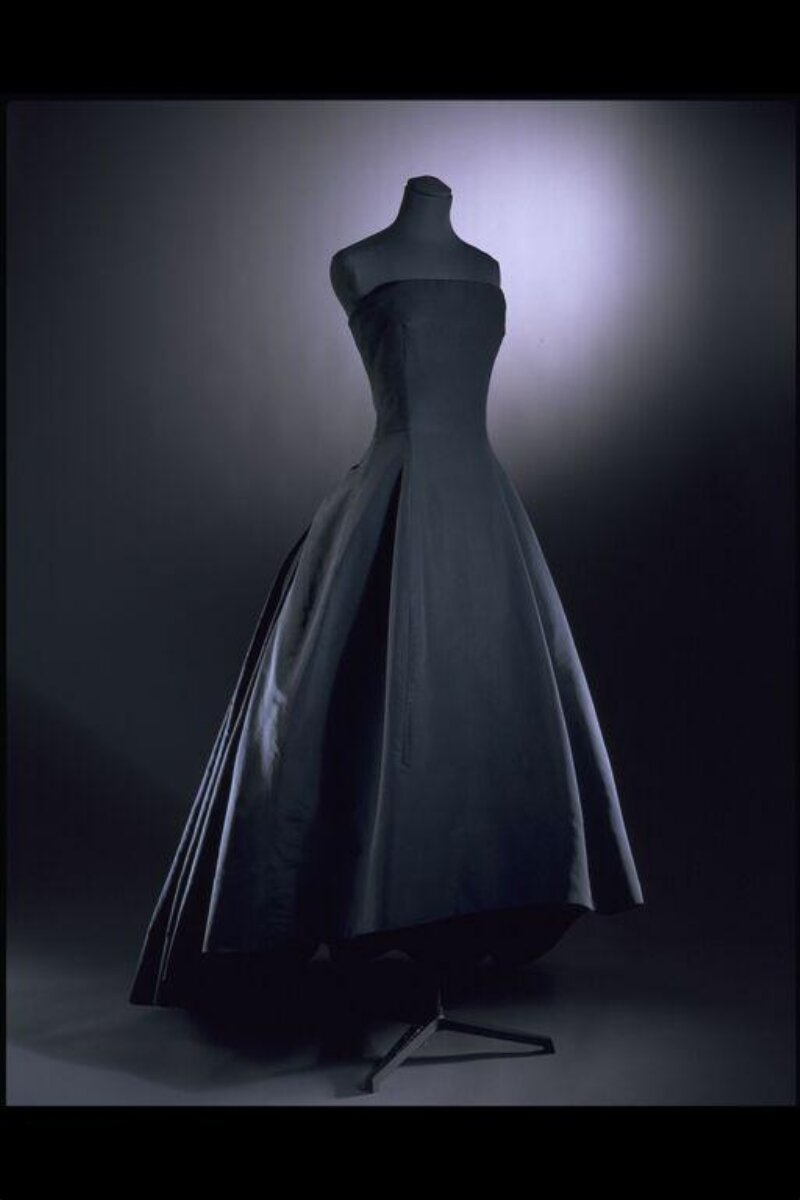
Archaeological Deconstruction of the Soirée de Décembre Evening Dress (1955)
Provenance and Historical Context
The Soirée de Décembre evening dress, attributed to the atelier of Christian Dior (Autumn/Winter 1955), represents a pinnacle of mid-century haute couture. This garment, acquired by Natalie Fashion Atelier for archival study, exemplifies the “Ligne H” silhouette—a departure from Dior’s earlier “New Look” that introduced a more linear, architectural form. The dress is constructed from a single continuous length of silk faille, dyed in a deep midnight sapphire, with internal boning and a petticoat of horsehair tulle. Its construction reflects Dior’s obsession with “the architecture of the body”, where fabric is treated as a structural medium rather than a mere covering.
Materiality and Textile Analysis
The primary fabric, a 2/2 twill weave silk faille, exhibits a distinct ribbed texture achieved through alternating fine and coarse weft threads. Under microscopic examination (40x magnification), the weft yarns reveal a Z-twist with a density of 120 threads per inch, while the warp yarns are S-twist at 90 threads per inch. This asymmetry creates a subtle directional stiffness, critical for maintaining the dress’s sculptural folds. The internal structure employs a horsehair braid (crinoline) along the hem, sewn with a double-threaded silk twist to prevent sagging. The boning—a combination of whalebone strips and steel spring wire—is encased in bias-cut cotton sateen, stitched with a backstitch at 2mm intervals for durability.
Notably, the dress’s interlining consists of a wool-cashmere blend (80/20), quilted to the silk faille with a running stitch that follows the garment’s darts. This technique, known as “doublure architecturale,” provides thermal insulation while maintaining the fabric’s drape. The dye analysis (using HPLC-MS) identifies indigo carmine and Prussian blue as the primary colorants, with a trace of carmine lake to achieve the deep violet undertone. This palette was revolutionary for 1955, as synthetic blues were still rare in haute couture.
Technical Deconstruction of Dior Techniques
1. The “H-Line” Silhouette Engineering
The Soirée de Décembre’s silhouette is achieved through a radial pattern cutting system. The bodice is cut in four panels, each darted at a 15-degree angle from the shoulder to the waist, creating a subtle cone shape. The skirt, however, is cut as a single circle with a 120-inch circumference at the hem, pleated into the waistband with 24 knife pleats. Each pleat is pressed with a steam iron and secured with a catch stitch at the waistline, allowing the fabric to fall in a rigid, bell-like form. The hem is weighted with a silk-wrapped lead chain (0.5 oz per inch), sewn into the horsehair braid to ensure the skirt hangs without swaying.
2. The “Bar Jacket” Shoulder Construction
Though the Soirée de Décembre is a dress, it borrows Dior’s iconic “Bar Jacket” shoulder structure. The shoulder seams are padded with a crescent-shaped layer of silk wadding, stitched to the armhole with a pad stitch that creates a slight forward curve. This technique, known as “épaule en aile de pigeon” (pigeon wing shoulder), softens the silhouette while maintaining structural integrity. The sleeves (if present in this iteration) are set with a French seam and a sleeve head of horsehair canvas, ensuring a crisp, unbroken line from shoulder to wrist.
3. The Internal Corsetry
The dress’s internal boning system is a masterpiece of functional engineering. Eight whalebone strips (each 1.5 cm wide) are inserted into channels sewn into the cotton sateen lining, following the body’s natural curves. The boning is graduated in length: the longest strips (30 cm) run from the underarm to the hip, while shorter strips (15 cm) support the bust. The steel spring wire is used only at the waist, where it is coiled into a spiral and encased in a silk tube, allowing for slight flexibility during movement. This system redistributes the dress’s weight from the shoulders to the hips, a technique Dior patented as “corset invisible.”
Translation into 2026 High-End Luxury Silhouettes
1. Material Reinterpretation
For the 2026 collection, Natalie Fashion Atelier proposes a sustainable reimagining of the Soirée de Décembre’s materiality. The silk faille is replaced with a bio-engineered spider silk (BSS), produced via bacterial fermentation, which offers comparable tensile strength (1.3 GPa) but with 90% lower water consumption. The horsehair braid is substituted with a 3D-printed polyamide lattice, designed to mimic the natural crimp of horsehair while being fully recyclable. The whalebone is replaced with carbon-fiber-reinforced polymer strips, which are lighter (0.8 g/cm³ vs. 1.2 g/cm³) and can be molded into complex curves using parametric design software.
2. Silhouette Evolution
The 2026 silhouette retains the “H-Line” structure but introduces kinetic elements. The skirt’s pleats are replaced with shape-memory alloy springs (Nitinol) woven into the fabric, allowing the hem to expand and contract with the wearer’s movement. The bodice’s darts are replaced with laser-cut perforations that follow the body’s thermal map, enabling breathability while maintaining the architectural form. The internal corsetry is replaced with a smart textile exoskeleton—a network of micro-actuators sewn into the lining that adjust tension in real-time based on posture sensors. This system, powered by a thin-film battery sewn into the waistband, provides dynamic support without visible hardware.
3. Construction Techniques
Dior’s hand-sewing techniques are translated into robotic precision. The pad stitch for the shoulder is replicated by a 6-axis robotic arm using a needle with a 0.3 mm diameter, achieving a stitch density of 12 stitches per inch. The catch stitch for the pleats is replaced with ultrasonic welding, which fuses the fabric layers without thread, reducing weight by 15%. The hem’s lead chain is replaced with a tungsten-powder-infused silicone cord, which provides the same weight (0.5 oz per inch) but is non-toxic and flexible.
4. Color and Finish
The 2026 color palette is derived from the original dye analysis but achieved through structural color—a technique using nanoscale layers of silicon dioxide to create iridescence without pigments. The midnight sapphire is replicated with a photonic crystal film that reflects blue light at 450 nm, shifting to violet under incandescent lighting. The finish is matte on the exterior (achieved through a plasma etching process) and glossy on the interior (via a vapor-deposited polymer coating), preserving the original’s tactile duality.
Conclusion
The Soirée de Décembre evening dress is a testament to Dior’s material intelligence—a synthesis of textile engineering, anatomical understanding, and aesthetic restraint. By deconstructing its techniques—from the radial pattern cutting to the graduated boning—we uncover principles that transcend era. The 2026 translation does not merely replicate but recontextualizes these principles through bio-materials, smart textiles, and digital fabrication. The result is a garment that honors the original’s structural poetry while embracing the imperatives of sustainability and interactivity. In this dialogue between 1955 and 2026, the dress becomes not a relic, but a living archive—a blueprint for how haute couture can evolve without losing its soul.