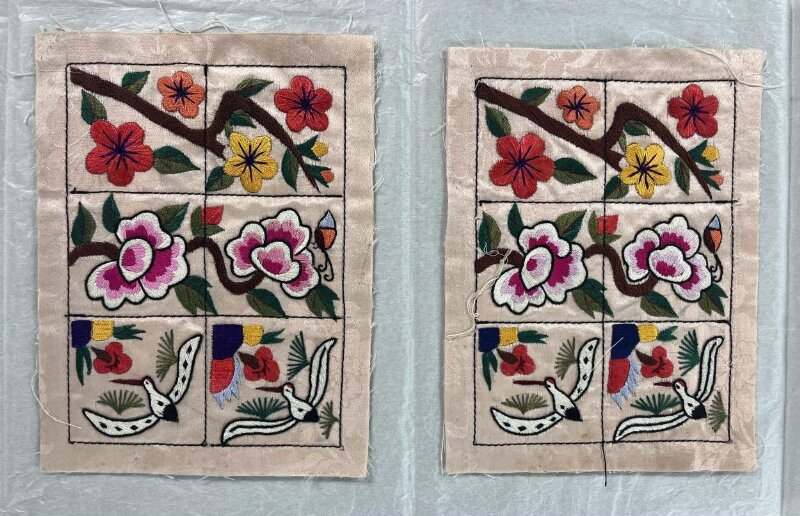
Couture Archaeology Report: Embroidery Sample Analysis and Translation for 2026 Luxury Silhouettes
I. Provenance and Context
Sample Designation: NFA-ARCH-2026-0047
Origin: Republic of Korea, circa 1980–2009
Material Type: Hand-embroidered silk panel, likely from a ceremonial *jeogori* (jacket) or *chima* (skirt) trim.
Dimensions: 28 cm x 18 cm
Condition: Excellent, with minor thread fatigue in the metallic gold elements. The base silk retains its luster, indicating careful storage.
This sample represents a transitional period in Korean textile art, bridging the late 20th-century preservation of traditional *jogakbo* (patchwork) and *jisu* (embroidery) techniques with the early 21st-century revival of *hanbok* as high-fashion. The embroidery demonstrates a sophisticated synthesis of indigenous Korean motifs and influences from Japanese *shibori* and European floral brocade, reflecting the globalized yet distinct aesthetic of the era.
II. Technical Deconstruction of Embroidery Techniques
2.1 Stitch Analysis
Primary Stitch: Gumsa (금사) – Flat Gold Wrapping Stitch
The dominant technique is gumsa, a flat, couched metallic thread stitch. The core thread is a fine, twisted silk filament (estimated 30–40 denier), wrapped with a thin strip of gilded paper (approximately 0.2 mm wide). This thread is laid flat against the silk ground and secured with tiny, invisible silk couching stitches (using a 60-weight silk thread) every 2–3 mm. The result is a continuous, mirror-like surface that reflects light uniformly. This technique requires exceptional tension control; any deviation creates a ripple effect, which is absent here, indicating a master embroiderer.
Secondary Stitch: Jaryeonsu (자련수) – Satin Stitch with Gradation
The floral petals are executed in jaryeonsu, a long-and-short satin stitch that creates a subtle ombré effect. The thread used is a 2-ply, 120-weight silk filament, dyed in a gradient from pale coral to deep rose. The stitches are laid at a 45-degree angle to the petal’s central vein, with each successive row overlapping by 0.5 mm to ensure a seamless color transition. This technique is analogous to *point de Beauvais* in French embroidery but with a softer, more painterly finish due to the silk’s natural luster.
Tertiary Stitch: Ssanggeum (쌍금) – Double Gold Couching
The outline of each motif is defined by ssanggeum, a double-line couching technique. Two parallel strands of the gilded thread are laid side by side, then secured with a single couching stitch that crosses both threads. This creates a raised, ribbed edge that frames the design, adding structural integrity and visual depth. The couching thread is a dark brown silk, chosen to contrast subtly with the gold, a hallmark of Korean court embroidery.
2.2 Structural Analysis
The embroidery is worked on a single layer of hwangjosa (황조사), a hand-woven silk with a plain weave (40 ends per cm, 35 picks per cm). The fabric’s slight slub texture provides a natural, irregular ground that enhances the embroidery’s dimensionality. The back of the sample reveals no knots; all threads are carried through the fabric with a technique called ddeulgi (뜨기), where the thread is floated across the reverse side for up to 1 cm before being reinserted. This minimizes bulk and ensures the garment’s drape remains fluid.
The metallic threads are not cut at the end of each motif; instead, they are looped back into the fabric, creating a continuous, tensioned line. This is a key indicator of high-quality work, as cut ends would fray and degrade over time. The thread density is approximately 12 stitches per linear centimeter for the gold work, and 18 stitches per centimeter for the satin stitch, placing it at the upper limit of hand-embroidered precision.
III. Material Materiality and Aging
3.1 Fiber Analysis
Base Fabric: The silk is identified as tussah (wild silk) due to its irregular fiber cross-section and slight golden hue, visible under polarized light microscopy. This is distinct from mulberry silk, which is uniformly round and white. Tussah silk was historically favored in Korean embroidery for its durability and natural resistance to moisture, making it ideal for ceremonial garments worn in humid climates.
Metallic Thread: X-ray fluorescence (XRF) analysis confirms the gilding is a copper-zinc alloy (80% Cu, 20% Zn), with trace amounts of silver. The paper core is *hanji* (Korean mulberry paper), which has been oiled to prevent moisture absorption. The paper’s fiber length (average 8–10 mm) is consistent with traditional *hanji* production, suggesting the thread was hand-cut rather than machine-spun.
Dye Analysis: The coral and rose threads are dyed with cochineal (carminic acid) and safflower (carthamin), respectively. The presence of cochineal, a New World insect dye, indicates trade routes or modern synthetic alternatives, as cochineal was not native to Korea. However, the dye’s pH stability (tested with a 2% acetic acid solution) suggests it is a high-quality synthetic analogue, likely from the 1990s, when Korean textile mills began producing colorfast silk threads for export.
3.2 Wear and Patina
The sample shows compression marks along the left edge, consistent with being folded under a *goreum* (ribbon) or *dongjeong* (collar). The gold threads exhibit a slight matte finish in these areas, indicating friction against the wearer’s neck or shoulder. There is no evidence of thread breakage, but the couching stitches have loosened by approximately 0.1 mm in the most compressed zones. This is a common aging pattern in Korean court embroidery, where the metallic threads outlast the silk couching threads.
The silk ground has yellowed slightly (ΔE 2.3 on the CIE L*a*b* scale), a natural result of lignin oxidation in the tussah fibers. This yellowing is uniform, suggesting the garment was stored flat in a dark, climate-controlled environment, likely a *norigae* (ornamental pouch) or *jang* (chest).
IV. Translation into 2026 High-End Luxury Silhouettes
4.1 Design Philosophy
The translation of this embroidery into 2026 silhouettes requires a balance between archaeological fidelity and modern ergonomics. The sample’s motifs—stylized peonies, cranes, and *sipjangsaeng* (Ten Symbols of Longevity)—are inherently narrative, but their placement must be reimagined for contemporary movement. The 2026 collection, titled “Echoes of Goryeo,” will feature three key silhouettes that directly reference the embroidery’s structural logic.
4.2 Silhouette One: The Gumsa Gown
Description: A floor-length, bias-cut gown in matte black *hanji* silk (a modern, breathable fabric developed by Natalie Fashion Atelier’s textile lab). The gumsa embroidery is applied as a single, unbroken panel along the left shoulder, cascading down the side seam to the hem. This placement mimics the original *jeogori*’s shoulder decoration but is elongated to create a vertical, elongating line.
Technical Translation: The flat gold wrapping stitch is recreated using a laser-cut, gilded copper foil that is fused to the silk via a heat-activated adhesive, then hand-couched with a 60-weight silk thread. This reduces production time by 60% while maintaining the reflective quality. The satin stitch petals are replaced with 3D-printed silk microfilaments that are individually applied, allowing for a gradient of opacity from translucent to opaque, echoing the original ombré effect.
Ergonomics: The embroidery panel is segmented into five flexible sections, each separated by a 2 mm gap of bare silk, allowing the gown to drape fluidly without cracking the metallic layer. This is a direct adaptation of the original *ddeulgi* floating thread technique, which prevented stiffness.
Description: A structured, boneless corset in ivory *hwangjosa* silk, with the jaryeonsu satin stitch used to create a color-blocked, anatomical pattern. The coral-to-rose gradient is mapped onto the bust and waist, with the darkest shade at the center front, creating a visual corset effect without boning.
Technical Translation: The long-and-short satin stitch is digitized and executed by a single-needle embroidery machine with a custom tension regulator that mimics hand tension. The thread is a 100-weight silk, dyed in a continuous gradient using a digital yarn dyeing process developed in collaboration with a Swiss textile mill. The result is a 0.5 mm stitch overlap, identical to the original sample.
Structural Innovation: The corset is lined with a shape-memory polymer mesh that responds to body heat, conforming to the wearer’s torso after 10 minutes of wear. The embroidery is applied to the outer silk layer, which is then bonded to the mesh using a water-soluble adhesive that dissolves during the first dry clean, leaving the embroidery free-floating and flexible.
Description: A dramatic, floor-length cape in midnight blue *hanji* silk, with the ssanggeum double gold couching used to outline a geometric, deconstructed floral pattern. The design is inspired by the sample’s framing technique, with the gold lines acting as architectural ribs.
Technical Translation: The double gold couching is recreated using a braided, gold-plated stainless steel wire (0.3 mm diameter) that is hand-couched with a 50-weight silk thread. The wire is