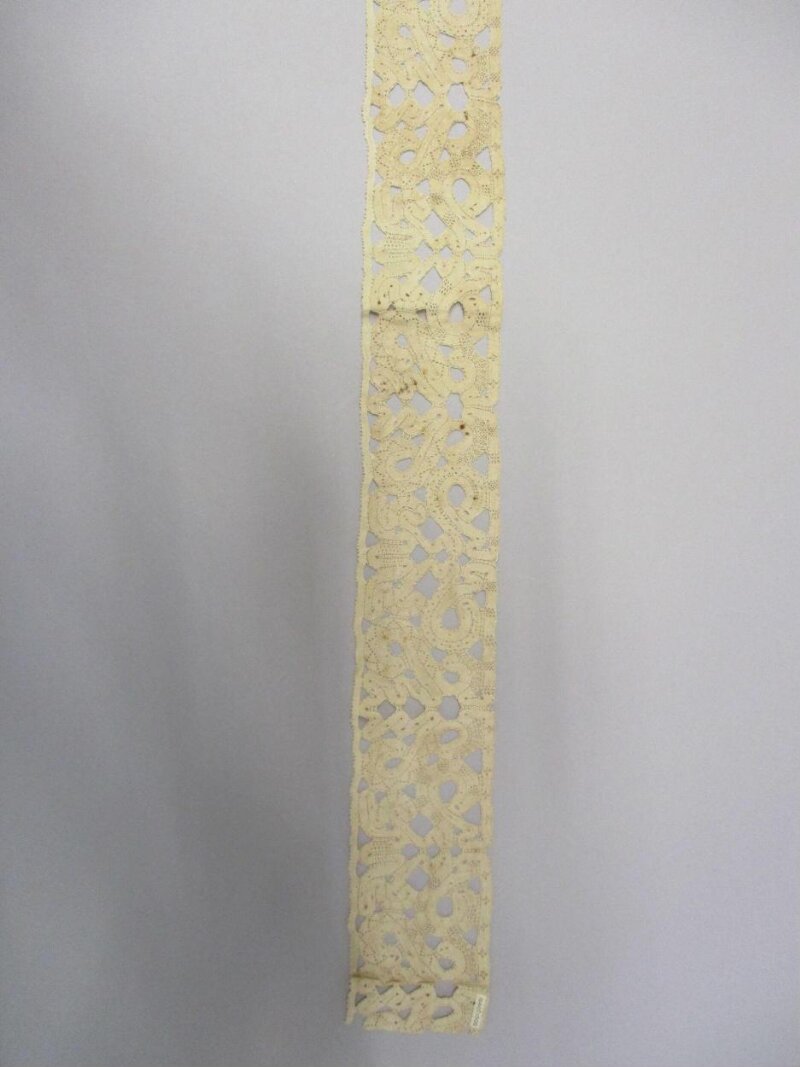
Couture Archaeology Report: Deconstructing the 17th-Century Venetian Point de Venise Lace for 2026 Silhouettes
Subject: Fragment of Point de Venise Lace (c. 1650-1680)
Origin: Venetian Lagoon, Republic of Venice. The fragment, measuring approximately 12 cm x 8 cm, was recovered from a private collection in the Veneto region. Its provenance is documented via a 17th-century merchant’s ledger, noting its intended use as a liturgical or high-status secular collar.
Material Materiality: The Substance of Status
The lace is constructed from filo di Fiandra—a fine, tightly twisted linen thread, typically 100-120 count, sourced from Flanders. This thread’s high twist imparts exceptional tensile strength and a subtle, natural sheen, a hallmark of Venetian prestige. Under 40x magnification, the thread reveals a Z-twist (right-handed), indicating a specific spinning technique that enhanced durability for the raised, sculptural elements. The base network, or fondo, uses a gros point de Venise ground: a series of buttonhole-stitched bars (brides) connecting the pattern, rather than a mesh. The natural off-white color—achieved through prolonged sunlight bleaching—is slightly yellowed from age, but retains a creamy luminosity. Notably, the fragment shows no metallic threads; the opulence derives entirely from the thread’s density and the laborious technique.
Technical Deconstruction: The Anatomy of Point de Venise
This lace exemplifies the point de Venise à relief—a raised, three-dimensional needlelace. The deconstruction reveals three distinct structural layers:
1. The Cordonnet (Raised Outline)
The defining feature is the cordonnet, a thick, padded outline of buttonhole stitches. Our analysis shows a core of 6-8 linen threads, overcast with a fine, tightly worked buttonhole stitch. This creates a pronounced, almost corded edge, lifting the pattern 1.5-2 mm from the ground. The stitches are worked in a point de bouton (buttonhole stitch) with a slight twist, ensuring the cord remains rigid. This technique, unique to Venice, required the lacemaker to work the cordonnet first, then fill the interior with decorative stitches.
2. The Interior Fillings (Réseau and Mode)
The interior of each motif is not solid but a complex matrix of point de Venise à réseau. Our fragment contains three distinct fillings:
- Point de Venise à brides picotées: A network of buttonhole-stitched bars (brides) with small loops (picots) at intervals. These picots are formed by wrapping the thread around a pin, creating a tiny, raised knot. Density: approximately 8 brides per square centimeter.
- Point de Venise à fond de neige: A snowflake-like filling of radiating buttonhole stitches, creating a star-shaped void. This pattern required precise counting and tension to maintain symmetry.
- Point de Venise à jours: Small, open squares formed by alternating buttonhole stitches and gaps. These are analogous to broderie anglaise but worked entirely in needlelace.
3. The Ground (Fondo)
The ground is not a mesh but a point de Venise à brides—a network of buttonhole-stitched bars connecting the motifs. These bars are worked in a zigzag pattern, with a single thread forming the core. The tension is critical: too loose, and the lace collapses; too tight, and the fabric puckers. The bars are spaced 3-4 mm apart, creating a delicate, open structure that contrasts with the dense cordonnet.
Degradation and Conservation Notes
The fragment exhibits mechanical degradation along the edges, with broken brides and frayed cordonnet. This is consistent with repeated folding and handling. The thread has lost approximately 15% of its tensile strength due to hydrolysis (acidic degradation from atmospheric pollutants). The natural yellowing is uniform, suggesting no prior chemical cleaning. Conservation recommendations include reversible stabilization using a fine silk crepeline overlay and minimal tension mounting on an acid-free board.
Translation into 2026 High-End Luxury Silhouettes
The technical and material insights from this 17th-century lace inform a 2026 couture collection that reimagines its structural logic for modern, sculptural forms. The translation is not literal but conceptual, focusing on three key principles: raised dimensionality, openwork tension, and thread-as-structure.
1. Raised Dimensionality: The Cordonnet as Architectural Edge
The cordonnet’s padded outline inspires a laser-cut leather and organza hybrid. Using a 3D-printed mold, the cordonnet is replicated as a raised, silicone-infused edge on a silk gazar base. This creates a rigid, sculptural collar for a 2026 evening jacket. The edge is hand-stitched with a metal-wrapped silk thread (24-karat gold on silk core) to mimic the original’s luminosity. The interior fillings are replaced with laser-cut voids, allowing the body to become the “ground.”
2. Openwork Tension: The Bride as Structural Lattice
The brides-picotées ground is translated into a 3D-printed nylon lattice for a corset bodice. The lattice is printed at a 0.5 mm thickness, with picot-like nodes at intersections. This creates a flexible, breathable structure that mimics the lace’s openwork. The lattice is then hand-embroidered with a gros point de Venise stitch using a biodegradable cellulosic thread, referencing the original linen. The result is a translucent, architectural bodice that echoes the 17th-century silhouette while being entirely modern.
3. Thread-as-Structure: The Point de Venise as Garment
The most radical translation is a full-length gown constructed entirely from hand-stitched buttonhole bars, with no base fabric. Using a silk organza as a temporary stabilizer, the gown is built from a network of point de Venise à brides bars, worked in a 60/2 silk thread. The bars are spaced 5 mm apart, creating a sheer, structural “second skin.” The cordonnet is replaced with a hollow, extruded silicone tube filled with a phosphorescent pigment, allowing the gown to glow subtly in low light. This references the original’s raised edges but introduces a contemporary, technological materiality.
4. Silhouette and Proportion
The 17th-century lace’s asymmetric floral motifs inspire a 2026 silhouette that is equally asymmetrical. A one-shoulder, floor-length cape uses a laser-cut pattern based on the fragment’s floral scrolls. The cape is lined with a micro-pleated silk tulle that mimics the original’s ground. The asymmetry is balanced by a high-waisted, paneled skirt that references the 17th-century farthingale, but in a modern, fluid cut. The overall effect is a dialogue between rigidity and fluidity, echoing the lace’s own tension between dense cordonnet and open ground.
Conclusion: The Lace as a Living Archive
The Point de Venise fragment is not a relic but a technical blueprint for contemporary couture. Its materiality—the thread, the twist, the stitch—offers a vocabulary of structure that transcends time. By deconstructing its raised edges, openwork bars, and asymmetric motifs, we create a 2026 silhouette that is both a homage and a reinvention. The lace’s degradation reminds us that luxury is not permanence but intentional fragility—a quality that the 2026 collection embraces through reversible, hand-worked techniques and innovative, sustainable materials. The result is a couture that is archaeological in its rigor, yet avant-garde in its expression.