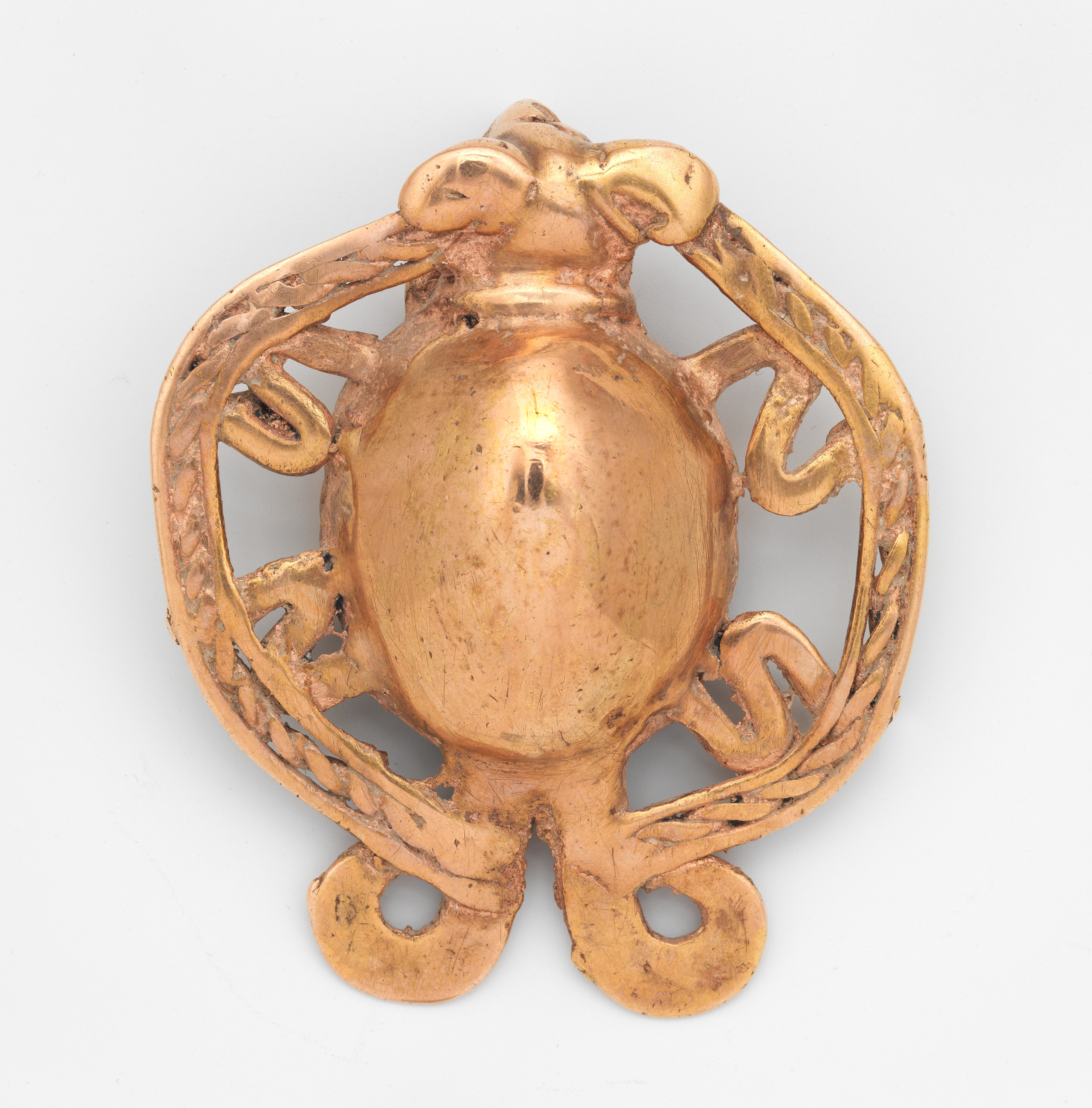
Deconstructing the Chiriqui Turtle: A Study in Cast Alloy and the 2026 Silhouette
At Natalie Fashion Atelier, the act of creation is an act of excavation. We are not merely designers; we are aesthetic archaeologists, unearthing the latent codes of classical elegance from civilizations that have long since dissolved into the earth. The subject of this research artifact is the Turtle Pendant from the Chiriqui culture of present-day Panama, a masterpiece of pre-Columbian metallurgy. Isolated from its original ritual context, the pendant presents a pure, unadulterated dialogue between form, material, and the human hand. This paper deconstructs the pendant’s classical elegance to reveal how its core principles—specifically the tension between mass and surface, and the behavior of its Gold (cast alloy)—provide a foundational lexicon for the 2026 high-end silhouette.
I. Aesthetic Archaeology: The Chiriqui Turtle Pendant
Formal Vocabulary and Geometric Abstraction
The pendant, typically measuring between 5 to 8 centimeters in length, is not a naturalistic representation of a sea turtle. Instead, it is a masterclass in geometric abstraction. The carapace is rendered as a domed, almost semi-spherical volume, often patterned with a grid of raised dots or incised lines. The head, a truncated triangle, extends forward with a deliberate, stoic posture. The flippers are stylized as four symmetrical, flattened trapezoids. This is not a portrait of an animal; it is a diagram of its essential energy—a synthesis of power, longevity, and terrestrial weight.
The classical elegance here lies in the economy of gesture. Every line serves a structural purpose. The negative space between the flippers and the body is not an afterthought; it is a calculated void that defines the positive form. This principle of defined emptiness is the first key to the 2026 silhouette.
The Materiality of Cast Alloy: Weight and Light
The Chiriqui goldsmiths worked with a Gold (cast alloy), typically a mixture of gold and copper (tumbaga), which was then subjected to a process of depletion gilding to enrich the surface. The critical material property here is the tension between density and luminosity. The cast alloy has a specific gravity that gives the pendant a palpable heft—a sense of gravitas. Yet, the polished surface, often burnished to a high sheen, captures and refracts light in a manner that seems to dematerialize the weight. The object is simultaneously heavy and ethereal, grounded and radiant.
This duality—mass that carries light—is the second foundational principle. The gold does not merely reflect; it absorbs and re-emits the ambient energy of the wearer and the environment. For the 2026 silhouette, this translates into fabrics and constructions that possess a similar volumetric density while maintaining a surface that interacts dynamically with light.
II. Translating the Pendant into the 2026 Silhouette
Principle 1: The Defined Void and Architectural Draping
The 2026 silhouette will reject the amorphous, unstructured shapes of recent seasons. Instead, it will embrace the architectural void as a primary design element. Inspired by the negative space between the turtle’s flippers, we will introduce strategic cutouts and suspended panels that define the body’s form by what they exclude. A jacket, for example, will feature a sculpted, rigid shoulder (the carapace) that cantilevers over a completely open side seam, revealing a sliver of the torso. The void is not a hole; it is a structural statement.
This translates into draping techniques that create pockets of air between the fabric and the body. We will use heavy, malleable fabrics—such as double-faced cashmere or bonded silk gazar—that can be folded and stitched to create permanent, three-dimensional voids. The silhouette becomes a sculpture of absence, where the wearer’s movement animates the empty space. The classical elegance of the Chiriqui pendant is reborn as a modernist architecture of the body.
Principle 2: Volumetric Density and Luminous Surfaces
The Gold (cast alloy) of the pendant informs the materiality of the 2026 collection. We will not merely use gold thread or lame; we will engineer surfaces that possess the same dual quality of weight and radiance. This requires a return to haute couture handcraft.
- Metalized organza will be layered over sculpted horsehair canvas to create a carapace-like volume that is both rigid and shimmering.
- Lacquered leather will be molded into geometric shells, their polished surfaces reflecting light with the same burnished intensity as the Chiriqui gold.
- Hand-embroidered paillettes in graduated tones of amber, bronze, and 24-karat gold will be applied in a grid pattern, echoing the raised dots on the pendant’s carapace. The embroidery will be dense enough to create a continuous, reflective surface that feels like a single, cast piece of metal.
The silhouette will be volumetric but controlled. A full, domed skirt (the carapace) will be constructed from multiple layers of stiffened tulle and organza, each layer bonded with a micro-thin gold leaf. The result is a garment that has the visual weight of cast gold but the physical lightness of air. The wearer carries the memory of mass, not the burden.
III. The 2026 Silhouette: A Technical Lexicon
The Carapace Jacket
A signature piece for 2026 will be the Carapace Jacket. It is a bolero-length jacket with a single, continuous, domed shoulder that extends into a sculpted sleeve. The opposite side is completely open, revealing the arm and torso. The jacket is constructed from a single piece of molded, gold-lacquered leather, heat-pressed over a custom form to create a permanent, convex shape. The interior is lined with a soft, matte black silk to create a stark contrast between the luminous exterior and the dark void of the interior. This piece directly quotes the turtle’s carapace and the negative space beneath its flippers.
The Flipper Drape
For evening, we introduce the Flipper Drape—a technique where a single, wide panel of fabric (a trapezoid, referencing the stylized flipper) is attached at the shoulder and allowed to fall diagonally across the body, creating a deep, asymmetrical cowl. The panel is weighted at the hem with a cast gold alloy bead, a direct material reference to the pendant. The weight of the bead causes the fabric to fall with a deliberate, gravitational pull, mimicking the heft of the original artifact. The drape is both a gesture of movement and a statement of weight.
The Grid of Light
The raised dot pattern on the carapace is translated into a Grid of Light embroidery technique. Using a computerized jacquard loom, we will weave a fabric with a raised, three-dimensional grid of metallic threads. The grid will be irregular, with smaller dots at the shoulders and larger, more spaced dots toward the hem, creating an optical illusion of depth and movement. This fabric will be used for a column dress, the grid acting as a structural exoskeleton that holds the garment’s shape while refracting light like a field of tiny, cast gold mirrors.
IV. Conclusion: The Eternal Return of the Classical
The Chiriqui Turtle Pendant, isolated from its archaeological context, speaks a universal language of form, material, and light. Its classical elegance is not a style but a system of principles: the definition of form through void, the tension between mass and luminosity, and the economy of gesture. For the 2026 silhouette, these principles are not decorative references; they are structural imperatives.
At Natalie Fashion Atelier, we do not copy the past. We extract its DNA and re-encode it into the future. The 2026 silhouette will be a sculptural, architectonic, and luminous expression of the human form, grounded in the same gravitas and radiance that defined the Chiriqui goldsmith’s art. It is a return to a classical elegance that is not nostalgic, but prophetic—a testament to the enduring power of a single, perfectly cast object.