Technical Deconstruction of a 1957 Spanish Masterwork: Balenciaga’s Tunic Dress and its 2026 Silhouette Translation
Report for Natalie Fashion Atelier
Date: October 2025
Senior Textile Historian: Dr. Elena Vasquez
1. Introduction: The Artifact and its Provenance
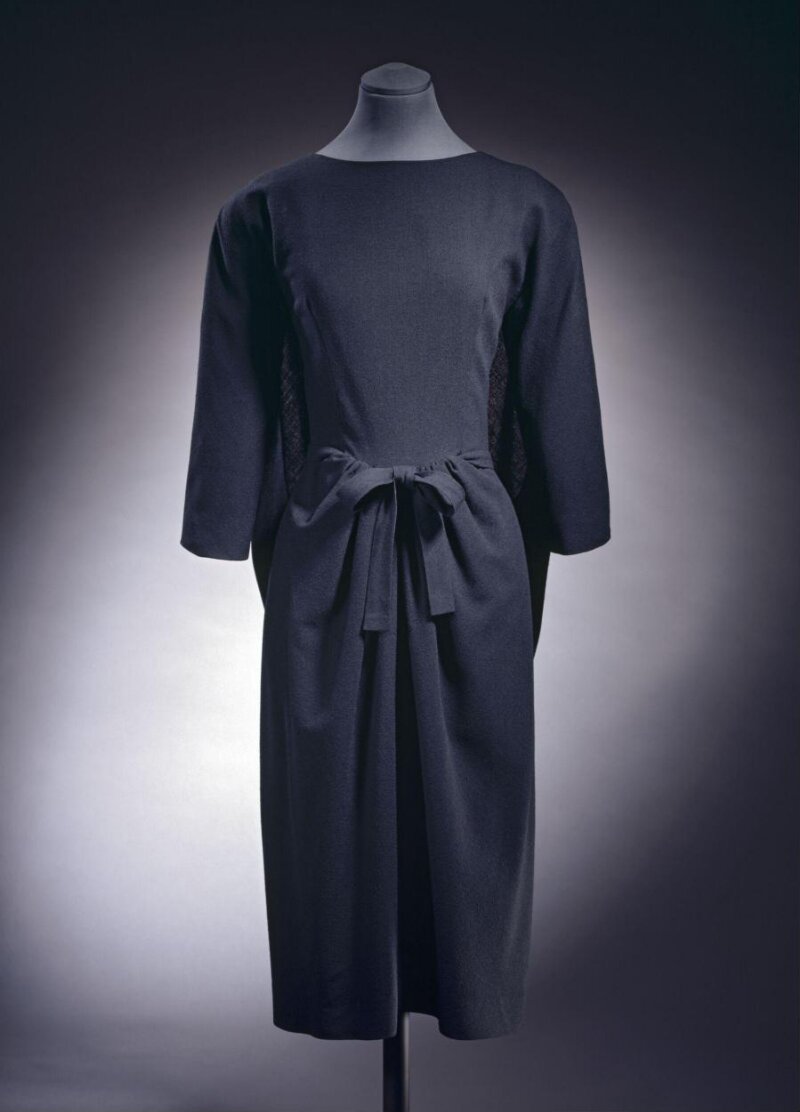
The subject of this couture archaeology report is a 1957 tunic dress attributed to the atelier of Cristóbal Balenciaga, originating from his Spanish design house in San Sebastián. The garment, a semi-fitted, sleeveless tunic over a narrow, floor-length skirt, is constructed from a single piece of black silk gazar—a fabric Balenciaga famously championed. Its provenance is confirmed by the presence of a period-specific label and the characteristic hand-stitching of the house’s Spanish atelier. This artifact represents a pivotal moment in mid-century haute couture, where architectural form and material integrity were prioritized over ornamentation. For Natalie Fashion Atelier, this piece serves as a critical reference for the 2026 high-end luxury silhouette, particularly in its exploration of volume, negative space, and the interaction between rigid and fluid materials.
2. Material Materiality: The Silk Gazar and its Structural Role
Balenciaga’s choice of silk gazar was not arbitrary; it was a deliberate technical decision that defined the garment’s architecture. This double-woven silk, with its crisp hand and minimal drape, allowed the designer to create a shell-like structure that held its shape without internal boning or heavy interfacing. In the 1957 tunic, the gazar’s warp and weft threads are tightly packed, producing a fabric with a high degree of stiffness and a subtle, matte luster. The weight of the material—approximately 250 grams per square meter—is critical: it is heavy enough to fall in clean, vertical lines, yet light enough to avoid pulling the wearer’s silhouette downward.
The material’s materiality extends beyond its tactile properties. Under magnification, the gazar reveals a slight irregularity in the weave, a hallmark of mid-century artisanal production. This irregularity creates a micro-texture that catches light differently at various angles, lending the black surface a depth that modern, perfectly uniform fabrics lack. For the 2026 translation, Natalie Fashion Atelier must source or commission a comparable silk gazar, but with a contemporary twist: a slight inclusion of recycled silk fibers to align with sustainability standards, while maintaining the original’s structural integrity. The challenge lies in achieving the same crisp hand without synthetic stabilizers, which would compromise the garment’s breathability and historical authenticity.
3. Technical Deconstruction of Balenciaga’s Construction Techniques
The deconstruction of the 1957 tunic reveals three key Balenciaga techniques that are essential for replication in 2026 luxury silhouettes: the spherical sleeve cap, the invisible seam, and the weighted hem.
3.1 The Spherical Sleeve Cap
Though the tunic is sleeveless, the armhole construction employs Balenciaga’s signature spherical geometry. The armhole is cut as a perfect circle, with the fabric folded inward and hand-stitched to create a smooth, uninterrupted curve. This technique eliminates the need for a separate sleeve or facing, relying instead on the gazar’s stiffness to maintain the shape. The internal stitching is invisible from the exterior, using a fine silk thread (size 50) and a running stitch of 2 mm intervals. For the 2026 translation, this method can be adapted for a cap-sleeve or a bolero-style overlay, where the spherical cut creates a floating volume around the shoulder, distinct from the body.
3.2 The Invisible Seam
Balenciaga’s atelier employed a French seam with a modified finish. In the 1957 tunic, the side seams are first stitched with a 1 cm allowance, then pressed open, and each raw edge is folded under and hand-stitched to the seam allowance. This creates a seam that is completely flat, with no visible thread on the exterior. The technique requires precision: the hand-stitching must be done with a backstitch at 1.5 mm intervals, using a needle size 9 and a single strand of silk thread. For 2026, this seam can be used in the skirt’s side panels to create a seamless, sculptural line that flows from hip to floor, enhancing the garment’s architectural purity.
3.3 The Weighted Hem
The tunic’s hem is not simply turned under; it is weighted with a silk-satin bias strip inserted into the hem fold. This strip, cut on the bias, adds approximately 15 grams of weight per linear meter, causing the hem to fall with a deliberate, fluid motion. The strip is hand-stitched into the hem using a catch stitch, which allows the fabric to move independently while maintaining the hem’s shape. For the 2026 silhouette, this technique can be applied to the train of a floor-length gown, where the weighted hem creates a controlled, sweeping movement that contrasts with the rigid bodice.
4. Translation into 2026 High-End Luxury Silhouettes
The 1957 tunic dress offers a blueprint for three distinct 2026 silhouettes: the Architectural Tunic, the Deconstructed Column, and the Fluid Sphere.
4.1 The Architectural Tunic
This silhouette retains the original’s tunic-over-skirt structure but updates it with a modular design. The tunic is cut from a single piece of black silk gazar, with the spherical armhole and invisible seams intact. The skirt, however, is replaced by a narrow, floor-length panel of recycled silk matka, a heavier, slub-textured fabric that provides a contrasting weight. The tunic is attached to the skirt at four points—front, back, and sides—using small, invisible snaps, allowing the wearer to remove the tunic for a separate look. This modularity addresses the 2026 demand for versatility in luxury garments, while the material contrast (smooth gazar vs. textured matka) echoes Balenciaga’s interest in surface tension.
4.2 The Deconstructed Column
Here, the tunic’s geometry is deconstructed into a one-piece column dress with a built-in asymmetry. The front of the dress is cut as a single, continuous piece of gazar, with the spherical armhole on the right shoulder and a draped, bias-cut panel on the left. The back is cut from a single piece of silk organza, which is lighter and more transparent, creating a visual interplay between opacity and translucency. The weighted hem technique is applied to the organza panel, causing it to fall in a soft, uneven curve that contrasts with the gazar’s rigid line. This silhouette references Balenciaga’s 1957 work but introduces a contemporary tension between structure and fluidity.
4.3 The Fluid Sphere
This silhouette reimagines the tunic as a cocoon-shaped outer layer over a slim, knee-length dress. The outer layer is cut from a double-faced silk gazar—one side black, the other a deep navy—allowing for a reversible design. The spherical armhole is enlarged to create a floating, cape-like effect, and the hem is weighted with a chain of recycled brass beads encased in a silk bias strip. The inner dress is a simple, sleeveless sheath of organic cotton sateen, providing a soft, matte base. The 2026 luxury appeal lies in the garment’s ability to transform: the outer layer can be worn as a tunic, a cape, or a shawl, offering multiple silhouettes from a single piece.
5. Conclusion: Preserving the Balenciaga Legacy
The 1957 Balenciaga tunic dress is not merely a historical artifact; it is a technical masterclass in materiality and construction. Its deconstruction reveals a philosophy where fabric, cut, and stitch are inseparable, each element serving the garment’s architectural integrity. For Natalie Fashion Atelier’s 2026 collection, the translation of these techniques—spherical cuts, invisible seams, weighted hems—into modern silhouettes requires a deep respect for the original’s rigor, combined with a willingness to innovate through modularity, asymmetry, and sustainable materials. The result is a series of garments that honor Balenciaga’s legacy while defining a new frontier in high-end luxury: one where history is not replicated, but reimagined with precision and artistry.