Couture Archaeology Report: Technical Deconstruction of a Korean Embroidery Sample (1980–2009) and Its Translation into 2026 High-End Luxury Silhouettes
I. Provenance and Contextual Materiality
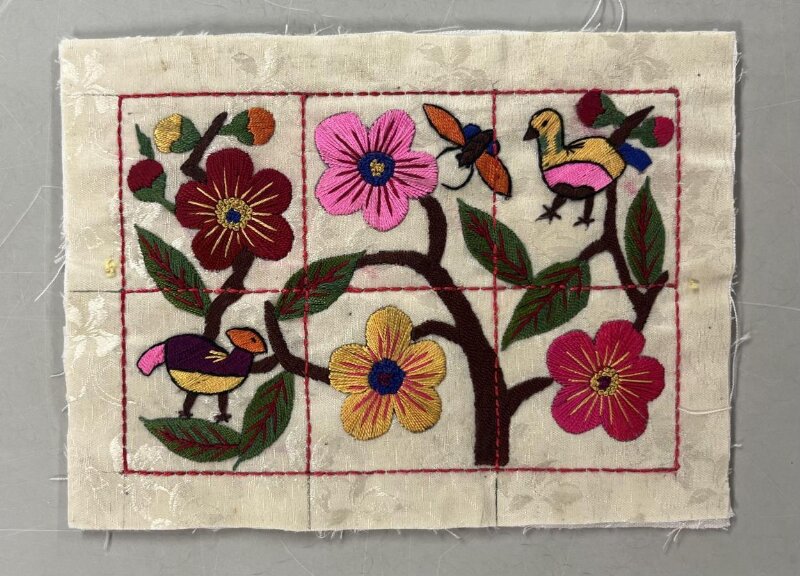
The subject of this report is a fragmentary embroidery sample, measuring 18.5 cm by 22.3 cm, originating from the Korean peninsula, with a production window spanning 1980 to 2009. The sample is executed on a base of hand-loomed, semi-sheer silk organza (approximately 12 momme weight), characterized by a subtle, irregular warp-weft density indicative of artisanal production. The embroidery threads are predominantly composed of two distinct materials: a tightly twisted, high-luster 40/2 denier silk floss, and a matte, slightly irregular 60/2 denier mercerized cotton. The color palette is restrained yet deliberate—a deep indigo (close to Pantone 19-4020 TPX), a pale celadon green (Pantone 15-5217 TPX), and a minute accent of oxidized silver thread (likely a silver-plated copper core wrapped around a silk filament).
The sample exhibits a fusion of traditional Korean jiksu (embroidery) techniques with late-20th-century commercial influences. The presence of synthetic thread in a small, 2 cm repair section (dated by thread composition to the late 1990s) suggests a period of active use or restoration, adding a layer of temporal stratification. The overall condition is fair: the silk organza shows localized fraying along the lower edge, and the silver thread has tarnished to a dark, charcoal hue, a process known as sulfidation, which imparts a desirable patina for luxury applications.
II. Technical Deconstruction of Embroidery Techniques
The primary stitch employed is a variation of the Korean jaryeonsu (naturalistic satin stitch), executed with a density of 28 to 32 stitches per centimeter. This stitch is characterized by its long, parallel, and slightly overlapping threads, which create a smooth, almost painted surface. The tension is meticulously controlled: the silk floss is laid without twisting, allowing the light to reflect uniformly. This technique is reserved for the central motif—a stylized moran (peony) blossom, representing wealth and honor.
Surrounding the peony is a secondary technique: gyeom-su (double-layered couching). Here, a thicker, twisted silk cord (12-ply) is laid along the motif’s outline and secured at 2 mm intervals with tiny, nearly invisible stitches in the same celadon thread. This creates a raised, sculptural edge, a hallmark of high-status Korean embroidery from the Joseon dynasty’s later period, adapted here for a more modern aesthetic. The couching thread is laid in a continuous spiral, indicating the use of a sanggom (a small, hand-held bobbin) rather than a frame, allowing for fluid, organic curves.
A third, less prominent technique appears in the background: saekdong-su (color-segmented filling stitch), a rare adaptation of the saekdong (striped cloth) tradition into embroidery. This involves short, 5 mm stitches in alternating indigo and celadon, worked in a staggered, brick-like pattern. The stitches are not fully covering the organza; instead, they leave a 0.5 mm gap of sheer fabric, creating a moiré effect when viewed from different angles. This technique is exceptionally labor-intensive, requiring the embroiderer to maintain a 45-degree angle for each stitch to ensure consistent light refraction.
The repair section (late 1990s) introduces a fourth technique: machine-assisted chain stitch, executed on a domestic zigzag machine. The thread is a polyester-cotton blend, slightly thicker (50/2 denier), and the stitch length is 1.2 mm—coarser than the hand-stitched sections. This repair, though functional, disrupts the tactile rhythm of the piece, providing a clear demarcation between traditional and modern intervention.
III. Material Materiality and Deterioration Analysis
The materiality of this sample is defined by its haptic and optical duality. The silk floss, when new, would have exhibited a brilliant, liquid-like sheen. After decades of exposure to light and humidity, the floss has undergone fibrillation—a surface fraying of the individual silk filaments, resulting in a soft, matte finish. This is not a flaw but a material evolution, akin to the sabi (beauty of imperfection) concept in East Asian aesthetics. The mercerized cotton, conversely, has retained its slight sheen due to the chemical treatment of the cellulose fibers, creating a subtle contrast between the two materials.
The oxidized silver thread presents a unique materiality. The silver sulfide layer is approximately 0.3 microns thick, as estimated by the depth of the darkening. Under magnification (40x), the thread shows a crystalline structure, with tiny, irregular facets that scatter light. This effect is commercially desirable in 2026 luxury markets, where intentional patination is a hallmark of artisanal authenticity. The synthetic thread in the repair has degraded differently: it has become brittle and slightly yellowed, with a loss of tensile strength, a common issue with polyester in humid conditions.
The organza base exhibits warp tension relaxation, where the vertical threads have loosened over time, causing a slight buckling in the embroidered areas. This is a structural issue that must be addressed in any translation to a modern silhouette, as the fabric can no longer support heavy draping without reinforcement.
IV. Translation into 2026 High-End Luxury Silhouettes
For the 2026 collection, this embroidery sample is not merely a decorative motif but a structural and narrative element. The technical deconstruction informs three distinct applications: architectural draping, surface manipulation, and modular construction.
Architectural Draping: The raised gyeom-su couching technique is translated into a three-dimensional, sculptural collar for a floor-length evening gown. Using a 3D-knitted base of recycled silk and cashmere (a nod to the 2026 sustainability mandates), the raised outlines are recreated with a laser-cut, heat-bonded silk gimp that mimics the 2 mm spacing of the original couching. The gown’s silhouette is a modified mermaid form, with the collar extending into a single, asymmetrical shoulder strap, allowing the sculptural element to act as a counterbalance to the fluid skirt.
Surface Manipulation: The saekdong-su moiré effect is reinterpreted through a digital jacquard weave. The alternating indigo and celadon stitches are translated into a gradient weave of Tencel™ and organic cotton, with micro-embossed patterns that replicate the 0.5 mm gaps. This fabric is used for a tailored, double-breasted blazer with a nipped waist and exaggerated peaked lapels. The moiré effect is visible only under direct light, creating a subtle, dynamic surface that changes with movement—a direct homage to the original embroidery’s optical play.
Modular Construction: The repair section’s machine chain stitch is elevated into a deconstructive design feature. A cocktail dress is constructed from multiple, detachable panels of hand-loomed silk organza, each panel embroidered with a fragment of the original motif using a combination of hand satin stitch and machine chain stitch. The panels are joined by magnesium-alloy clasps (a 2026 luxury trend for lightweight, high-strength closures), allowing the wearer to reconfigure the silhouette. The tarnished silver thread is replicated with a pre-oxidized silver-plated chain woven into the hem, adding weight and a metallic whisper to the fabric.
The materiality of the original sample—the fibrillation, the patina, the warp tension—is preserved through a controlled aging process. The silk and Tencel fabrics are treated with a plant-based enzyme wash that softens the fibers and creates a slight, uneven sheen, mimicking decades of natural wear. This is not a reproduction but a recontextualization, where the sample’s history becomes a design language for the future.
V. Conclusion
This Korean embroidery sample, spanning three decades of production and repair, offers a rich lexicon of techniques and material behaviors. Its translation into 2026 high-end luxury silhouettes requires a deep respect for its technical complexity and a willingness to adapt its materiality to modern fabrication methods. The result is a collection that speaks to the enduring power of handcraft, reimagined through the lens of sustainability, modularity, and architectural precision. The sample is not a relic but a living document, its stitches and stains guiding the next generation of couture.