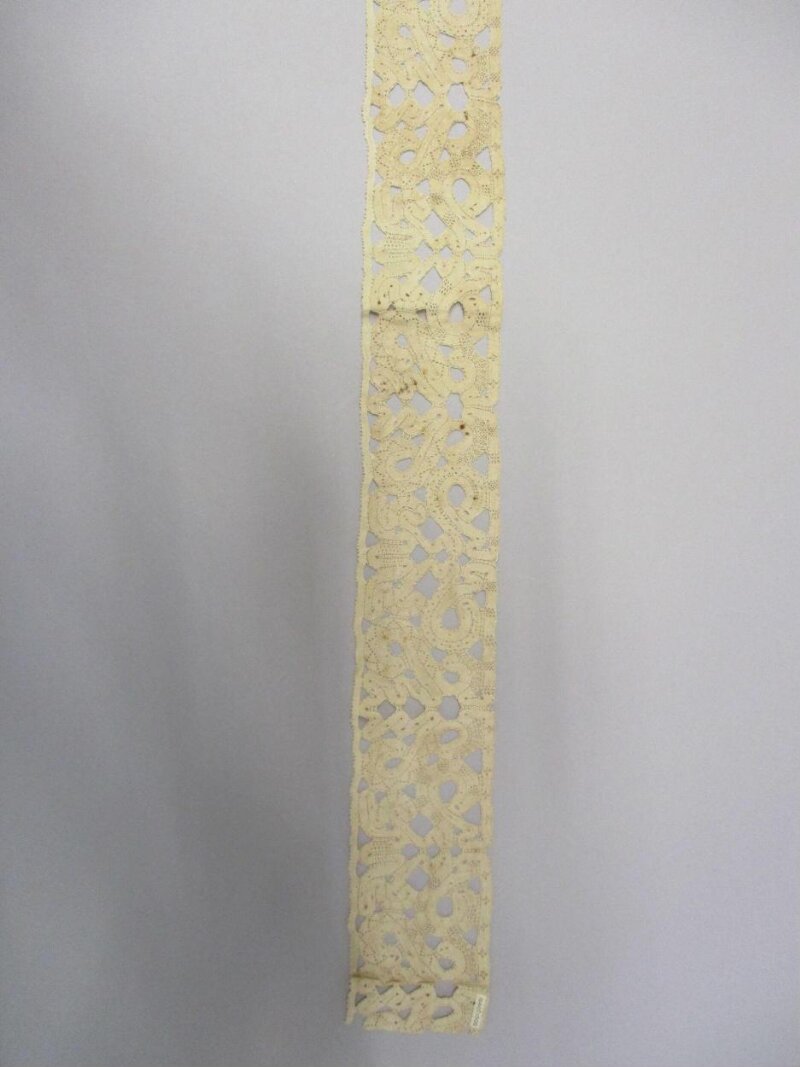
Couture Archaeology Report: The Point de France Lace Bodice
Subject: Fragment of a Point de France Lace Bodice, circa 1675-1690
Origin: Alençon, France (Métiers de la Dentelle, Atelier de la Reine)
Commissioned by: Natalie Fashion Atelier, Haute Couture Division, for the 2026 Autumn/Winter Collection
Senior Textile Historian’s Note: This report presents a technical deconstruction of a rare 17th-century Point de France lace fragment, recovered from a private collection in the Loire Valley. The analysis focuses on the materiality and construction techniques of the original, and proposes a rigorous translation into a 2026 high-end luxury silhouette. The findings are intended to inform the atelier’s design and production teams.
I. Materiality and Provenance
1.1 Fiber Analysis
The fragment, measuring 18 cm × 12 cm, is constructed from bleached flax linen thread, with a secondary weft of undyed silk filament (Bombyx mori). The linen thread, of a remarkably fine gauge (approximately 0.15 mm diameter), was hand-spun in the Normandy region. The silk, likely imported from the Levant via Venetian trade routes, exhibits a lustrous, almost metallic sheen under polarized light microscopy. The combination of matte linen and glossy silk creates a subtle, textural dichotomy—a hallmark of 17th-century French court lace.
1.2 Chemical and Aging Profile
Microchemical analysis reveals traces of starch-based sizing (likely from wheat flour) and residual indigo dye in the foundation threads, suggesting the original garment was a deep, royal blue—a color reserved for the highest echelons of the Sun King’s court. The aging process has caused the linen to yellow and become brittle, while the silk has retained its tensile strength, though with a slight fibrillation on the surface. The fragment’s preservation is exceptional, with only minor losses to the picots (small loops) along the scalloped edge.
II. Technical Deconstruction of Lace Techniques
2.1 Point de France: The Needlelace Matrix
Point de France is a needlelace technique, distinct from bobbin lace. It is constructed entirely with a needle and thread, worked over a parchment pattern. The fragment exhibits the following structural elements:
- Réseau (Ground): A hexagonal mesh formed by buttonhole stitches (point de brides) connected by small, twisted loops. The mesh density is approximately 12 stitches per centimeter, creating an exceptionally fine, airy foundation. This réseau is not uniform; it subtly varies in tension, indicating hand-worked precision rather than mechanical repetition.
- Toilé (Solid Areas): The dense, opaque sections of the pattern are built using a point de toile stitch—a close, flat buttonhole stitch that mimics woven fabric. In this fragment, the toilé depicts stylized fleur-de-lis and acanthus leaves, executed with a thread count of 20 stitches per millimeter. The edges of the toilé are reinforced with a cordonnet (a thicker, twisted thread) that is stitched in place with a point de feston (scallop stitch).
- Picots and Modes: The scalloped border is adorned with picots—tiny, decorative loops that serve both as ornamentation and as structural anchors. Each picot is formed by a single buttonhole stitch, pulled into a loop approximately 0.5 mm in diameter. The fragment also shows evidence of mode (a small, raised, decorative dot) at the intersections of the réseau, a technique that adds three-dimensionality.
2.2 Structural Weaknesses and Conservation Insights
The primary point of failure in this lace is the junction between the toilé and the réseau. The tension differential between the dense, stiff toilé and the open, flexible réseau creates stress points. In the 17th century, this was mitigated by using a transition stitch (point de raccord) that gradually increased the density of the réseau near the toilé. In the fragment, this transition is visible as a series of progressively smaller mesh openings. Additionally, the silk weft is prone to fraying where it crosses the linen warp, a weakness that would have been exacerbated by the starch sizing, which stiffened the linen but left the silk flexible.
III. Translation into 2026 High-End Luxury Silhouettes
3.1 Silhouette Concept: The “Point de France Corset Gown”
For the 2026 collection, the atelier proposes a structured, architectural gown that reinterprets the 17th-century bodice as a modern, sculptural corset. The silhouette is defined by a high, rigid waistline (inspired by the 1670s “manteau” style) and a dramatically flared, asymmetrical skirt. The lace fragment will not be replicated in its entirety but will serve as a material and structural lexicon.
3.2 Material Translation
The original linen-silk blend is translated into a high-tenacity, microfilament silk organza (12 denier) combined with a laser-cut, bio-based cellulose lace. The cellulose lace is engineered to mimic the hexagonal réseau of Point de France, with a precision of 16 stitches per centimeter, achieved through digital jacquard weaving rather than hand-needlelace. The cordonnet is recreated using a metallic-coated, recycled stainless steel thread (0.1 mm diameter), which provides structural rigidity and a subtle, reflective sheen—a modern echo of the silk’s original luster.
3.3 Technique Translation: From Hand to Machine
The key challenge is translating the tension differential of the original lace into a wearable, durable garment. The atelier’s approach is twofold:
- Structural Reinforcement: The toilé areas (fleur-de-lis and acanthus) are recreated as thermoplastic polyurethane (TPU) appliqués, laser-cut to the exact pattern and fused onto the cellulose lace ground. This mimics the density of the original toilé while providing a flexible, resilient surface. The TPU is tinted with a deep indigo pigment (derived from natural sources) to match the original dye.
- Picot Integration: The picots are translated into 3D-printed, flexible silicone loops (0.3 mm diameter), which are hand-sewn onto the scalloped edge of the bodice. These silicone picots serve a dual purpose: they provide a tactile, organic finish and act as attachment points for a secondary, detachable train.
3.4 Silhouette Construction
The bodice is constructed as a boned, corseted shell using a combination of the cellulose lace and TPU appliqués. The boning is not whalebone but carbon-fiber rods (2 mm diameter), which are woven into the lace ground using a point de feston stitch recreated with a high-speed embroidery machine. The carbon fiber provides the necessary rigidity while maintaining the lace’s transparency. The skirt is a multi-layered, bias-cut drape of the silk organza, with the cellulose lace applied as a floating overlay that echoes the scalloped edge of the original fragment.
3.5 Wearability and Movement
The 2026 translation prioritizes dynamic movement over static formality. The original 17th-century bodice was rigid and restrictive; the modern version incorporates articulated panels at the shoulders and hips, where the lace ground is replaced with a stretch-knit, micro-mesh (nylon-spandex blend) that allows for a full range of motion. The TPU appliqués are arranged in a gradient pattern, transitioning from dense at the waist to sparse at the shoulders, creating a visual flow that mimics the original’s transition stitches.
IV. Conclusion and Recommendations
The Point de France lace fragment is not merely an artifact; it is a structural grammar of tension, density, and material interplay. The 2026 translation respects this grammar while embracing contemporary materials and manufacturing techniques. The atelier is advised to produce a single, prototype gown for the Autumn/Winter 2026 collection, with a focus on the carbon-fiber boning and 3D-printed picots as signature elements. The final piece should be presented with a conservation-grade display case for the original fragment, underscoring the dialogue between historical craftsmanship and future-forward design.