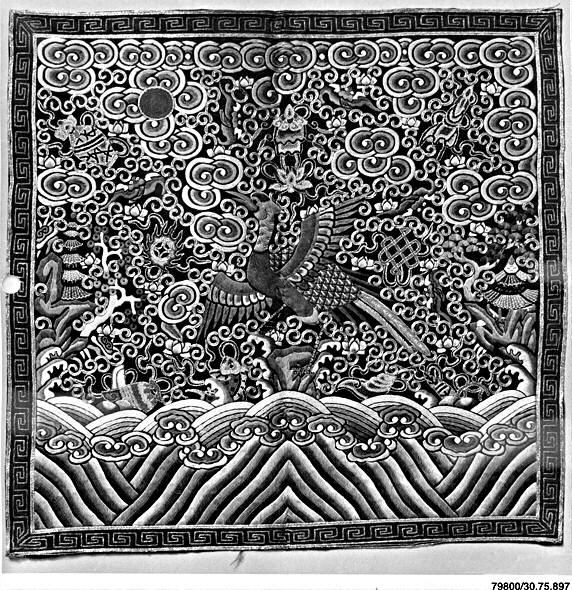
Archive Specimen: The Rank Badge with Golden Pheasant
Artifact Classification: Buzi (Mandarin Square), Qing Dynasty, mid-18th to early 19th century.
Heritage Lineage: Imperial China, Civil Official Rank II (Second Rank).
Primary Materiality: Silk satin ground, couched metallic thread (gold-wrapped silk), polychrome silk floss.
Archive Context: Isolated aesthetic archaeology—a fragment of courtly semiotics, detached from its ceremonial function and examined purely as a structural and textural lexicon for 2026 haute couture.
Deconstructing Classical Elegance: The Grammar of Rank and Refinement
The Golden Pheasant rank badge is not merely an emblem of status; it is a masterclass in hierarchical composition and restrained opulence. The central motif—a golden pheasant in flight against a cosmic backdrop of clouds, waves, and sacred mountains—operates on a principle of asymmetrical balance. The bird’s body is rendered in dense, directional couching of metallic thread, creating a surface that catches light with each angle of view. This is not static decoration; it is a kinetic interplay of luminosity and shadow, a precursor to the modern concept of active surface architecture.
The silken ground—a deep, almost indigo navy—serves as a void of infinite depth. Against this, the metallic thread does not merely outline; it constructs volume through gradated density. The feathers are built from concentric arcs of couched gold, each arc varying in tightness to suggest both texture and movement. This technique, known as pan jin (flat gold embroidery), achieves a sculptural relief without adding bulk. For the 2026 silhouette, this informs a new approach to surface tension: where fabric is not draped but mapped in zones of reflective and matte finish, creating a three-dimensional illusion from a two-dimensional plane.
Classical elegance here is defined by negative space. The waves at the base are rendered in a rhythmic, repetitive pattern of overlapping scales, each scale outlined in silver-gilt thread. The sky above the pheasant is left largely untouched, allowing the bird to breathe. This principle of strategic emptiness is the most potent lesson for luxury silhouettes: the power of what is not said, not stitched, not adorned.
Materiality as Narrative: Silk and Metallic Thread in 2026
Silk: The Fluid Armature
The ground silk of the rank badge is a satin weave—a structure that maximizes the luster of the filament while providing a smooth, uninterrupted field for embroidery. In 2026, silk is reimagined not as a passive substrate but as an active structural element. The haute couture silhouette will employ double-faced silk gazar, a fabric that holds architectural pleats and sharp geometric folds without collapsing. This echoes the rank badge’s use of silk as a rigid yet breathable canvas—a paradox that defines high-end construction.
The weight and drape of the original satin is translated into engineered bias cuts that follow the body’s natural torque. The pheasant’s wings, spread in a dynamic V, inspire a new sleeve architecture: the asymmetrical wing sleeve, where one side of the garment is constructed from a single, continuous piece of silk that folds over the shoulder like a bird’s primary feather. The metallic thread’s tensile strength is mirrored in the use of liquid metal organza—a silk organza woven with ultra-fine copper filaments—that can be laser-cut into lace-like patterns that mimic the couched arcs of the original embroidery.
Metallic Thread: The Light Conductor
The metallic thread in the rank badge is not a simple wire; it is a composite material: a silk core wrapped in gold leaf-coated paper, then twisted. This construction yields a thread that is both rigid and supple, capable of being couched into tight curves or left to lie in sweeping lines. For 2026, this informs the development of conductive couture textiles—threads that integrate micro-LEDs or thermochromic pigments, allowing the garment to change luminosity in response to movement or ambient light. The pheasant’s feathers become a dynamic surface, where the metallic embroidery is not merely decorative but interactive.
The couched technique—where the metallic thread is laid on the surface and secured by tiny silk stitches—is translated into applied metallic appliqués that are heat-bonded or laser-welded onto the silk base. This eliminates the need for a backing fabric, allowing the metallic elements to float on the surface, creating translucent, light-filtering zones. The result is a silhouette that appears to be woven from light itself, with the metallic threads acting as optical fibers that guide the viewer’s eye along the garment’s structural lines.
Informing 2026 High-End Silhouettes: From Emblem to Architecture
Silhouette I: The Asymmetric Wing Jacket
Inspiration: The pheasant’s left wing, depicted in a downward stroke, while the right wing rises.
Construction: A single-shoulder jacket in midnight blue silk gazar, with the left side cut in a sharp, descending point that ends at the hip. The right side is a sculptural wing, built from layered metallic organza petals, each petal couched with gold thread in a radial pattern. The asymmetry is not arbitrary; it follows the golden ratio derived from the badge’s composition. The jacket closes with a single, hidden magnetic clasp at the waist, echoing the badge’s central placement on the chest.
Silhouette II: The Wave-Pleated Evening Gown
Inspiration: The overlapping scale pattern of the waves at the base of the badge.
Construction: A floor-length gown in double-faced silk charmeuse, with a bodice that is entirely unadorned—a nod to the negative space of the sky. The skirt is a cascade of engineered pleats, each pleat tipped with a metallic thread edge that catches light. The pleats are not uniform; they vary in width and depth, mimicking the irregular rhythm of the waves. The hem is weighted with a liquid metal band—a ribbon woven from gold and copper threads—that gives the gown a fluid, gravitational pull.
Silhouette III: The Cosmic Cage Dress
Inspiration: The cosmic backdrop of clouds and sacred mountains, rendered in a single plane.
Construction: A cage dress in black silk tulle, overlaid with a lattice of metallic thread that forms a three-dimensional topography. The lattice is laser-cut from a single sheet of silver-gilt organza, with the pattern derived from the cloud motifs. The dress is worn over a silk slip that is dyed in a gradient from deep indigo to pale gold, creating the illusion of a sky at dawn. The metallic lattice is suspended from the shoulders and hips, never touching the body, creating a floating, ethereal silhouette that references the pheasant’s flight.
Conclusion: The Archaeology of Future Luxury
The Rank Badge with Golden Pheasant, when isolated from its historical context, reveals itself as a prototypical system of luxury construction. Its material dialogue between silk and metal, its compositional grammar of asymmetry and negative space, and its textural hierarchy of matte and reflective surfaces are not relics of the past but blueprints for the future. In 2026, the haute couture silhouette will not merely reference these elements; it will re-embody them through advanced textile engineering and architectural draping. The golden pheasant, once a symbol of imperial rank, becomes a generative algorithm for light, movement, and structure—a timeless artifact that continues to inform the most refined expressions of human adornment.