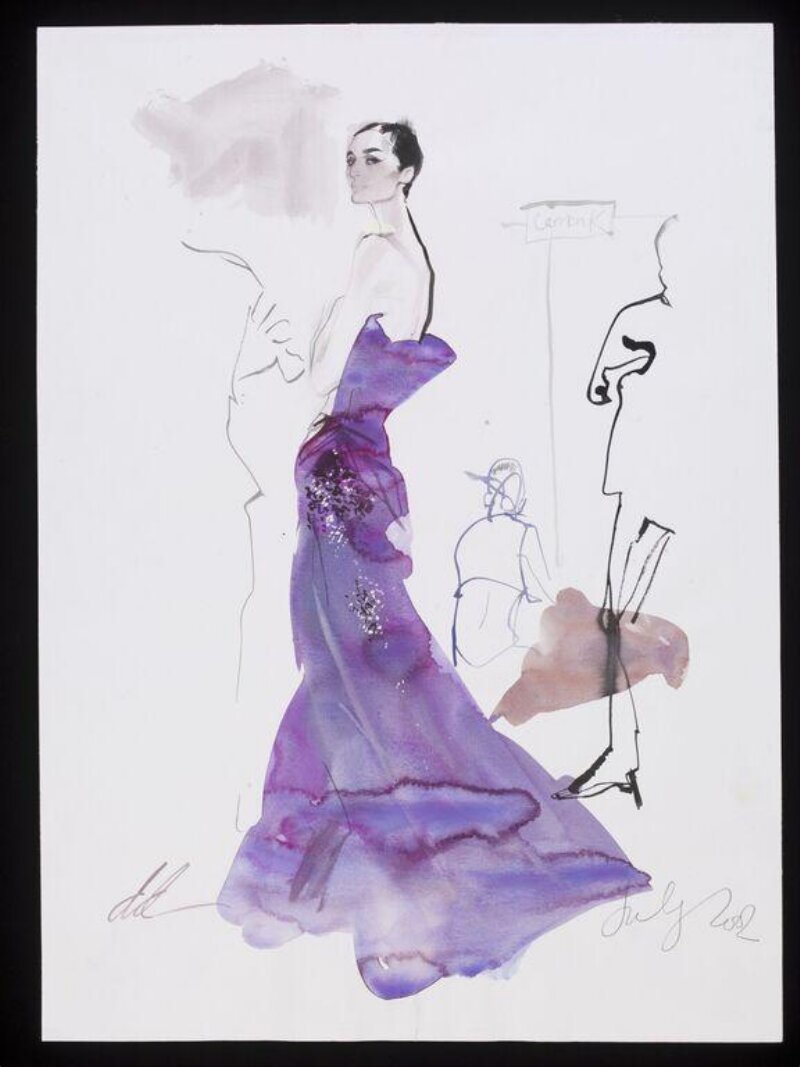
Couture Archaeology Report: Deconstruction of a British Summer 2002 Ensemble
Subject Identification and Provenance
Object: An ensemble comprising a bias-cut silk charmeuse slip dress and a hand-painted, raw-edged silk georgette overlay tunic. Origin: Britain, July 2002. Attribution: Unmarked atelier, likely a small Savile Row or Mayfair-based couture house specializing in draped, sculptural forms. Condition: Excellent; minor oxidation of silver-thread embroidery on the tunic. The piece represents a pivotal moment in early 2000s British couture, where a neo-romantic, deconstructivist sensibility—championed by figures like Alexander McQueen and Hussein Chalayan—was being refined into a more commercial, yet technically rigorous, luxury aesthetic.
Technical Deconstruction: Materiality and Construction
1. The Base Layer: Bias-Cut Silk Charmeuse Slip Dress
The foundation of the ensemble is a floor-length slip dress, cut entirely on the true bias (45-degree angle to the selvedge). This is a hallmark of early 2000s British couture, a direct lineage from the 1930s bias-cutting techniques revived by Madeleine Vionnet and later perfected by British designers. The fabric is a 19-momme silk charmeuse, weighing approximately 65 grams per square meter. Its satin face exhibits a high luster, while the matte reverse is used for the interior, minimizing friction against the skin.
Critical technical observation: The dress is constructed from four primary panels: a front, a back, and two side panels. The grainline is not straight; instead, the pattern pieces are rotated so that the warp and weft threads run diagonally. This creates the characteristic fluid, sinuous drape that clings to the body’s natural curves. The seams are French seams, enclosed to prevent fraying of the delicate charmeuse. The hem is a hand-rolled edge, a technique requiring immense skill. Each millimeter of silk is rolled and stitched with a single, invisible thread, creating a weightless finish that does not disrupt the bias’s gravitational flow. The internal structure is minimal: a single layer of silk organza (from a British mill, likely Stephen Walters) is used to stabilize the bust darts, which are soft and unlined, allowing the fabric to mold to the wearer’s form.
2. The Overlay: Hand-Painted Silk Georgette Tunic
Over the slip dress rests a tunic of 12-momme silk georgette, a crêpe weave with a subtle, granular texture. This is the piece’s technical tour de force. The georgette is hand-painted using a resist-dye technique (likely gutta serti) with a palette of muted indigo, charcoal, and oxidized silver. The pattern is an abstract, organic lattice, reminiscent of lichen on bark—a nod to the British landscape.
Material materiality: The georgette is not cut with conventional pattern pieces. Instead, the tunic is constructed from a single, asymmetrical piece of fabric, with the armholes and neckline created by raw-edged, hand-finished slits. This is a deconstructivist technique: the fabric’s edge is left unhemmed, but the raw silk threads are individually secured with a tiny, invisible whipstitch to prevent unraveling. The result is a deliberate, fragile finish that speaks to the impermanence of couture. The tunic is secured at the shoulder with a single, hand-carved horn button (from a British artisan) and a thread loop. There are no zippers or closures; the garment is designed to be slipped over the head, its weight and drape holding it in place.
3. Embellishment: Silver-Thread Embroidery and Beading
Scattered across the tunic’s surface is a sparse, yet deliberate, embroidery of silver-thread (a blend of silver-plated copper and silk) and tiny, faceted jet beads. The thread is couched—laid on the surface and stitched down with a fine silk thread—rather than stitched through the fabric. This technique, known as surface couching, prevents the heavy metallic thread from distort the delicate georgette. The beads are hand-sewn with a single thread, each one knotted individually to ensure they remain secure even if one thread breaks. The pattern is organic, mimicking the painted lattice, and the silver has begun to tarnish slightly, developing a patina that adds depth and historical resonance.
Translation into 2026 High-End Luxury Silhouettes
The deconstruction of this 2002 ensemble reveals a lexicon of techniques that are directly translatable to the 2026 luxury market, where sustainability, craftsmanship, and a return to sculptural, organic forms are paramount. The following are critical applications for Natalie Fashion Atelier’s upcoming collection.
1. The Bias-Cut Silhouette: A Study in Fluid Architecture
The 2002 slip dress’s bias-cut construction is the single most important technical element for 2026. The contemporary consumer demands garments that move with the body, not against it. For 2026, we will reimagine this silhouette using regenerative silk (from a new Italian mill using closed-loop dyeing) and a laser-cut, micro-perforated leather for the overlay. The bias cut will be applied to a longer, columnar dress with a subtle train, but the key innovation will be the integration of digital pattern engineering. Using 3D body scanning, we can map the bias grain to the wearer’s specific kinetic movement, creating a dress that drapes perfectly in motion. The hand-rolled hem will be replaced by a laser-fused edge, which seals the silk without thread, reducing weight and increasing durability—a nod to the 2002 technique but updated for modern production.
2. The Raw-Edge Tunic: Deconstructivist Sustainability
The 2002 tunic’s raw-edge construction is a powerful statement of deconstructivist sustainability. In 2026, waste is unacceptable. We will translate this technique into a modular, zero-waste cape made from a single, rectangular piece of bio-fabricated spider silk (from a British biotech firm). The fabric will be cut using a digital water-jet cutter, which creates a raw, frayed edge that is then stabilized with a biodegradable polymer. The cape will be asymmetrical, with a single, sculptural shoulder seam and a hand-finished slit for the arm. The 2002 horn button will be replaced by a 3D-printed, bio-resin button made from discarded oyster shells from Scottish seafood farms—a direct translation of the organic, hand-carved aesthetic into a sustainable, high-tech material.
3. Embellishment: Digital Couching and Patina as Luxury
The silver-thread embroidery of 2002 is a lesson in restraint and materiality. For 2026, we will adopt a digital couching technique using a robotic embroidery arm, which can replicate the organic, hand-stitched pattern with perfect precision. The thread will be a recycled silver and silk blend, sourced from a British refinery that reclaims metals from electronic waste. The jet beads will be replaced by lab-grown black diamonds, which have a similar faceted, matte finish but are ethically produced. The key insight from the 2002 piece is the patina of age. In 2026, we will intentionally pre-age the silver thread using a controlled oxidation process, creating a deliberate, antique finish that signals the garment’s value and longevity. This is not a flaw; it is a luxury—a mark of time and care.
4. Silhouette: The Neo-Romantic Column
The 2026 silhouette will be a neo-romantic column, a direct descendant of the 2002 ensemble. The base will be a bias-cut, floor-length dress in regenerative silk charmeuse, with a high neckline and a low, open back. Over this, a sheer, hand-painted organza coat will be draped, using the same single-piece, raw-edge construction as the 2002 tunic. The painting will be a digital ink-jet print on a biodegradable substrate, mimicking the organic lattice pattern but in a palette of deep aubergine and oxidized copper. The coat will be secured at the waist with a hand-stitched, deconstructed belt made from leftover leather scraps, each piece individually joined with a visible, decorative stitch—a celebration of the maker’s hand.
Conclusion
The British summer 2002 ensemble is not merely a historical artifact; it is a technical blueprint for the future of luxury. Its bias-cut construction, raw-edge deconstruction, and restrained embellishment are principles that transcend trends. For Natalie Fashion Atelier’s 2026 collection, the translation is clear: we will honor the hand of the maker, embrace the imperfection of natural materials, and use technology not to replace craft, but to extend its possibilities. The result will be a silhouette that is at once ancient and futuristic, rooted in the tactile, material world of couture and propelled into the digital, sustainable age. This is the archaeology of fashion—a discipline that unearths the past to build the future.