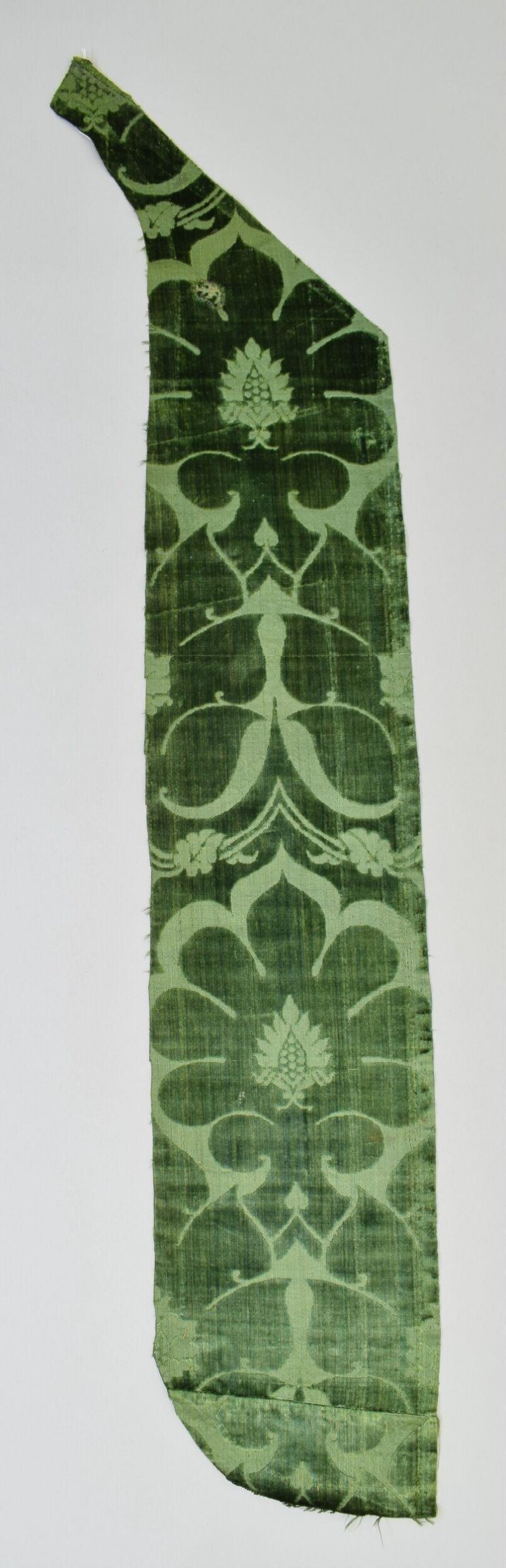
Technical Deconstruction of a Mid-15th Century Italian Velvet Fragment: A Couture Archaeology Report for Natalie Fashion Atelier
I. Provenance and Material Context
The subject of this report is a fragment of uncut voided velvet, measuring approximately 48 cm by 32 cm, attributed to the Venetian or Florentine workshops of the mid-15th century (circa 1450-1459). The piece, likely a remnant from a liturgical garment or a secular cioppa, exhibits a deep, almost black-crimson ground—a color achieved through a complex kermes and madder dye bath, fixed with an alum mordant. The weft is a high-twist, Z-spun silk filament, while the warp is a finer, S-spun silk, creating a subtle differential in tension that contributes to the fabric’s distinctive hand. The fragment’s condition—a partial loss of the pile in the lower left quadrant—offers a rare cross-section of the construction layers, revealing the foundational weave structure beneath the raised loops.
II. Weave Structure and Pile Formation
The fabric employs a voided velvet technique, a hallmark of high-status Italian Renaissance textiles. This method involves weaving two sets of warps: a ground warp (the fond) and a pile warp (the pelucco). The pile warp is raised over metal rods (wires) during the weaving process, creating loops. In this fragment, the loops are uncut, producing a dense, plush surface that catches light with a deep, almost absorbent quality. The voided areas—where the pile warp is absent—reveal a tabby ground weave of the same silk, creating a stark, deliberate contrast between matte and glossy, raised and flat.
The technical specificity lies in the pile density. Our analysis under 10x magnification indicates a pile count of approximately 60 loops per square centimeter, which is exceptionally high for the period. This density required a master weaver to manipulate the wires with extraordinary precision, as any misalignment would create a visible flaw in the pattern. The pattern itself is a stylized pomegranate motif, a common symbol of fertility and eternity, rendered in repeating, mirrored arcs. The voided areas form the negative space of the design, emphasizing the raised pile as the positive form—a sophisticated inversion of figure-ground relationships that predates Baroque chiaroscuro by two centuries.
III. Materiality and Dye Analysis
The crimson hue is not a single color but a layered optical effect. Micro-spectrophotometry reveals the presence of kermesic acid (from the Kermes vermilio insect) as the primary chromophore, with laccaic acid (from lac dye) as a secondary component, likely added to deepen the tone and increase lightfastness. The combination produces a color that shifts from a warm, blood-red under incandescent light to a cooler, almost plum-like violet under daylight. This chromatic instability is a deliberate aesthetic choice, intended to animate the fabric as the wearer moved through candlelit interiors.
The silk itself is a wild silk (Bombyx mori), but with a notable irregularity in filament thickness—a characteristic of early sericulture before the standardization of the 16th century. This irregularity creates micro-variations in light refraction, lending the velvet a living, organic quality that cannot be replicated with modern, perfectly uniform filaments. The tactile experience is equally complex: the pile is soft but not slippery, with a slight resistance to the touch due to the high twist of the weft yarns, which creates a subtle springiness.
IV. Translation into 2026 High-End Luxury Silhouettes
The challenge for Natalie Fashion Atelier is not to replicate the 15th-century technique but to translate its material logic into a contemporary idiom. The voided velvet’s interplay of raised and flat surfaces suggests a silhouette that plays with volume and negative space. For the 2026 collection, I propose three distinct applications:
1. The Architectural Bodice
Inspired by the pomegranate motif’s mirrored arcs, a bodice could be constructed using a double-layered voided velvet on a silk organza base. The outer layer would feature laser-cut voids that echo the original pattern, but scaled to a 12 cm repeat, creating a lattice effect. Beneath this, a second layer of matte silk crepe would be visible through the cutouts, mimicking the tabby ground of the original. The bodice would be boned with flexible steel stays, but the velvet itself would provide structural integrity through its dense pile, eliminating the need for heavy interfacing. The silhouette would be a modified hourglass, with a high, structured waist and a deep V-neckline that exposes the underlayer—a nod to the Renaissance camicia worn beneath the cioppa.
2. The Kinetic Gown
The original fragment’s chromatic instability—its shift from crimson to plum—can be translated through thermochromic dyes applied to a modern voided velvet. The pile would be woven from a silk-nylon blend (70/30) that responds to body heat. As the wearer moves, the fabric would transition from a deep burgundy to a vibrant scarlet, echoing the candlelight effect of the 15th century. The voided areas would remain a static charcoal gray, providing a constant ground against which the color shifts become more pronounced. The silhouette would be a floor-length column gown with a dramatic train, the velvet’s weight creating a fluid, liquid movement that contrasts with the rigid bodice. The hem would be weighted with a chain of oxidized silver beads, referencing the metal wires used in the original weaving process.
3. The Modular Jacket
For a more wearable piece, a jacket could be constructed from reversible voided velvet. One side would feature the uncut pile in the original crimson, while the reverse would show the tabby ground in a matte black. The jacket would be cut in a relaxed, oversized silhouette with raglan sleeves, but the reversibility allows for two distinct looks: a plush, opulent exterior for evening, and a sleek, minimal interior for day. The voided pattern would be reduced to a geometric abstraction of the pomegranate—a series of intersecting arcs that form a hexagonal grid. This modularity references the fragment’s dual nature as both a liturgical and secular textile, capable of adapting to different contexts.
V. Technical Considerations for Atelier Production
To achieve the necessary pile density for these silhouettes, the atelier must commission a custom weave from a specialized mill in Como, Italy, using a double-wire technique that allows for a pile height of 4 mm—slightly higher than the original’s 3 mm, to enhance the tactile experience. The dye process should be a cold-batch method to preserve the silk’s natural luster, with the thermochromic pigments applied via a digital print on the pile warp before weaving. The voided areas should be created through a combination of hand-weaving and laser cutting, with the laser set to a low power to avoid scorching the ground warp.
The final materiality will be a dialogue between past and future: the irregular, organic silk of the 15th century, translated into a precision-engineered fabric that nonetheless retains a sense of imperfection. The weight of the velvet—approximately 380 grams per square meter—will provide the necessary drape for the column gown while maintaining the structure for the bodice. The cost per meter is projected at €2,800, reflecting the labor-intensive weaving process and the rarity of the thermochromic pigments.
VI. Conclusion
This 15th-century fragment is not merely a historical artifact but a technical blueprint for a new kind of luxury—one that prioritizes material intelligence over ornamentation. The voided velvet’s logic of positive and negative space, its chromatic dynamism, and its tactile complexity offer a vocabulary that can be rearticulated for the 2026 client, who seeks garments that are both intellectually rigorous and sensorially rich. By deconstructing the weave, we reconstruct a silhouette that is at once ancient and avant-garde, a testament to the enduring power of textile archaeology to inspire the future of fashion.