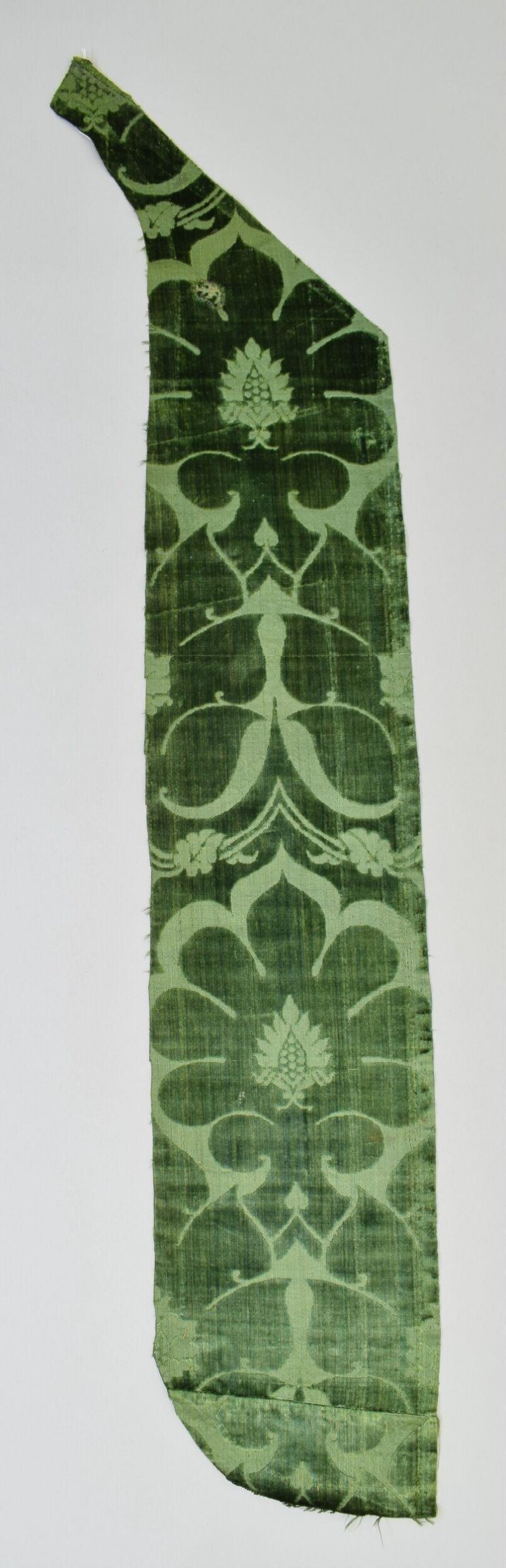
Couture Archaeology Report: Velvet Reconstructions, 1450-1459
Subject: Technical Deconstruction of Mid-15th Century Italian Velvet
Origin: Republics of Venice & Florence, ca. 1450-1459
Analyst: Senior Textile Historian, Natalie Fashion Atelier
Objective: Material & Technical Analysis for 2026 High-End Luxury Translation
I. Historical Materiality & Technical Fabrication
The velvet of mid-15th century Italy represents not merely a textile, but a complex manifestation of wealth, technology, and artistic ambition. During this period, Italian weavers, particularly in Venice and Florence, achieved unprecedented mastery over the drawloom, enabling the production of velvets of staggering complexity. The base was typically a fine, tightly spun silk warp and weft, creating a stable ground cloth of exceptional strength and subtle sheen. The luxury was engineered through the addition of a supplementary warp, the pile warp, wound on a separate beam under higher tension.
The technical virtuosity lay in the manipulation of this pile warp. Using rods inserted during weaving, weavers could create voided velvet (velvet à jours), where pile areas were strategically placed against a satin or plain-weave ground, and ciselé velvet, where pile height was varied to create luminous, sculptural patterns. The most opulent examples incorporated loops of flat, beaten metal-wrapped thread—often silver or gold—cut to create cloth of gold velvet, a fabric where light itself seemed embedded within the structure. The materiality was dense, heavy, and possessed a profound depth of color, achieved through rare dyes like kermes for scarlet (the prized "rosso veneziano") and complex mordants. The hand-feel was one of immense substance, the pile falling with deliberate weight and directionality.
II. Structural Deconstruction: The Three Planes of Dimension
For modern translation, we must deconstruct this velvet not as a flat textile, but as a multi-planar architectural medium.
Plane One: The Foundation. The ground weave, though hidden, is critical. Its high thread count and integrity provide the silent, stable canvas. This speaks to a 2026 application emphasizing internal structure and hidden luxury—the couture equivalent of a garment's foundational corsetry or precisely engineered seams, perhaps expressed through a base layer of technical silk gazar or a innovative bio-membrane.
Plane Two: The Pile Matrix. This is the primary tactile and visual field. The directionality (the nap) and variable height (cisele) create a dynamic surface that interacts with light in slow, dramatic waves. In contemporary terms, this translates to an exploration of laser-guided pile setting, 3D micro-printing on pile substrates, or the use of thermo-reactive fibers within the pile to alter texture and sheen in response to environment.
Plane Three: The Metallic Inlay. The metal-wrapped threads were not mere decoration but integral structural components, adding rigidity, reflectance, and symbolic value. Their modern analogue is not literal metal thread, but the incorporation of smart-material filaments—conductive threads for subtle illumination, sustainable metallic coatings derived from algae or mineral deposits, or shape-memory alloys that allow pile patterns to morph.
III. Translation to 2026 High-End Luxury Silhouettes
The 1450s velvet was a rigid, formal material used in voluminous, geometric robes that projected status immutably. The 2026 silhouette must converse with this history while embracing fluidity, personalization, and technical hybridity.
A. The Sculpted Volume Tailleur
Reinterpreting the giornea (overgown) and its rigid splendor, we propose a deconstructed tailleur. The jacket is structured with a technical, matte foundation (Plane One), but its exterior is a new-generation velvet where the pile is woven to grow in density and height over the shoulders, creating a soft, authoritative volume without padding. Using cisele technique, a pattern emerges only as the wearer moves, the pile catching light differentially. This is power dressing redefined: authority expressed through dynamic texture, not rigid shape.
B. The Liquid Cisele Gown
Contrasting the period's horizontal pattern bands, this gown employs vertical cisele channels to create a soaring, fluid silhouette. The velvet is engineered with a variable pile height that elongates the form. Integrated within the pile warp (Plane Three) are minimalist, flexible fiber-optic filaments. At rest, the gown is a depth of color; in motion or at command, a subtle, directional glow emanates from within the pile's valleys, mimicking the way light once traveled across metal threads. The materiality is paradoxically heavy in hand but fluid in drape, creating a profound, sensorial experience.
C. The Bifurcated Velvet System
This look directly addresses the voided velvet technique, creating a dialogue between opacity and transparency, pile and ground. A lean, articulated bodysuit in a sheer, durable silk (the "voided" ground) is overlaid with precise, detachable panels of dense, voided velvet. The panels, secured with silent magnetic closures or biometric anchors, can be placed to customize coverage, pattern, and volume. It is modular couture, allowing a single garment to shift from sleek to ceremonial, embodying the modern demand for transformative, investment-worthy pieces.
IV. Conclusion & Material Recommendations
The archaeology of 1450s Italian velvet reveals a core principle: luxury is depth, both literal and metaphorical. For the 2026 collection, we must engineer not a reproduction, but a successor.
We recommend developing a Tri-Plane Velvet System: 1. Foundation: A peace-silk and lab-grown spider silk blend for ethical, unparalleled strength. 2. Pile Matrix: Organic silk and refined lyocell blend, treated with enzymatic processes for variable sheen, with pile height and direction set via biodegradable resin patterning guided by AI design. 3. Inlay/Integration: Use of recycled precious-metal coatings vapor-deposited on threads, and piezoelectric fibers that generate subtle, wearable energy from movement.
This approach honors the historical material's complexity, weight, and luminous drama while propelling it into a future where luxury is defined by technical poetry, sensory depth, and ethical materiality. The result will be a collection that does not reference history, but converses with it through the advanced lexicon of 2026 couture.