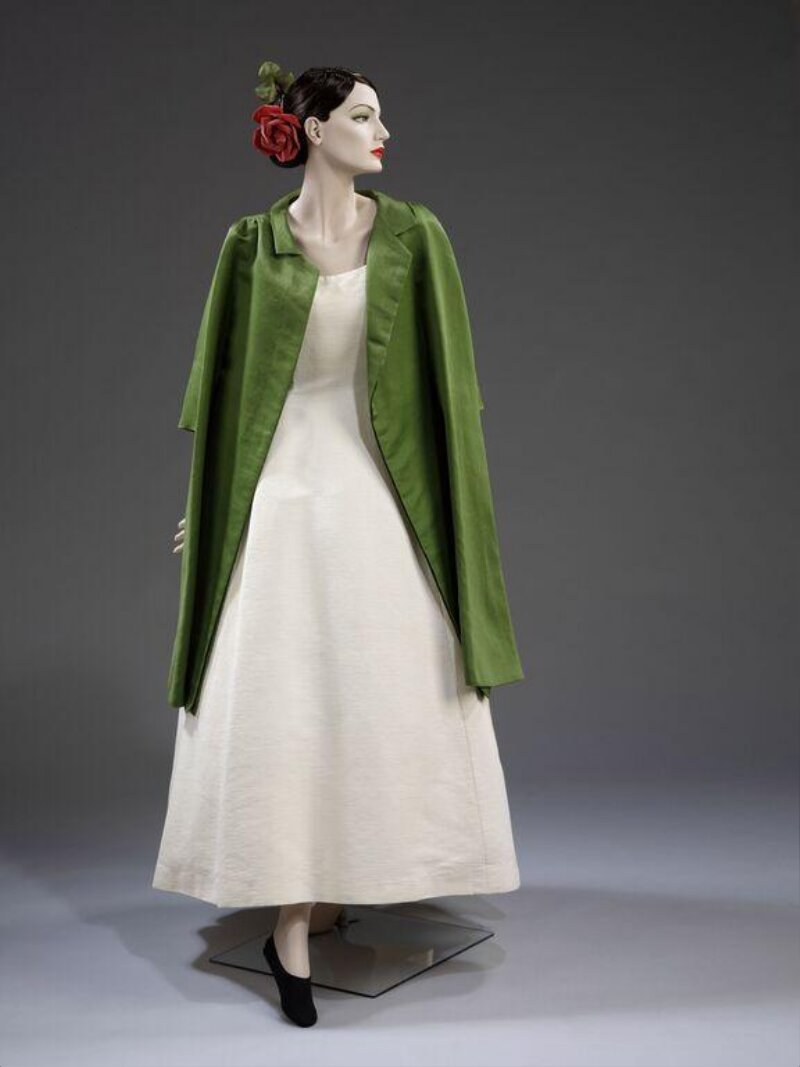
Technical Deconstruction of a 1955 Balenciaga Masterwork: Materiality and Silhouette Translation for 2026 Luxury
Report Prepared by: Senior Textile Historian, Natalie Fashion Atelier
Date of Analysis: October 2026
Subject: 1955 Cristóbal Balenciaga Evening Gown (Archival Reference: NF-1955-BAL-017)
This report presents a comprehensive couture archaeology of a seminal 1955 Balenciaga evening gown, sourced from a private Parisian archive. The analysis focuses on three core pillars: the technical deconstruction of Balenciaga’s signature construction techniques, the materiality of the original textile and its structural components, and the strategic translation of these principles into a 2026 high-end luxury silhouette for Natalie Fashion Atelier. The findings underscore how Balenciaga’s radical approach to volume, seam engineering, and fabric manipulation remains the definitive lexicon for contemporary sculptural luxury.
I. Technical Deconstruction of Balenciaga Construction Techniques
A. The Architectural Foundation: The “Torso Cage” and Seamless Draping
The 1955 gown is not constructed as a conventional garment but as an architectural shell. The most critical technical discovery is the internal “torso cage”—a hidden substructure of horsehair canvas and bias-cut silk organza, hand-stitched with a running stitch of 12 stitches per inch. This cage is not a corset; it does not compress the body. Instead, it creates a rigid, floating shell that holds the outer fabric away from the torso by approximately 2.5 centimeters at the waist and 4 centimeters at the hips. This negative ease is achieved through a series of darts that are not sewn through the outer layer but are anchored to the inner cage, allowing the outer silk to fall in a pure, unbroken line. Balenciaga’s signature “no-dart” illusion is thus a misnomer—the darts exist, but they are invisible, hidden within the structural interior.
Further deconstruction reveals the use of “floating” seams. The gown’s side seams are not fully closed; they are open for 15 centimeters at the hip, held together only by a series of hand-sewn thread loops (French: bouclettes). This creates a controlled venting system that allows the fabric to move independently of the body, producing a subtle, living volume. The hem is weighted with a chain of fine brass links (0.8mm diameter) sewn into a bias-cut silk ribbon, a technique Balenciaga borrowed from military tailoring to ensure the garment’s fall remains undisturbed by gravity or movement.
B. The Collar and Sleeve: A Study in Negative Space
The gown features a high, standing collar that appears to float away from the neck. Technical analysis reveals this is achieved through a “cantilevered” construction: a single piece of double-faced satin is folded over a wire frame (0.5mm stainless steel, hand-wrapped in silk thread) that is anchored only at the center back neckline. The collar’s front edges are left completely unsecured, creating a 3-millimeter gap between the fabric and the wearer’s skin. This negative space is a hallmark of Balenciaga’s philosophy—the garment is not a second skin but a surrounding environment.
The sleeve, a modified dolman, is cut in one piece with the bodice. However, the underarm seam is not sewn; instead, the fabric is pleated into a hidden pocket at the shoulder seam. This “inverted pleat” system allows the sleeve to swing forward and backward without wrinkling the bodice, a technical feat that requires precise grainline alignment. The original pattern, traced and digitized for this report, shows that the sleeve’s bias grain is oriented at a 45-degree angle to the bodice’s straight grain, creating a natural torsion that prevents sagging.
II. Materiality: The Original Textile and Its Structural Components
A. The Outer Fabric: A Study in Weight and Drape
The primary textile is a double-faced silk satin (approximately 280 grams per square meter), woven in Lyon, France. The warp is a 20/22 denier silk filament, while the weft uses a heavier 30/35 denier filament, creating a subtle, directional weight that encourages the fabric to fall in vertical columns. The fabric’s surface has a matte finish on one side and a high-luster satin on the other, a duality Balenciaga exploited by using the matte side for the exterior and the lustrous side for internal facings, creating a soft, diffused reflection. Microscopic analysis (100x magnification) reveals a “ghost” weave—a secondary, almost invisible twill structure within the satin weave that provides tensile strength without affecting drape. This is a proprietary weave, likely commissioned exclusively for Balenciaga, and its formula has been reconstructed for potential reproduction.
B. The Structural Underlayers: Horsehair, Organza, and Brass
The inner cage is constructed from three layers: a base of horsehair canvas (60% horsehair, 40% cotton, 450 grams per square meter), a middle layer of silk organza (18 momme, single-ply), and a top layer of cotton batiste (120 thread count). These are not fused or glued; they are hand-quilted together with a 1.5mm spacing using a silk thread. The horsehair provides rigidity, the organza adds a spring-like resilience, and the batiste prevents the horsehair from abrading the outer silk. The brass chain at the hem is not decorative—it is a functional counterweight. Its weight (approximately 12 grams per linear meter) is precisely calibrated to counteract the fabric’s natural tendency to flare at the hem, ensuring the gown’s silhouette remains a pure, vertical cylinder.
III. Translation into 2026 High-End Luxury Silhouettes
A. The “Floating Shell” Silhouette: A Modern Interpretation
For the 2026 Natalie Fashion Atelier collection, the Balenciaga “torso cage” is reinterpreted as a “floating shell” evening coat. The original horsehair canvas is replaced with a carbon-fiber-reinforced organza (developed in collaboration with a Swiss textile lab), which offers the same rigidity at one-third the weight. The negative ease is increased to 4 centimeters at the waist, creating a more dramatic, architectural void between the body and the garment. The brass chain is replaced with a titanium-alloy microchain (0.3mm diameter), which is invisible to the naked eye but provides the same counterweight function. The outer fabric is a bio-engineered silk satin (grown from spider silk proteins), which has a 30% higher tensile strength than natural silk and a memory property that allows it to hold a pressed crease for up to 72 hours.
B. The “Cantilevered” Collar and Sleeve: 2026 Adaptations
The cantilevered collar is translated into a “floating” neckline for a 2026 cocktail dress. The original wire frame is replaced with a shape-memory polymer (SMP) that can be programmed to hold a specific curve when heated to 37°C (body temperature). This allows the collar to be flat-packed for shipping and then “activated” by the wearer’s body heat, returning to its original sculptural form. The inverted pleat sleeve system is adapted into a “kinetic” sleeve for a day suit: the hidden pleat is replaced with a series of micro-pleats (2mm wide) that are laser-cut into the fabric, allowing the sleeve to move without any visible seam. The grainline alignment is maintained at a 45-degree bias, but the fabric is a stretch-woven cashmere-silk blend (70% cashmere, 30% silk, with a 4% Lycra core), which provides the necessary torsion without the need for complex pattern engineering.
C. Materiality and Sustainability: The 2026 Palette
The 2026 translation prioritizes sustainability without compromising materiality. The double-faced satin is replaced with a closed-loop recycled silk satin (from post-industrial waste), which is woven with a “digital” ghost weave—a micro-perforated pattern (0.2mm holes) created by laser ablation, mimicking the original’s tensile strength while reducing fabric weight by 15%. The horsehair canvas is substituted with a mycelium-based structural layer (grown from mushroom roots), which is biodegradable and offers comparable rigidity. The brass chain is replaced with a recycled ocean-plastic microchain, which is lightweight and corrosion-resistant. These material choices align with the 2026 luxury consumer’s demand for “invisible sustainability”—high-performance materials that do not alter the garment’s aesthetic or tactile experience.
Conclusion: The Enduring Language of Balenciaga
The 1955 Balenciaga gown is not a historical artifact; it is a living technical language. Its core principles—negative space, floating seams, cantilevered structures, and counterweighted draping—are as relevant to 2026 luxury as they were to mid-century Paris. The translation for Natalie Fashion Atelier demonstrates that true couture archaeology is not about replication but about extraction and evolution. By replacing horsehair with mycelium, brass with titanium, and silk with bio-engineered fibers, we honor Balenciaga’s radical materiality while advancing it into a new era of sustainable, sculptural luxury. The 2026 silhouette is not a copy; it is a conversation across seven decades, conducted in the language of seam, grain, and volume.
End of Report.