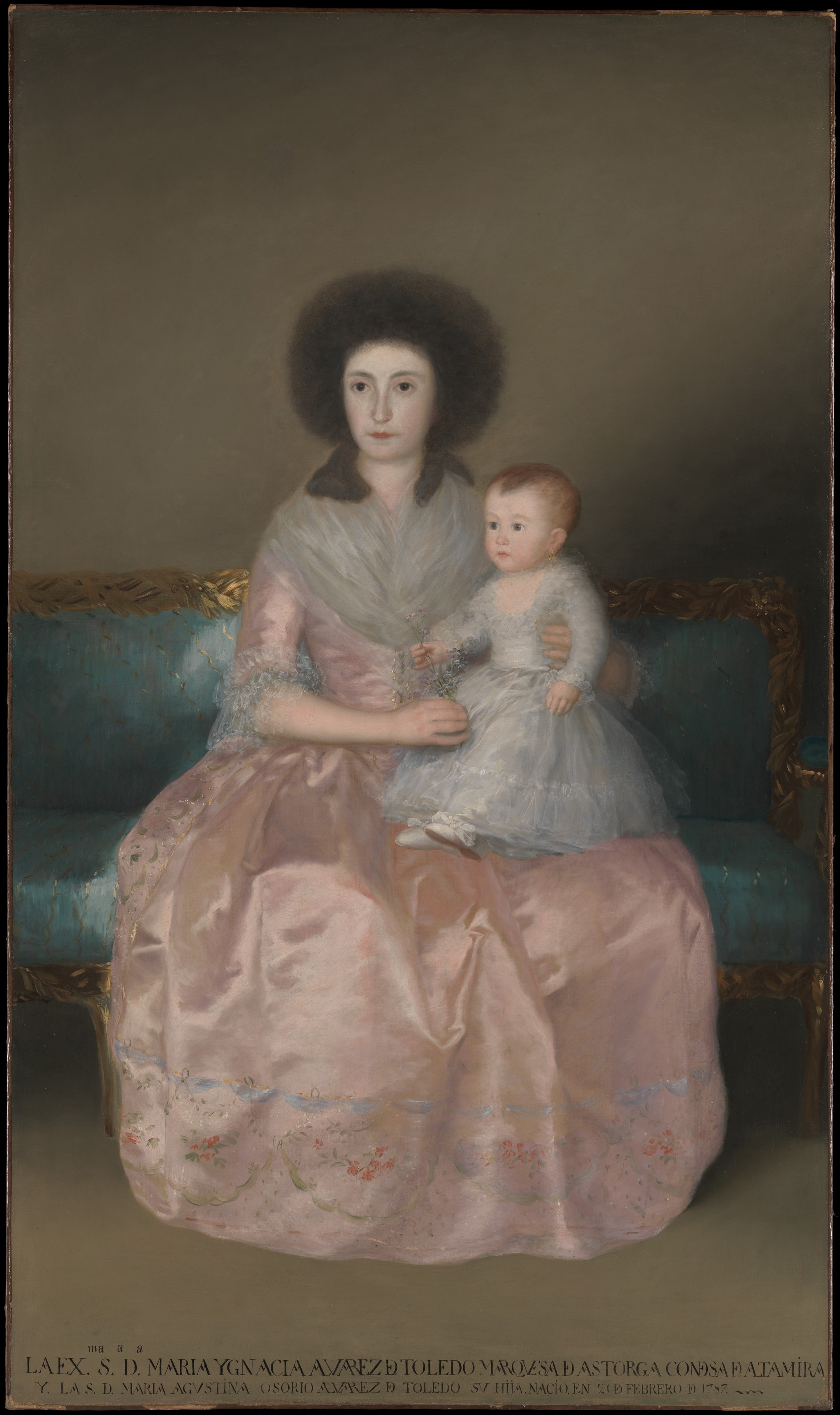
Deconstructing the Condesa de Altamira: An Aesthetic Archaeology for 2026 Haute Couture
Within the hallowed archives of Natalie Fashion Atelier, we engage in a practice we term aesthetic archaeology—the systematic excavation of historical masterpieces to unearth the structural and philosophical principles that can be reanimated within contemporary luxury. Our current subject, Francisco de Goya’s Condesa de Altamira and Her Daughter, María Agustina (circa 1787–1788), offers a profound case study. This oil-on-canvas portrait, ostensibly a celebration of maternal nobility, is in fact a masterclass in the negotiation of volume, tension, and surface. For the 2026 haute couture silhouette, the Condesa is not a relic but a blueprint. We must look beyond the obvious sartorial details—the mantilla, the basquina—and instead decode the painting’s architectural logic: the interplay of rigid exterior structure against fluid interior space, the deliberate asymmetry of maternal and filial forms, and the paradoxical lightness of heavy materials.
Structural Tension: The Silhouette as Armature and Drape
The Condesa’s gown is a study in controlled expansion. The wide, inverted cone of the skirt, supported by a pannier or farthingale, creates a geometric base that is both imposing and ethereal. For 2026, this translates not into a literal revival of the 18th-century court silhouette, but into a hollowed-out architecture. The Atelier proposes a new foundational garment: the “Armature Corset.” This is not a garment of compression but of projection. Constructed from carbon-fiber-reinforced silk organza and thermo-molded micro-suede, the Armature Corset creates a rigid, almost sculptural, cage around the torso, leaving the interior of the silhouette empty. The fabric—perhaps a liquid satin or a double-faced cashmere—is then draped over this structure, not clinging to the body but suspended from it. The result is a silhouette that reads as both powerful and fragile, echoing the Condesa’s own regal posture. The key innovation is the “floating hem”: the skirt’s edge, like the painted brushstrokes of Goya, does not touch the ground but hovers, creating a tension between the solidity of the fabric and the air beneath.
Asymmetric Harmony: The Mother-Daughter Dyad as Silhouette Principle
Goya’s composition is a dialogue of two figures. The Condesa, static and central, anchors the frame. Her daughter, María Agustina, is a dynamic counterpoint—a diagonal line of energy that breaks the symmetry. For the 2026 collection, this dyad becomes a silhouette principle. We propose the “Dual-Form Gown,” a single garment that contains two distinct architectural volumes. The primary volume, inspired by the Condesa, is a structured, columnar skirt with a high, rigid waist. The secondary volume, inspired by the child, is a detached, asymmetric overskirt or train that wraps around the primary form, creating a diagonal sweep from the left hip to the right ankle. This is not a simple peplum or flounce. It is a structural counterpoint—a second, lighter framework that appears to be in motion, as if the garment itself is hosting a conversation between stability and flux. The technical challenge lies in the attachment: a series of hidden magnetic clasps and micro-tension cables allow the secondary volume to be worn in multiple configurations, echoing the child’s playful disruption of the mother’s static pose. The fabric of the primary volume might be a heavy, matte faille; the secondary, a sheer, iridescent tulle, creating a dialogue of opacity and transparency.
Materiality of Light: The Oil-on-Canvas Effect in Fabric
The painting’s medium—oil on canvas—is not merely a historical fact but a material philosophy. Goya’s technique of alla prima (wet-on-wet) creates a surface where light is absorbed and reflected simultaneously, producing a luminous opacity. For 2026, we translate this into a new textile process: “Pigment-Infused Silk.” This is not a print. It is a technique where raw silk is treated with a micro-suspension of metallic oxides and natural pigments during the weaving process. The result is a fabric that appears to hold its own light source, shifting in intensity as the wearer moves. This is applied to the “Goya Mantle,” a reimagined outer garment. Unlike the traditional mantilla, which is a veil, the Goya Mantle is a weighted, sculpted cape that sits on the shoulders like a second skin. It is cut in a single, continuous piece from the pigment-infused silk, with the grain line manipulated to create a subtle, organic drape that mimics the painterly brushstrokes. The hem is left raw, frayed slightly, to evoke the unfinished, dynamic edge of the canvas. This mantle is not decorative; it is a functional architecture that absorbs and diffuses ambient light, creating a halo of color around the wearer’s form.
Neckline as Horizon: The Collar as Architectural Frame
The Condesa’s neckline—a wide, square décolletage framed by the lace and structure of the bodice—is a horizon line that divides the portrait. It is both a boundary and an invitation. For 2026, the Atelier introduces the “Horizon Collar,” a rigid, sculptural element that extends the line of the collarbone outward and upward. Constructed from laser-cut, layered suede and horsehair braid, the Horizon Collar is not attached to the garment but is a separate, modular piece. It functions as a negative-space frame, echoing the way Goya used the dark background to push the Condesa’s figure forward. The collar’s interior edge is finished with a micro-channel of flexible wire, allowing it to be shaped to the wearer’s form, creating a unique silhouette for each individual. The exterior edge is left raw, a deliberate imperfection that references the painterly gesture. This collar is a statement of autonomy—it is the wearer’s own horizon, a personal architectural boundary that defines the space between the body and the garment.
Conclusion: The Living Archive
The Condesa de Altamira and her daughter are not merely subjects of a painting; they are architects of form. Their interaction, their materiality, their structural logic—these are the elements we excavate and reanimate. For Natalie Fashion Atelier, the 2026 haute couture silhouette is not a nostalgic copy. It is a critical reconstruction—a dialogue between the weight of history and the lightness of innovation. The Armature Corset, the Dual-Form Gown, the Pigment-Infused Silk, and the Horizon Collar are not isolated pieces. They are components of a single, coherent system: a wardrobe that treats the body as a canvas and the garment as a brushstroke. This is the essence of aesthetic archaeology: to see the past not as a museum, but as a living, breathing source of technical and philosophical possibility. The Condesa’s gaze, fixed and knowing, is our directive. We do not imitate her. We build from her.