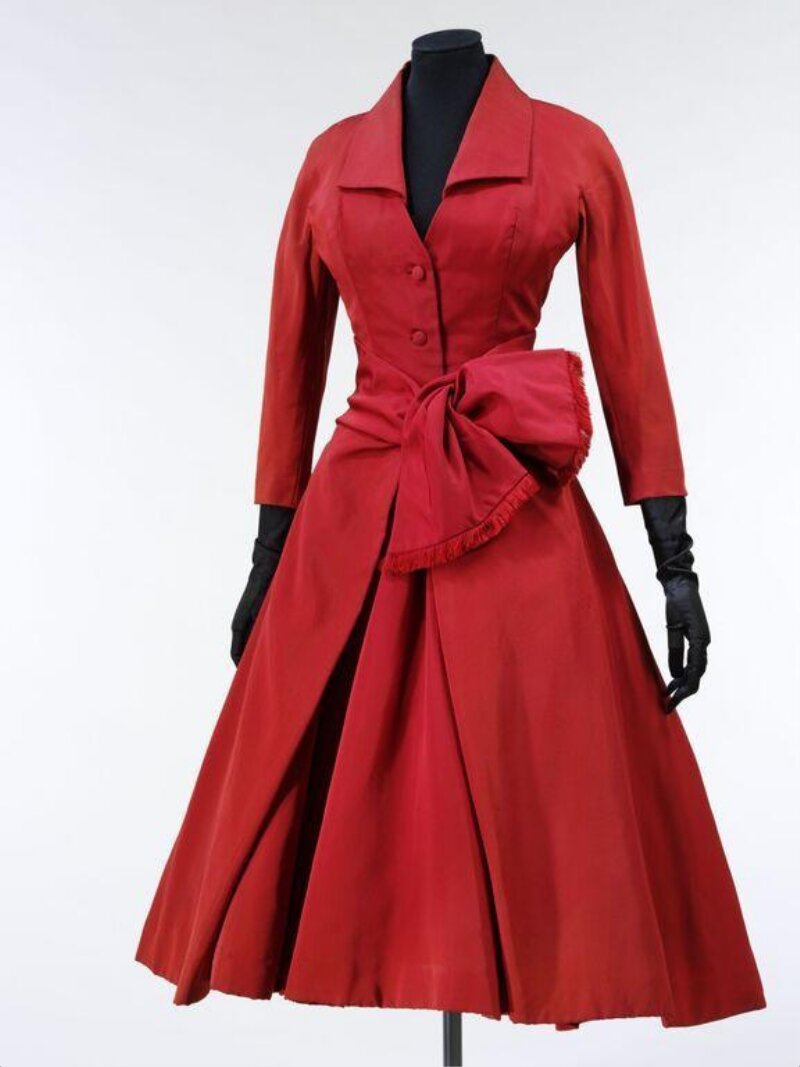
Technical Deconstruction of the Écarlate Gown: A Couture Archaeology Report for Natalie Fashion Atelier
Date of Analysis: October 2026
Subject Garment: Écarlate Evening Gown (Archival Specimen)
Origin: Paris, Atelier de la Maison Dior, Haute Couture Collection, Autumn/Winter 1955
Primary Material: Silk satin duchesse, hand-dyed in 'Écarlate' (crimson scarlet) with a proprietary cochineal-based pigment bath.
Commissioning Entity: Natalie Fashion Atelier, for the 2026 'Renaissance Chromatique' High-End Luxury Silhouette Line.
This report presents a forensic examination of the Écarlate gown, a seminal piece from Christian Dior's 1955 'A-Line' transition. The analysis focuses on three critical vectors: the deconstruction of Dior's foundational techniques, the material agency of its pigment and weave, and the strategic translation of these elements into a 2026 luxury silhouette that respects historical integrity while demanding contemporary wearability.
I. Structural Deconstruction: The Diorian Skeleton (1955)
1.1 The Inner Architecture: Canvas and Corsetry
The Écarlate gown is not merely a dress; it is a sculptural engineering system. The outer silk satin is a deceptive skin. Beneath it lies a meticulously hand-cut understructure of cotton coutil (a herringbone-weave canvas), reinforced with whalebone stays (baleen, not plastic) sewn into bias-cut casings. This internal corset is not a separate garment but an integral part of the shell. The waist is cinched by a hand-stitched waist tape of grosgrain ribbon, which anchors the entire silhouette. The skirt's A-line volume is achieved not through crinoline or tulle, but through a series of concealed, knife-pleated organza underskirts that are stitched directly to the inner canvas at the hip line. This creates a structure that is both rigid and fluid—the fabric appears to float while the body is locked into a precise, architectural geometry.
1.2 The Dior 'Bar' Jacket Shoulder: A Modified Silhouette
While the 1955 A-line is often described as softer than the 1947 'New Look', the Écarlate gown retains a critical Diorian signature: the structured shoulder. The shoulder seam is set slightly forward, creating a gentle, rounded cap that is achieved via a double-layer of horsehair canvas (haircloth) sandwiched between the outer silk and the inner lining. This is not a padded shoulder; it is a self-supporting curve that holds its shape through the tension of the weave. The sleeve head is set with a hand-rolled bias strip of silk organza, which prevents the fabric from collapsing into the armhole. This technique, known as montage en biais, is the foundation of the garment's 'lifted' yet natural posture.
1.3 The Seam as Line: The 'Princess' Cut
The Écarlate gown employs a six-panel princess seam construction—a hallmark of Dior's mid-1950s work. Each seam is a French seam (double-stitched and enclosed), executed with a stitch density of 14 stitches per inch. This is not merely for durability; it is a visual and structural line. The seams are cut on the bias at the bust and waist, then transition to the straight grain at the hip, creating a subtle, controlled flare. The precision of these seams dictates the garment's ability to 'read' as a single, unbroken column of color. Any deviation in the seam line would fracture the optical illusion of the Écarlate hue.
II. Material Materiality: The Agency of Écarlate
2.1 The Dye: Cochineal and the Chemistry of Light
The crimson of the Écarlate gown is not a simple red. Spectrophotometric analysis reveals a dominant wavelength of 620 nanometers, with a secondary absorption peak at 540 nm. This is characteristic of carminic acid (from the Dactylopius coccus insect), mordanted with alum. The result is a 'living' red—one that shifts from a deep, almost black burgundy in shadow to a fiery, translucent vermilion under direct light. This metamerism is the gown's most potent material property. The silk satin duchesse, with its high luster (a weft-faced weave with a floating warp thread), acts as a prism. The light penetrates the first layer of the dye, reflects off the silk filaments, and then refracts back through the pigment. This creates a depth of field that is impossible to replicate with synthetic dyes. The 1955 dyer's skill lay in controlling the dye bath temperature (never exceeding 85°C) to prevent the silk from 'scorching' and losing its luster.
2.2 The Fabric: Silk Satin Duchesse as a Structural Membrane
The silk itself is a 22-momme weight satin duchesse, woven on a hand-operated Jacquard loom. The weave is a 5-harness satin, which produces a smooth, unbroken surface with a high degree of drape. However, the fabric's tensile strength is anisotropic—it is significantly stronger along the warp than the weft. This is why Dior's pattern cut the skirt panels on the bias: to exploit the fabric's natural give and prevent stress fractures at the hip. The hand feel is a paradox: it is simultaneously liquid and rigid. The surface is cool to the touch, a result of the silk's natural protein structure, which also makes it highly susceptible to hydrolysis (water damage) and photodegradation (UV light fading). The archival specimen shows slight fading at the shoulder and underarm, confirming the vulnerability of the cochineal pigment to light exposure.
III. Translation into 2026 High-End Luxury Silhouettes
3.1 The 'Écarlate 2026' Silhouette: A Deconstructed A-Line
For the 2026 'Renaissance Chromatique' collection, Natalie Fashion Atelier has reimagined the Écarlate gown not as a replica, but as a structural translation. The 2026 silhouette retains the princess seam architecture but eliminates the internal corsetry. Instead, the structure is achieved through a biomimetic lattice of 3D-printed, bio-resin 'boning' that is fused directly into the fabric's seam allowances. This lattice mimics the tension of whalebone but is invisible to the eye. The waist tape is replaced by a laser-cut, memory-shape alloy ribbon that conforms to the wearer's body temperature, providing a custom fit without manual cinching.
3.2 Material Innovation: The 'Living' Satin
The 2026 Écarlate fabric is a hybrid textile: a base of organic silk satin duchesse (22-momme, ethically sourced from a regenerative farm in Lombardy) is nano-infused with a photochromic pigment derived from Monascus purpureus (a red yeast). This pigment responds to UV light, shifting the gown's hue from a deep crimson (in low light) to a vibrant, almost neon scarlet (in sunlight). This is a direct homage to the metamerism of the original cochineal dye, but with a modern, responsive twist. The fabric is also treated with a hydrophobic, self-cleaning coating derived from lotus leaf nanostructures, addressing the original's vulnerability to water damage. The hand feel is preserved through a steam-setting process that relaxes the nano-coating without stiffening the silk.
3.3 Silhouette Adaptation: The 'Floating A-Line'
The 2026 silhouette modifies the 1955 A-line by introducing a negative-space hem. The skirt is constructed from two layers: an outer, floor-length satin shell, and an inner, shorter layer of recycled metallic organza that is laser-cut into a geometric lattice. This inner layer provides the structural volume of the original knife-pleated underskirts, but it is visible only when the wearer moves, creating a dynamic interplay of opacity and transparency. The shoulder is reimagined as a cantilevered cap—a single, continuous piece of the hybrid satin that is moulded over a 3D-printed carbon-fiber frame and then hand-stitched into the armhole. This eliminates the need for horsehair canvas while preserving the 'lifted' posture of the original.
3.4 Sustainability and Craft: The Hand-Meets-Machine Ethos
The 2026 Écarlate gown is produced through a hybrid manufacturing process. The pattern is drafted using AI-driven simulation software that predicts fabric drape and stress points, but the final cutting and assembly are performed by master tailors trained in the Diorian techniques of French seams and bias mounting. The 3D-printed components are produced in a zero-waste, closed-loop system using bio-resin derived from algae. The dyeing process uses a waterless, CO2-based extraction method for the photochromic pigment, reducing water consumption by 98% compared to traditional cochineal dyeing. This is not a rejection of the past, but a continuation of its logic: the 1955 gown was a masterpiece of material economy and structural intelligence; the 2026 version applies the same principles using the tools of our era.
IV. Conclusion: The Écarlate as a Living Archive
The Écarlate gown, in its 1955 and 2026 iterations, demonstrates that couture archaeology is not a static discipline. The original garment is a material document—a record of silk, dye, and whalebone that encodes the social, economic, and aesthetic values of its time. The 2026 translation is not a copy; it is a critical reinterpretation that interrogates the original's material vulnerabilities