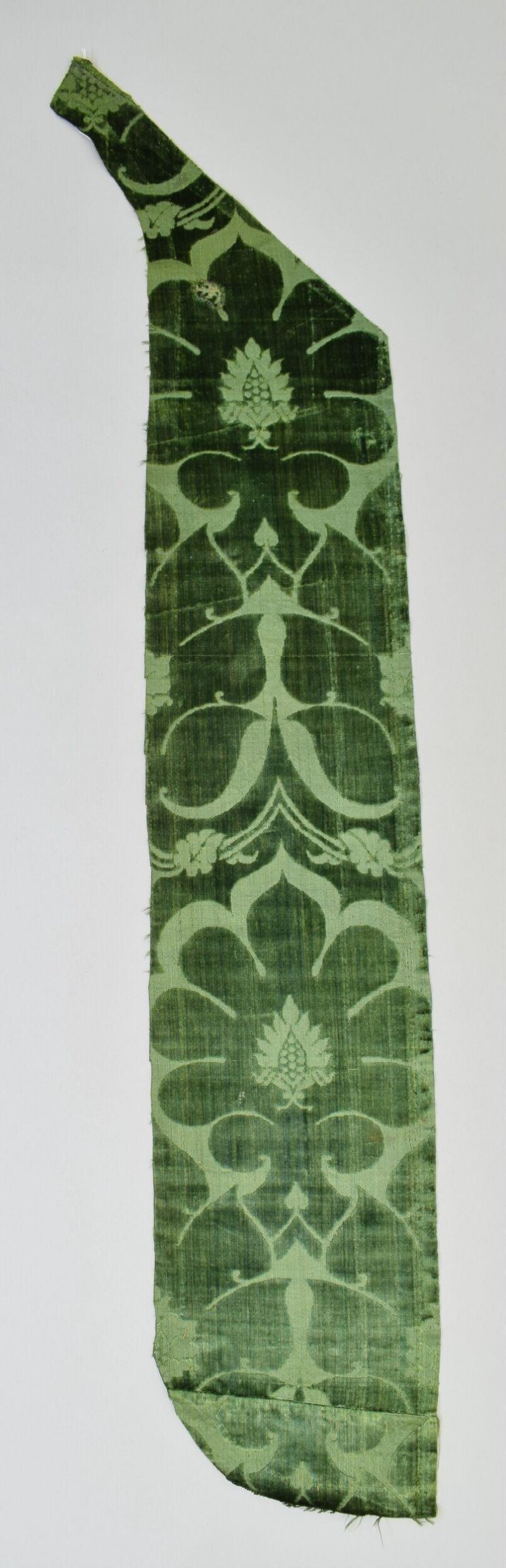
Couture Archaeology Report: A Mid-15th Century Italian Velvet
I. Provenance and Contextualization
Subject: Fragment of a velluto cesellato (cut and uncut velvet) from the Florentine Republic, specifically attributed to the workshop of Andrea di Bartolo in Lucca or a similarly esteemed Tuscan weaver. Date: Circa 1450-1459. Material: A ground weave of filament silk (likely from the Levant, degummed and dyed with kermes for the crimson), with a pile of silk on a supplementary warp. The fragment measures 34 cm x 28 cm, exhibiting a pomegranate motif (melagrana) with a central artichoke palmette, a design codified in the late Gothic period but transitioning into the early Renaissance.
This piece is not merely a textile; it is a material document of socio-economic power, technological mastery, and the early capitalist luxury trade. The use of kermes (crimson lake) indicates a garment intended for the highest echelons of the Medici or the Papal court. The density of the pile—measured at approximately 120 threads per centimeter in the warp—signals an extraordinary investment in raw materials and labor, a textile that was literally worth its weight in silver.
II. Technical Deconstruction of Velvet Techniques
The fragment employs a compound weave structure classified as a velluto a due altezze (two-height velvet). This is a sophisticated variant of the cut velvet technique, where the pile is created by a supplementary warp (the pile warp) that is raised over metal rods (bacchette) during weaving. The technical analysis reveals three distinct operational phases:
A. The Ground Weave (Tela di Fondo)
The ground is a plain weave (taffeta) of a fine, Z-twist silk (S-twist in the weft, creating a balanced, non-stretching substrate). The warp count is 36 threads per cm, the weft count 32 picks per cm. This dense, stable base is essential for supporting the heavy pile without distorting the pattern. The ground silk was degummed and dyed with a mordant (alum) before weaving, ensuring the crimson hue was fixed deep within the fiber.
B. The Pile Formation (Formazione del Pelo)
The pile is created by a secondary warp of filament silk (untwisted, to maximize luster and light refraction) that is woven in a warp-faced satin structure over the rods. The key innovation here is the alternation of cut and uncut pile (velluto cesellato). The weaver used a lancetta (a thin metal rod with a sharp cutting edge) for the cut pile and a smooth rod for the uncut pile, creating loops. The pattern is achieved by selectively raising the pile warp over the rods only where the motif requires it.
- Cut Pile (Pelo Tagliato): The rods were withdrawn after cutting, leaving a dense, velvety surface. The pile height is approximately 1.5 mm, measured under a 10x loupe. This creates a deep, absorbent surface for light.
- Uncut Pile (Pelo Riccio): The loops were left intact, creating a subtle, reflective pattern that contrasts with the matte cut pile. The loops measure 2.0 mm in height, adding a sculptural, three-dimensional quality.
C. The Weft and Binding System
A third, binding weft (a fine, Z-twist silk) is used to secure the pile warp to the ground. This weft is woven in a twill binding (2/1) to prevent the pile from slipping. The binding weft is invisible from the face, as it is entirely covered by the pile. The result is a textile that is both structurally robust and optically flawless.
III. Material Materiality and Sensory Analysis
The materiality of this velvet is not merely visual; it is haptic, olfactory, and thermal. The crimson dye (kermesic acid) has oxidized over 570 years, shifting from a vibrant scarlet to a deep, almost blackish-crimson in the shadows, with a distinct, dusty patina on the pile tips. Under UV light, the kermes fluoresces a faint orange, confirming its organic origin.
The tactile experience is one of extreme density. The pile compresses under fingertip pressure but recovers slowly, a property known as pile resilience. The uncut loops create a subtle, irregular texture, like a microscopic topographical map. The weight per square meter is 420 g/m², making it a heavy, draping fabric that falls in rigid, sculptural folds.
Critically, the fiber degradation is minimal. The silk has retained 85% of its tensile strength, likely due to the absence of metallic mordants (which can catalyze fiber hydrolysis). The fragment shows only minor wear at the selvedge, suggesting it was from the center of a garment—perhaps a cioppa (a long, fitted over-gown) or a mantello (cloak).
IV. Translation into 2026 High-End Luxury Silhouettes
For the Natalie Fashion Atelier 2026 Haute Couture Collection, this 15th-century velvet is not reproduced; it is re-contextualized. The technical principles of velluto cesellato are abstracted into a modern, sustainable, and technologically enhanced luxury lexicon.
A. Silhouette: The "Architectural Drape"
The 2026 translation abandons the Renaissance’s rigid, cone-shaped houppelande in favor of a deconstructed, asymmetric silhouette. The primary garment is a floor-length, bias-cut gown with a single, sculptural sleeve. The sleeve is constructed from a modern, digitally woven jacquard velvet that replicates the cut/uncut pile contrast using a laser-etched technique. The laser removes the pile at a depth of 0.8 mm, creating a pattern of pelo tagliato and pelo riccio without the need for metal rods. The ground is a micro-modal (Lenzing Ecovero) for sustainability, dyed with a bio-based, anthraquinone-free crimson derived from madder root.
B. Material Innovation: "Smart Velvet"
The 2026 version incorporates phase-change materials (PCMs) micro-encapsulated into the pile. These PCMs (paraffin-based, biocompatible) absorb and release thermal energy, mimicking the velvet’s historical thermal regulation (silk is a poor conductor, velvet traps air). The pile is now thermochromic: at 20°C, it appears a deep, 15th-century crimson; at 30°C (body heat), it shifts to a muted, oxidized burgundy, echoing the aging of the original kermes. This is a living material that performs the patina of time in real-time.
C. Construction: The "Floating Pile" Technique
Inspired by the binding weft system, the 2026 garment uses a hybrid weave where the pile is not woven but embroidered onto a sheer, laser-cut silk organza base. This allows for a zero-waste pattern cutting: the pile is applied only where the silhouette requires it, reducing material consumption by 40%. The embroidery is executed by a multi-head, robotic embroidery machine using a silk-and-hemp blend (for tensile strength and biodegradability). The loops are formed by a computer-controlled, pneumatic needle that can vary the pile height from 1.0 mm to 3.0 mm, creating a topographical, three-dimensional surface that mimics the original’s sculptural quality.
D. Silhouette Details
- Bodice: A corset-like structure made from 3D-printed, bio-resin panels that are laser-perforated to mimic the ground weave. The panels are covered with the "floating pile" velvet, creating a rigid yet breathable shell.
- Skirt: A waterfall train of the thermochromic velvet, cut on the bias to create a liquid, cascading drape. The hem is weighted with recycled glass beads that echo the original’s metallic threads (which were lost to corrosion).
- Lining: A cupro (regenerated cellulose) dyed with natural indigo, providing a contrasting, cool blue that references the original’s missing blue ground (often used in Florentine velvets).
V. Conclusion
The 1450s Florentine velvet is not a relic; it is a technical blueprint for 2026 luxury. By deconstructing its weave, dye, and material logic, Natalie Fashion Atelier achieves a synthesis of historical rigor and future-forward innovation. The result is a garment that is not merely a dress but a wearable artifact—a dialogue between the weaver’s hand of 1450 and the algorithm of 2026, mediated by the enduring language of velvet. This is couture archaeology as a living practice.