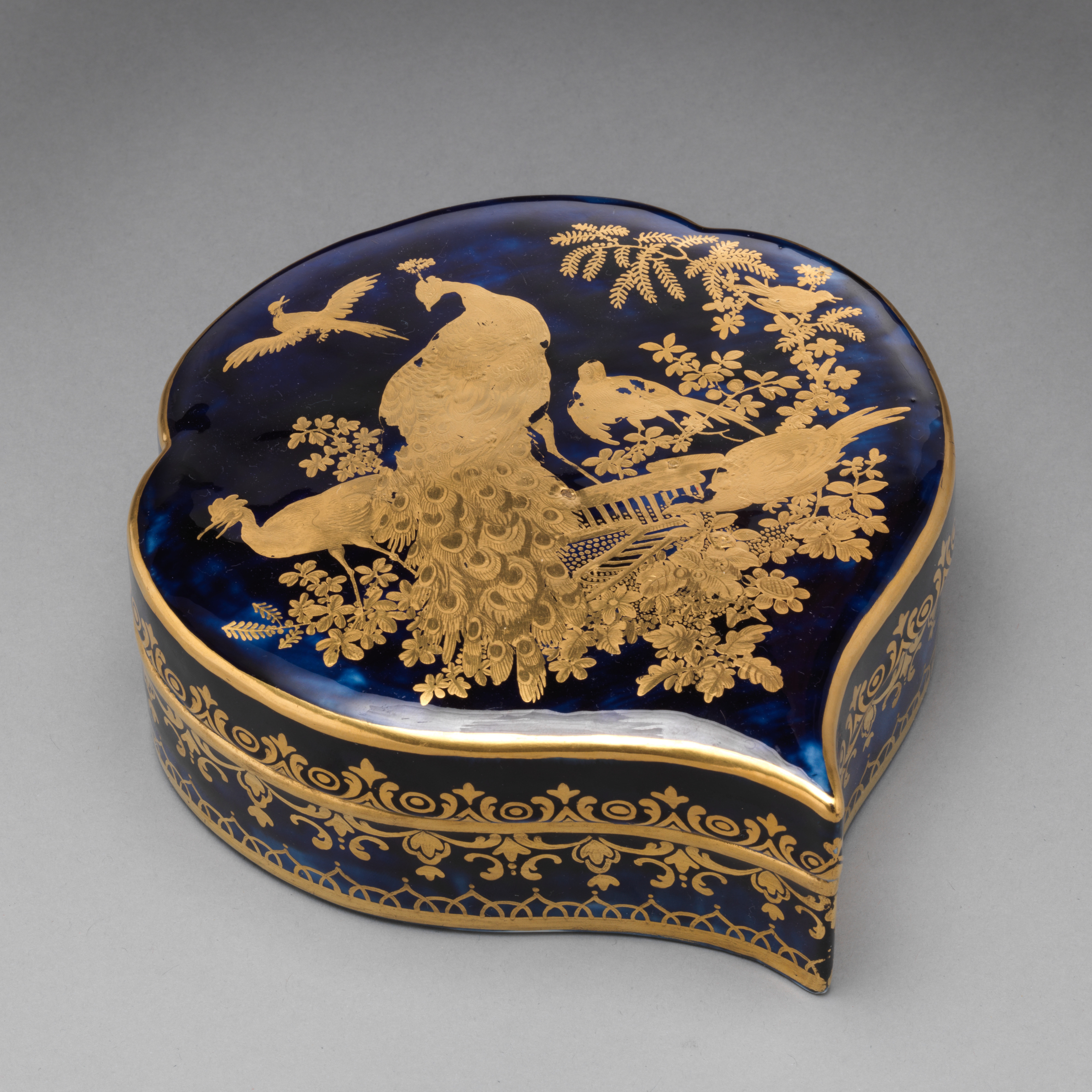
Deconstructing the Porcelain Cabinet: The Toilet Box as a Silhouette Engine for 2026
The isolated artifact—a soft-paste porcelain toilet box comprising four nested containers, its surface a field of Mazarin blue ground overlaid with intricate gold decoration—presents a unique challenge to the aesthetic archaeologist. Removed from its functional context of the aristocratic dressing table, the object becomes a pure study in volumetric proportion, chromatic tension, and the logic of containment. For Natalie Fashion Atelier, this 18th-century object is not a decorative curiosity but a generative schema for the 2026 luxury silhouette. The box’s architecture of nested volumes, its dialogue between a deep, absorbing blue and a precise, reflective gold, and its articulation of interiority versus exteriority, directly inform a new vocabulary of form for the coming season.
Volumetric Containment and the Nested Silhouette
The primary structural lesson of the toilet box is its principle of nested containment. The master container houses four smaller, distinct boxes, each a complete volume in itself, yet subordinate to the larger form. This logic translates directly into a silhouette strategy for 2026: the layered, independent volume. We reject the monolithic, single-volume garment in favor of a composition of discrete, interacting shapes.
The Master Shell and the Internal Form
The outer garment—a structured coat, a sculpted cape, or a rigid gilet—acts as the master shell. Its silhouette is defined by a clear, unbroken perimeter, much like the rectangular or oval footprint of the toilet box. Within this shell, the secondary garments (the “four smaller boxes”) are not mere linings but fully realized, independent volumes. A crisp, architectural jacket in a stiffened faille might enclose a softer, blouson bodice in a fluid silk. The outer shell provides the defining contour; the inner volumes provide the dynamic, shifting mass. This creates a silhouette that is both controlled and surprising, a study in static elegance and latent movement.
Articulated Compartments in the Silhouette
This logic extends to the vertical axis. The four boxes can be interpreted as distinct zones of the body: the shoulders/bust, the waist, the hips, and the hem. Each zone is treated as a separate, contained volume. For 2026, we propose a silhouette where the shoulder is a firm, rounded dome (the first box), the waist is a compressed, cinched volume (the second box), the hip is a flared, structured bell (the third box), and the hemline is a clean, weighted base (the fourth box). The transition between these zones is not a smooth curve but a deliberate, architectural joint, a seam that announces the separation of volumes, mirroring the lid of each porcelain container.
Chromatic Tension: Mazarin Blue Ground as a Silhouette Agent
The Mazarin blue ground is not merely a color; it is a chromatic agent that defines the silhouette’s perception. This deep, slightly violet-infused blue possesses an extraordinary optical density. It absorbs light, creating a surface that feels both deep and flat, like a void rendered in pigment. In a 2026 context, this color is employed not as a simple background but as a primary structural element.
The Void as Volume
The Mazarin blue ground on the porcelain creates a sense of infinite depth within a finite boundary. We translate this by using the color on matte, dense fabrics—a double-faced wool, a compacted cashmere, a micro-ribbed jersey. The garment becomes a chromatic block, a volume that seems to recede from the viewer’s eye, making its physical form feel more substantial and mysterious. This is not a color that flatters the silhouette; it defines the silhouette by creating a stark, absorbing field against which any other element—a gold thread, a seam, a fold—registers with absolute clarity.
Ground and Figure: The Silhouette as a Negative Space
In the original artifact, the gold decoration is applied over the blue ground. The blue is the primary, the gold the secondary. For the 2026 silhouette, we invert this logic. The Mazarin blue garment becomes the ground, and the body itself becomes the figure. The silhouette is not defined by the garment’s outline against the skin, but by the garment’s volume against the void of the room. This is a powerful, almost architectural approach to dressing. The wearer’s form is a negative space within a hard, chromatic shell. This demands a rigorous construction: the garment must hold its shape independently of the body, creating a self-supporting, sculptural volume.
Gold Decoration as a Structural and Light-Modulating System
The gold decoration on the toilet box is not a random pattern; it is a system of articulation. It defines edges, creates frames, and modulates the surface. For the 2026 silhouette, gold is not an embellishment but a functional, structural component.
Gold as a Seam and a Joint
We propose the use of metallic thread, gilded piping, or applied gold leaf to articulate the seams between the “nested volumes” of the garment. A gilded seam at the shoulder, waist, or hip becomes a line of demarcation, a visual joint that clarifies the silhouette’s compartmentalized logic. This is not decorative; it is architectonic. The gold line acts as a tensile element, drawing the eye along the garment’s structural skeleton. It transforms a simple seam into a precious, deliberate articulation, echoing the gilded rims of the porcelain boxes.
Gold as a Surface Modulator
The gold decoration on the porcelain often takes the form of fine scrollwork, arabesques, or geometric lattices. In fabric, this translates to intricate, metallic embroidery or jacquard weaving that is concentrated at specific structural points: the collar, the cuffs, the hem, the center front closure. This localized metallization creates a play of light and shadow across the deep blue ground. The gold catches the light, creating a dynamic, shifting surface that animates the otherwise static, absorbing blue. The silhouette is thus perceived not as a single, flat shape but as a three-dimensional, light-responsive object.
Conclusion: The Artifact as a Generative Blueprint
The soft-paste porcelain toilet box, with its Mazarin blue ground and gold decoration, is far more than a historical curiosity. It is a complete, executable blueprint for the 2026 luxury silhouette. Its logic of nested containment provides a new model for layering and volume. Its chromatic density offers a strategy for defining form through absorption and negative space. Its gold articulation supplies a system for structural clarity and light modulation. For Natalie Fashion Atelier, the act of aesthetic archaeology is not about reproduction but about extraction and translation. We extract the object’s core principles—its volumetric logic, its chromatic agency, its structural articulation—and translate them into a contemporary, wearable language of form. The result is a silhouette that is at once classical, rigorous, and profoundly modern, a testament to the enduring power of the object to shape the future of fashion.