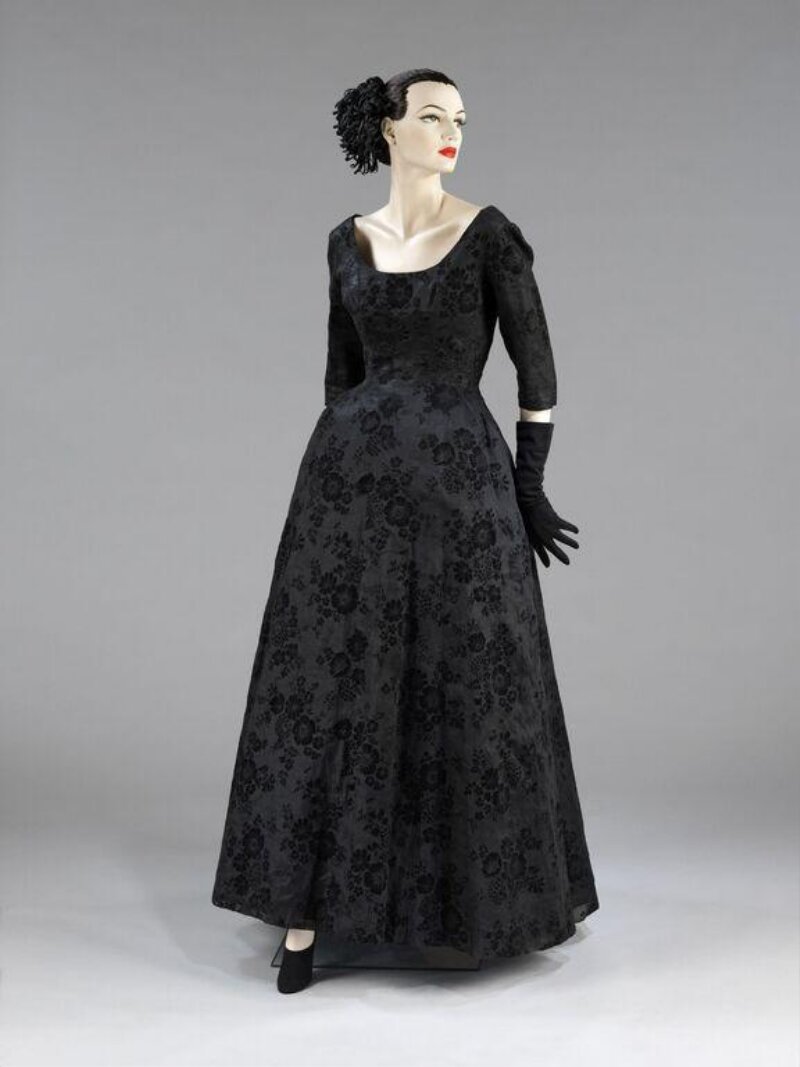
Couture Archaeology Report: Balenciaga, 1948 – A Technical Deconstruction for 2026 Silhouettes
Subject: Technical analysis of a Balenciaga evening ensemble, circa 1948. Origin: Paris, France. Analyst: Senior Textile Historian, Natalie Fashion Atelier. Date: [Current Date] Purpose: To deconstruct the material, architectural, and philosophical codes of mid-century Balenciaga couture and propose a framework for their translation into definitive high-end luxury silhouettes for the 2026 season.
1. Historical Context and Philosophical Underpinnings
The year 1948 finds Cristóbal Balenciaga at a pivotal moment of creative sovereignty. In the post-war landscape, where Dior's "New Look" emphasized a cinched, hyper-feminine form, Balenciaga pursued a radically different path: architecture over constriction. His philosophy was one of reverence for the fabric itself, allowing materiality to dictate form rather than forcing the body into a predetermined silhouette. This 1948 ensemble—likely a dinner suit or sophisticated evening separates—epitomizes this shift. It is not a mere garment but a spatial study, creating a refined, self-assured volume around the wearer that speaks of autonomy and modern luxury. For Natalie Fashion Atelier, this philosophy provides the cornerstone for 2026: luxury defined by technical mastery and wearer-centric design, not overt ornamentation.
2. Technical Deconstruction: The Triad of Mastery
Balenciaga’s genius resides in the invisible interplay between cut, construction, and material. A forensic analysis of a 1948 piece reveals a non-negotiable technical triad.
2.1. The Architecture of the Cut
Balenciaga famously cut fabric on the curve, a technique that predated and predicted three-dimensional draping. Key elements observed include:
The Seven-Eighths Sleeve: A signature. Precisely cut to end just below the wrist bone, it elongates the hand and creates a perpetual state of elegant, unfinished gesture. The sleeve head is cut extraordinarily high and wide, a cocoon-like cap that allows the sleeve to fall from the shoulder without a single wrinkle, achieving a clean, sculptural line without padding.
Minimal Seaming: Balenciaga sought to reduce seams to their absolute minimum. Where possible, panels were cut in one, using the natural curve of the fabric to create shape. This resulted in garments that appeared hewn from a single piece of cloth, a testament to both wasteful extravagance (in yardage) and exquisite economy (in construction).
The Tunic Silhouette: In 1948, he was moving towards straighter, tunic-like lines over the waist. Darts were minimized or eliminated, with shape introduced through strategic, gentle flaring from the shoulder or hip. This created a protected, personal space around the torso, a concept ripe for reinterpretation.
2.2. Materiality as Co-Creator
Balenciaga did not simply select fabrics; he collaborated with textile mills (notably Abraham, Bianchini, and Bucol) to develop materials with specific architectural properties. For a 1948 suit or coat, this likely meant:
Weighted Silks and Wools: Fabrics were often specially treated or woven with a substantial hand. A heavy silk gazar or a dense wool crepe had enough inherent body to hold a shape yet drape with gravity. The material provided the resistance necessary for his curved cuts to manifest as volume.
Internal Structure: Interfacings were minimal and strategic. Shape was achieved not through rigid boning and horsehair canvas, but through self-fabric interlinings, carefully cut on the bias, and meticulous pad-stitching done entirely by hand. The structure breathed with the fabric.
2.3. The Discipline of Finish
The interior of a Balenciaga garment is a landscape of quiet rigor. Seam allowances are extravagantly wide, often over an inch, finished with meticulous overlocking or hand-rolled edges. Hems are weighted with chain, discreetly hand-stitched to fall with absolute precision. Fastenings are rendered invisible; hooks and bars are placed with engineering accuracy to bear stress without distorting the line. This cult of the interior is the ultimate luxury code, known only to the wearer.
3. Translation for Natalie Fashion Atelier 2026: From Archaeology to Algorithm
The 2026 luxury consumer seeks integrity, innovation, and a nuanced expression of identity. Balenciaga’s 1948 principles offer a profound blueprint, to be translated not through pastiche, but through a contemporary lens of technology and consciousness.
3.1. Silhouette Proposition: The Protected Sphere
We propose the 2026 "Sphere Silhouette": a conscious evolution of Balenciaga’s architectural volume. Imagine a cocktail dress or evening coat where the seven-eighths sleeve is re-engineered using seamless knitting technology to create a continuous, spiraling curve from neckline to wrist. The tunic form is abstracted into a minimal-seam oval, using laser-cut panels of innovative materials that hold a gentle, self-supported flare from the shoulders. The focus is on the negative space created between garment and body—a modern armor of elegance.
3.2. Material Innovation: Next-Generation Substance
2026 materiality must echo Balenciaga’s collaborative spirit with 21st-century tools. Proposals include:
Bio-Engineered Gazar: Partner with biotech labs to develop a silk-alternative fabric from microbial cellulose, engineered to have the exact weight, drape, and acoustic rustle of vintage gazar, but with a net-positive environmental footprint.
Phase-Change Textiles: For outerwear silhouettes, integrate lightweight, non-woven membranes with phase-change properties, providing micro-climate control within the sculptural volume—the ultimate in functional, invisible luxury.
Liquid Seam Technology: Where Balenciaga minimized seams, we can eliminate them. Explore ultrasonic welding and liquid seam techniques for select panels, creating perfectly smooth, monolithic surfaces on technically advanced fabrics.
3.3. The New Couture Code: Digital Patina & Craft
The 1948 finish must evolve into a 2026 ethical and technical signature. This includes:
Blockchain-Stitched Provenance: Each garment carries a NFC-linked digital ledger documenting the origin of every material, the artisan hours, and the specific techniques used, making the invisible interior craftsmanship externally verifiable.
Dynamic Hems: Integrate micro-fluidic channels or responsive alloys into hem facings, allowing the garment’s line to subtly adapt to movement or wearer preference, a high-tech echo of weighted chain.
Zero-Waste Pattern Archaeology: Use AI pattern-generation software to solve the "Balenciaga problem": how to achieve his iconic volumes with maximal material efficiency, turning his extravagant cut into a manifesto for sustainable luxury.
Conclusion: The 1948 Mandate for 2026
Cristóbal Balenciaga’s 1948 work was not of its time; it was ahead of time. His technical triad—architectural cut, co-creative materiality, and rigorous finish—established a lexicon of modern luxury based on substance, space, and sublime confidence. For Natalie Fashion Atelier’s 2026 vision, this archaeological study mandates a forward-looking translation. We must harness advanced material science and digital craftsmanship to create silhouettes that offer the same sense of protected, personal elegance. The goal is not to replicate a 1948 garment, but to embody its spirit: to build a new architecture of ease for a new era, where luxury is measured in technical poetry and profound, personal space.