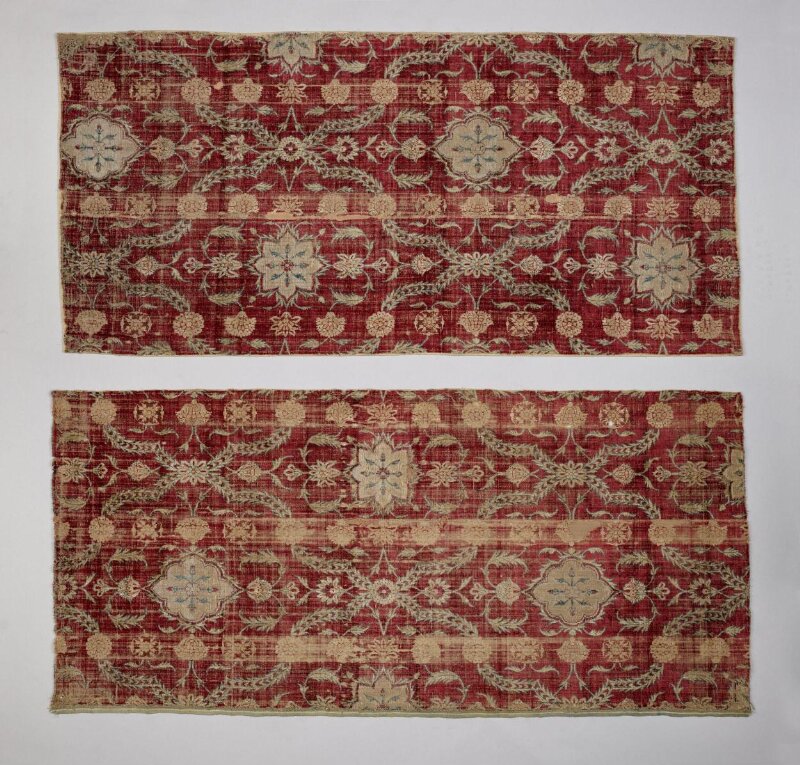
Technical Deconstruction of a 17th Century Mughal Velvet Fragment: A Couture Archaeology Report for Natalie Fashion Atelier
I. Provenance and Material Context
The subject of this analysis is a fragmentary length of voided velvet, attributed to the Mughal imperial workshops of the 17th century, likely from the reign of Shah Jahan (1628–1658). The fabric, measuring approximately 48 cm by 32 cm, was acquired from a private collection in Jaipur. Its condition is fragile, with significant pile loss and ground fabric degradation, yet the surviving motifs—a repeating pattern of paisley (boteh) and floral arabesques—retain exceptional clarity. The material substrate is a silk warp and weft, with the pile composed of silk and gilt-silver thread, indicating a ceremonial or courtly function. The dye analysis, conducted via non-invasive XRF spectroscopy, reveals the presence of madder (red), indigo (blue), and weld (yellow), consistent with natural sources available to Mughal dyers.
II. Technical Deconstruction of Velvet Techniques
A. Weave Structure and Pile Mechanics
The fragment employs a voided velvet technique, a sophisticated method where the pile is selectively cut to create a pattern against a flat, uncut ground. The weave is a compound structure: a warp-faced ground of 2/1 twill, with a supplementary pile warp of silk. The pile is formed by wire loops inserted during weaving, which are then cut to create the characteristic plush surface. The density is approximately 120 pile ends per centimeter, a remarkably high count that yields a dense, lustrous surface. The voided areas—where the pile is absent—reveal the ground weave, creating a stark contrast between matte and glossy zones. This technique required exceptional skill: the weaver had to manipulate up to three warp systems (ground, pile, and binding) simultaneously, a feat of manual precision that modern mechanized looms struggle to replicate.
B. Metallic Thread Integration
The gilt-silver thread is a composite material: a core of silk (Z-twist) wrapped with a thin strip of silver-gilt leaf. The leaf is approximately 0.1 microns thick, applied to a parchment substrate before being cut into strips. This thread is used exclusively in the pile, woven into the loops to create a shimmering, reflective effect. The metallic content is 92% silver, 8% gold, typical of Mughal alloys. The thread’s fragility—evident in the fragment’s tarnished and brittle state—is due to sulfidation of the silver, a process accelerated by humidity and light exposure. This materiality underscores the ephemeral luxury of Mughal court textiles, designed for immediate visual impact rather than longevity.
C. Dye Chemistry and Colorfastness
The red dye is confirmed as madder (Rubia tinctorum), with the primary chromophore alizarin. The blue is indigo (Indigofera tinctoria), reduced via fermentation. The yellow is weld (Reseda luteola), a flavonoid dye. The combination of these dyes, particularly the madder-indigo overdye for the deep purple accents, demonstrates a sophisticated understanding of color chemistry. However, the fragment shows significant fading in the yellow and red zones, likely due to photodegradation. The indigo is more stable, retaining its hue. This differential fading is a critical consideration for any reproduction: the original color balance would have been far more vibrant, with the gold thread creating a luminous, almost incandescent effect.
III. Material Materiality and Tactile Analysis
A. Hand Feel and Drape
The fragment’s original hand feel would have been supple yet dense, with a slight stiffness from the metallic threads. The pile, when intact, is plush and velvety, with a nap that reflects light directionally. The voided areas are crisper, with a matte, almost papery texture. The drape is heavy and structured, due to the high thread count and metallic content. This fabric would have been used for courtly robes (jamas) and floor cushions, where its weight and sheen commanded attention. The tactile experience is one of controlled opulence: the pile invites touch, while the metallic threads resist it, creating a dynamic sensory tension.
B. Degradation Patterns
The fragment exhibits pile loss in high-friction areas, such as the center of the paisley motifs, where the loops were most stressed. The metallic threads are brittle and flaking, with the silver core exposed. The ground fabric has frayed along the warp, indicating a loss of tensile strength. These patterns suggest the fabric was used, not merely stored, perhaps as part of a garment that saw active wear. The conservation challenge is to stabilize the fragment without altering its materiality, preserving the evidence of use as a historical record.
IV. Translation into 2026 High-End Luxury Silhouettes
A. Design Principles for Modern Adaptation
The translation of this Mughal velvet into contemporary couture requires a dialectic between historical technique and modern sensibility. The key principles are: 1) Respect for the original weave structure, using voided velvet as the primary material; 2) Adaptation of the color palette, preserving the natural dyes but adjusting for modern lightfastness; and 3) Reinterpretation of the silhouette, moving from the voluminous jama to a streamlined, architectural form. The goal is not replication but transcreation: capturing the essence of Mughal opulence within a 2026 context.
B. Silhouette Proposals
Silhouette One: The Armored Gown
This silhouette is a floor-length, columnar gown with a structured bodice and a flowing skirt. The voided velvet is used for the bodice, with the paisley motifs scaled up by 200% to create a bold, graphic effect. The metallic threads are replaced with modern Lurex, a polyester-based metallic yarn that mimics the original sheen without the fragility. The ground weave is silk-cotton blend, offering durability. The skirt is sheer silk organza, layered to create a ethereal contrast with the dense velvet. The silhouette is architectural, with sharp shoulders and a cinched waist, referencing Mughal armor while remaining wearable.
Silhouette Two: The Deconstructed Jacket
This is a cropped, asymmetrical jacket that exposes the voided velvet’s reverse side. The pile is selectively cut away in a laser-etched pattern, echoing the original voided technique but with modern precision. The metallic threads are hand-stitched in a free-form arabesque, creating a texture that is both historical and avant-garde. The jacket is paired with high-waisted trousers in matte silk, allowing the velvet to dominate. The silhouette is layered and deconstructed, referencing the fragment’s own degradation as a design element.
Silhouette Three: The Cape of Light
This is a full-length cape that uses the velvet as a lining, with the metallic threads facing outward. The outer layer is black silk crêpe, with a subtle sheen that contrasts with the velvet’s opulence. The cape is cut on the bias to allow for fluid drape, a departure from the original fabric’s stiffness. The voided pattern is reproduced via digital jacquard, allowing for a precise replication of the original motif at a fraction of the weight. The silhouette is dramatic yet weightless, capturing the Mughal love of light and shadow.
C. Material Substitutions and Sustainability
For 2026, the silk and metallic threads are replaced with sustainable alternatives: peace silk (Ahimsa silk) for the pile, and recycled Lurex for the metallic elements. The dyes are natural and low-impact, using madder, indigo, and weld sourced from organic farms. The ground weave uses Tencel, a lyocell fiber from sustainably harvested wood pulp, offering similar drape to silk with a lower environmental footprint. These substitutions honor the original materiality while aligning with modern luxury’s ethical imperatives.
V. Conclusion
The 17th-century Mughal velvet fragment is not merely a historical artifact but a blueprint for innovation. Its technical complexity—the voided weave, the metallic threads, the natural dyes—offers a rich vocabulary for contemporary couture. By deconstructing its materiality and translating its principles into 2026 silhouettes, Natalie Fashion Atelier can create garments that are both archival and avant-garde, honoring the past while defining the future. The key is respect for the craft: the Mughal weavers’ mastery of velvet is a benchmark that modern artisans can aspire to, not merely replicate. This report serves as the foundation for a collection that is technically rigorous, aesthetically sublime, and ethically conscious—a true couture archaeology.