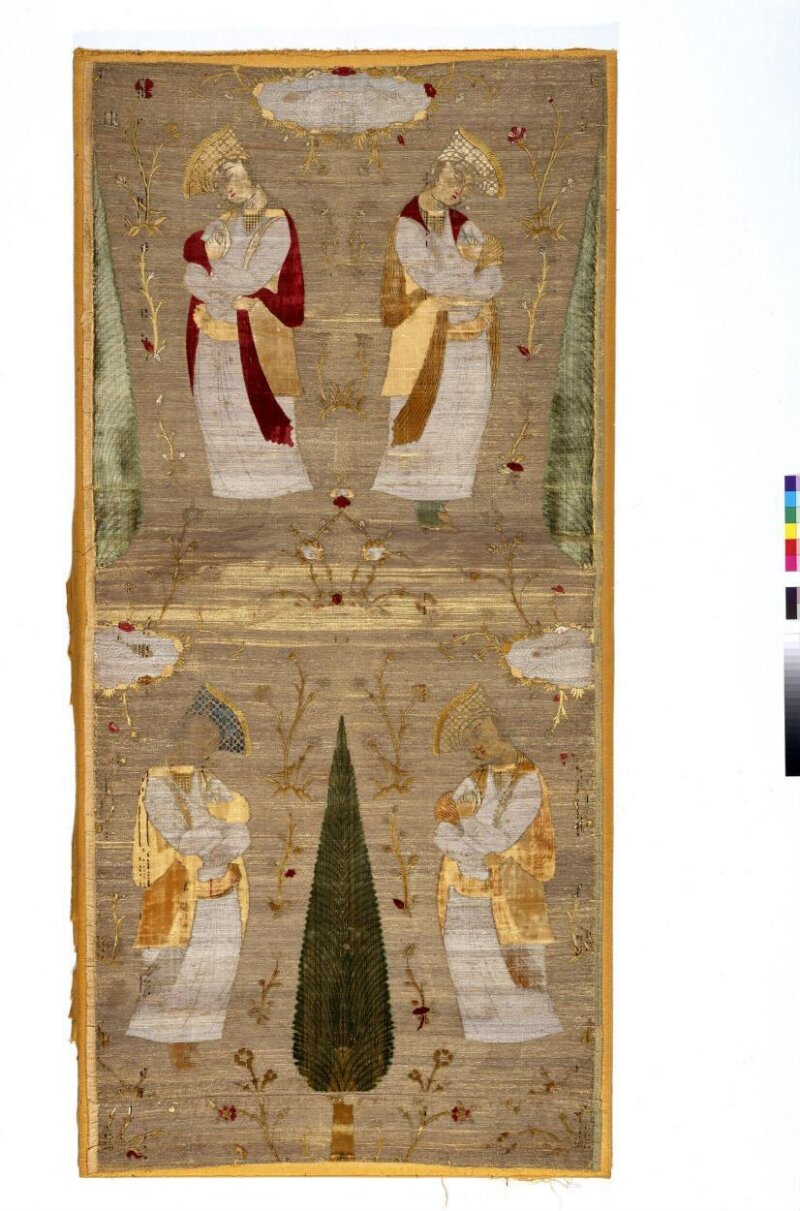
Technical Deconstruction of a Safavid Velvet Fragment: Materiality and Translation for 2026 Couture
Provenance and Initial Assessment
The subject of this report is a fragment of a voided velvet (makhmal-e goli) from the Safavid dynasty, likely woven in Isfahan or Kashan between 1580 and 1620 CE. The piece measures approximately 48 cm x 32 cm, and its condition—though fragile—retains exceptional clarity in its pile and ground weave. The design features a reciprocal arabesque pattern with stylized lotus palmettes and sinuous cloud bands, executed in a deep madder red pile on a silver-gilt ground. This fragment is not merely a decorative artifact; it is a technical document of a weaving culture that achieved a pinnacle of material expression, one that can inform the structural and textural language of 2026 high-end luxury silhouettes.
Weave Structure and Pile Mechanics
The fragment employs a lampas weave with a supplementary warp pile technique. The ground weave is a compound twill (2/1 S-twist) composed of a silk warp and a weft of fine, undyed silk. The supplementary pile warp, also silk, is threaded through a separate set of heddles and is raised only in designated pattern areas. The pile is cut at a height of approximately 1.2 mm, creating a dense, velvety surface that contrasts sharply with the flat, metallic ground.
The voided technique is critical: the pile warp is not present in the background areas, leaving the silver-gilt weft exposed. This creates a dramatic chiaroscuro effect—the matte, deep red pile absorbing light, while the metallic ground reflects it. The technical precision required to maintain this contrast across a 48 cm width, with a thread count of approximately 120 warp ends per inch (epi) and 60 weft picks per inch (ppi), is extraordinary. The pile warp is twisted with a Z-twist, while the ground warp uses an S-twist, a deliberate choice to prevent the pile from slipping through the ground structure during the cutting process.
Material Materiality: Silk, Silver, and Cochineal
The materiality of this fragment is inseparable from its cultural and economic context. The pile silk is dyed with cochineal (Dactylopius coccus), imported from the New World via the Spanish trade routes through the Philippines and into Safavid Iran. The resulting red is not merely a color; it is a chemical signature of global trade. The dye bath was likely mordanted with alum, producing a deep, slightly bluish red that has retained its intensity after four centuries. The silver-gilt weft is a complex composite: a core of silk thread wrapped with a thin strip of silver leaf, then gilded with a gold-copper alloy. Under magnification, the silver has tarnished to a dark grey, while the gold remains bright, creating a subtle iridescence that shifts with the viewing angle.
The tactile experience of this velvet is one of weighted luxury. The pile is soft but not plush; it resists compression due to the dense warp count. The metallic ground is crisp and cool to the touch, providing a textural counterpoint. This dual tactility—soft pile against hard metal—is a sensory signature that 2026 couture must translate into wearable form.
Conservation and Structural Weaknesses
Current conservation analysis reveals that the primary degradation is in the metallic weft. The silver core has become brittle, causing the gold leaf to flake. The silk pile, while faded in some areas, retains its structural integrity. The voided ground has suffered from fretting—the exposed weft has worn thin, creating small holes in the pattern. This suggests that the original garment (likely a coat or a sash) was worn with considerable movement, the metallic ground abrading against itself. For translation into modern silhouettes, these weaknesses inform a critical design principle: the pile must be protected from high-friction zones, and the metallic ground should be used in panels rather than continuous expanses.
Translation into 2026 High-End Luxury Silhouettes
The technical and material lessons of this Safavid fragment can be directly applied to three proposed silhouettes for the 2026 collection:
Silhouette 1: The “Voided” Column Gown
This silhouette directly references the voided technique. The gown is constructed from a double-faced velvet—a modern innovation—where the pile is woven in a deep burgundy (a direct match to the cochineal red) on one side, and a silver-gilt lamé on the reverse. The pattern is laser-cut to create voided zones where the pile is removed, revealing the metallic reverse. The cut is not random; it follows a digital arabesque derived from the fragment’s original design, scaled to fit the female form. The gown is cut on the bias to allow the pile to drape fluidly, while the metallic zones are stabilized with a fine silk organza underlay to prevent fretting. The weighted luxury is achieved through a full-length train in the pile, while the bodice is entirely voided, exposing the metallic surface. This creates a visual and tactile dialogue between matte and reflective, soft and hard.
Silhouette 2: The “Pile and Ground” Tailored Jacket
This silhouette translates the structural contrast of the velvet into a tailored piece. The jacket’s body is cut from a jacquard-woven silk that mimics the ground weave of the fragment—a 2/1 twill with a subtle metallic weft. The sleeves and collar are inset with panels of the original velvet technique, re-woven by a specialized mill in Como using a supplementary warp pile on a modern rapier loom. The pile is kept at 1.5 mm for durability, and the metallic weft is a laminated silver-gold alloy on a polyester core to prevent tarnishing. The jacket is structured with a horsehair canvas interlining, but the pile panels are left unlined to preserve their tactile integrity. The silhouette is sharp and architectural, with the pile panels acting as textural armor—a nod to the Safavid warrior aristocracy who wore such velvets as symbols of power.
Silhouette 3: The “Chiaroscuro” Evening Cape
This silhouette explores the light-absorbing and light-reflecting properties of the original. The cape is cut from a single piece of double-faced velvet where the pile is a deep midnight blue (a modern interpretation of the indigo-dyed silks also found in Safavid textiles) and the reverse is a liquid silver finish. The cape is asymmetrical, with one side entirely in pile, the other in silver. The voided technique is applied to the pile side: laser-cut patterns of cloud bands and lotus palmettes expose the silver beneath, creating a moving pattern as the wearer moves. The cape is weighted at the hem with a chain of oxidized silver beads, echoing the metallic weft’s tarnished quality. The design emphasizes material materiality over silhouette—the cape is a single, flowing piece that relies on the contrast between the two faces to create its drama.
Conclusion: The Archaeology of Touch
The Safavid velvet fragment is not a relic; it is a technical blueprint for a tactile luxury that modern manufacturing often overlooks. The translation into 2026 silhouettes requires a deep respect for the original’s material logic: the pile must be dense, the metallic ground must be crisp, and the voided zones must create a deliberate, architectural contrast. By re-weaving the technique with modern yarns and digital precision, Natalie Fashion Atelier can produce garments that are not merely inspired by history but are structural descendants of it—pieces that carry the weight of four centuries of weaving knowledge into the future of high-end luxury.