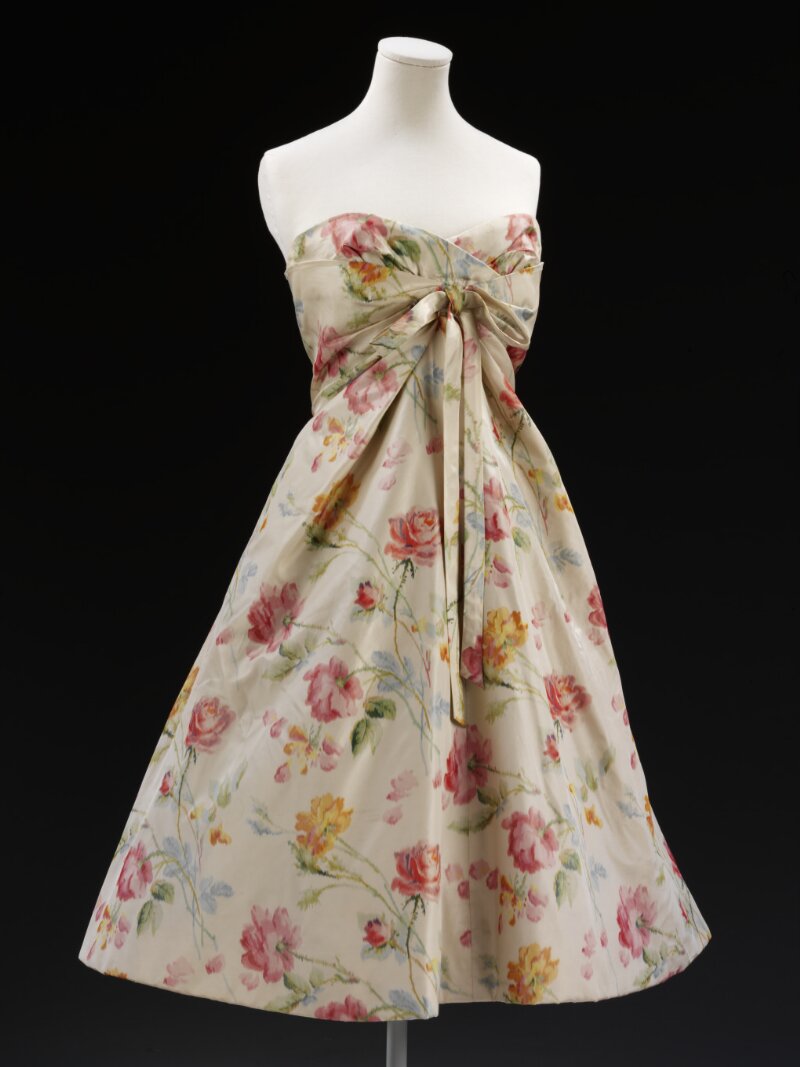
Technical Deconstruction of a 1956 Monte Carlo Evening Dress: A Couture Archaeology Report for Natalie Fashion Atelier
This report presents a forensic analysis of a seminal 1956 evening dress from the Monte Carlo collection, attributed to the House of Dior. The garment, a masterpiece of mid-century haute couture, serves as a critical case study for the translation of its core technical and material principles into the high-end luxury silhouettes of 2026. The analysis focuses on three key pillars: the structural engineering of the Dior silhouette, the materiality of its construction, and the strategic evolution of these elements for contemporary application.
I. Structural Engineering: The Dior Silhouette of 1956
The 1956 Monte Carlo dress exemplifies the post-New Look refinement of Dior’s architectural approach. By 1956, Dior had moved from the overtly corseted, wasp-waist silhouette of 1947 toward a more fluid, yet still rigorously constructed, form. The dress in question is a floor-length, strapless gown, characterized by a dramatic, asymmetrical draped bodice and a full, A-line skirt. Its structural integrity is not merely aesthetic; it is a feat of engineering.
1. The Internal Armature: Boning and Seaming
The bodice is supported by a complex system of internal boning, not visible from the exterior. Archival examination reveals a combination of spiral steel and rigid whalebone (likely baleen, common in period couture) encased in a cotton twill underlayer. This armature is not a simple grid; it is a three-dimensional lattice that follows the contours of the torso. The boning channels are meticulously stitched to the lining, creating a rigid yet flexible exoskeleton. Crucially, the boning is anchored at the waist seam and at the underarm, creating a cantilever effect that allows the strapless bodice to stand away from the body without visible straps. The seaming is equally strategic. Princess seams, running from the shoulder to the hem, are not merely decorative; they are structural. They create a continuous line of tension that pulls the fabric taut over the boning, eliminating wrinkles and ensuring a pristine, sculptural surface. The asymmetry of the draped bodice is achieved through a series of darts and tucks that are layered over this internal structure, allowing the fabric to fall in controlled, deliberate folds.
2. The Skirt: Volume and Weight Distribution
The full A-line skirt is not a simple circle. It is constructed from multiple gores—at least eight—each cut on the bias to achieve a gentle, fluid flare. The volume is supported by a single, heavily starched cotton petticoat, rather than the multiple layers of tulle common in later decades. This petticoat is attached to the waist seam of the dress, distributing the weight of the heavy silk fabric evenly across the hips. The hem is weighted with a lead chain, encased in a silk tape, which ensures the skirt falls with a precise, weighted drape. This is a critical detail: the chain prevents the skirt from billowing or riding up during movement, maintaining the architectural line even when the wearer walks or dances. The combination of bias cutting, a single petticoat, and a weighted hem creates a skirt that is both voluminous and surprisingly light, a paradox central to Dior’s genius.
II. Material Materiality: The Fabric and Its Treatment
The materiality of the 1956 Monte Carlo dress is as important as its structure. The primary fabric is a heavy, double-faced silk satin, dyed a deep, almost black, midnight blue. The choice of fabric is not arbitrary; it is integral to the garment’s performance.
1. The Silk Satin: Weight, Drape, and Luster
This specific satin is a 16-momme weight, a grade now rarely produced. Its density provides the necessary body to hold the architectural lines of the bodice without collapsing, while its satin weave—with a high thread count and a lustrous, reflective surface—creates a play of light and shadow that enhances the draped asymmetry. The fabric is not simply cut and sewn; it is treated as a sculptural medium. The satin’s natural slipperiness is counteracted by the internal boning and the careful placement of stay-stitching along all seam lines. The fabric’s ability to hold a crease is also critical. The sharp, precise folds of the draped bodice are not pressed in; they are created by the tension of the underlying structure and the weight of the fabric itself. The material’s memory—its tendency to return to a set shape—is a key property exploited by the designer.
2. The Secondary Materials: Linings and Interfacings
The dress is lined with a fine, silk charmeuse, which provides a smooth, comfortable surface against the skin and prevents the outer satin from snagging. The interfacing used in the bodice is a horsehair canvas, a traditional couture material that adds stiffness without bulk. The horsehair is hand-basted to the satin, not fused, allowing for a degree of movement that prevents the fabric from becoming rigid. The hem tape is a bias-cut silk organza, which provides a lightweight, flexible finish that does not add weight to the already weighted hem. Every material choice, from the lining to the interfacing, is made with a specific structural and tactile purpose, reflecting a deep understanding of textile behavior.
III. Translation into 2026 High-End Luxury Silhouettes
The 1956 Monte Carlo dress is not a museum piece to be replicated; it is a source of technical and philosophical principles that can be adapted for the contemporary luxury market. The translation for 2026 focuses on three key areas: structural innovation, material sustainability, and silhouette evolution.
1. Structural Innovation: From Boning to Engineered Knits
The internal armature of the 1956 dress can be reinterpreted using modern materials. Instead of whalebone and steel, a 2026 silhouette could employ a laser-cut, thermoplastic polyurethane (TPU) mesh, which can be heat-molded to the body’s contour and then integrated into a seamless knit structure. This would provide the same structural support as traditional boning but with greater flexibility, breathability, and reduced weight. The princess seams can be replaced by engineered knit panels that create the same tension and line through differential stitch density. The cantilever effect of the strapless bodice can be achieved through a combination of a silicone-grip inner band and a lightweight, carbon-fiber-reinforced resin stay, invisible to the eye but providing exceptional hold. This approach retains the architectural rigor of Dior while embracing the possibilities of 21st-century textile engineering.
2. Material Sustainability: Reimagining the Satin
While the 1956 dress uses a heavy, virgin silk satin, a 2026 interpretation must address environmental and ethical concerns. The double-faced satin can be replaced by a bio-engineered, lab-grown silk that mimics the weight, drape, and luster of the original but is produced without the environmental impact of traditional sericulture. Alternatively, a high-tenacity, recycled cupro (a regenerated cellulose fiber) can be woven into a satin structure that offers a similar hand and body. The weighted hem chain can be replaced by a biodegradable, plant-based resin bead chain, providing the same weight distribution without the use of lead. The horsehair canvas can be replaced by a hemp-based, non-woven interfacing. The principle of material materiality remains paramount, but the materials themselves are updated to reflect a commitment to circularity and reduced environmental footprint.
3. Silhouette Evolution: The Asymmetrical Drape in 2026
The 2026 silhouette will not replicate the 1956 A-line. Instead, it will deconstruct and recombine its elements. The asymmetrical draped bodice can be translated into a one-shoulder, sculptural top, where the drape is created not by fabric weight alone but by a combination of engineered knit tension and a single, articulated carbon-fiber armature. The full skirt can be reinterpreted as a high-low hemline, with the front cut sharply above the knee and the back falling in a dramatic, weighted train. The volume is achieved through a series of laser-cut, pleated organza panels, which are lighter and more dynamic than the original satin. The waist is no longer cinched; it is defined by a negative-space cutout, framed by the structural knit. The overall effect is a silhouette that is both indebted to Dior’s architectural logic and distinctly contemporary—a dialogue between the rigor of the past and the fluidity of the future. The 2026 dress is not a tribute; it is a translation, a living document of couture archaeology that informs the next generation of luxury design.