The Silver Creamer: An Aesthetic Archaeology of American Classical Elegance
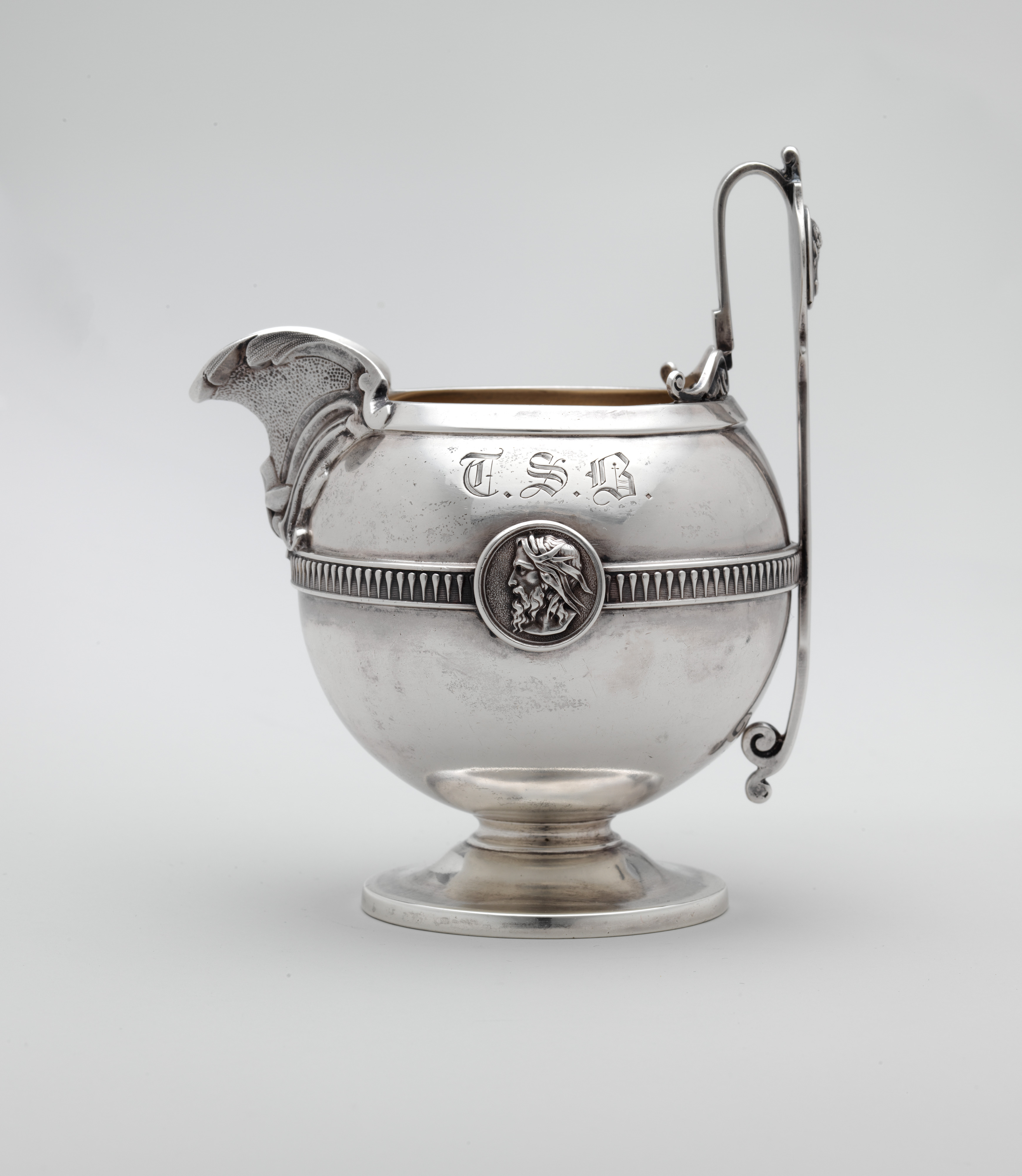
The silver creamer, a seemingly quotidian artifact of American domestic heritage, occupies a singular position within the lexicon of form. At Natalie Fashion Atelier, we approach this object not as mere tableware, but as a compressed volume of aesthetic intelligence—a study in controlled liquidity, structural tension, and the alchemy of light. Isolated from its functional context, the creamer reveals itself as a sculptural manifesto, a silent progenitor of silhouettes that will define 2026 haute couture. Its materiality, silver, is not a surface but a behavior; its form, a dialogue between the poured and the contained. This research artifact deconstructs the classical elegance of the American silver creamer, translating its core principles into a technical framework for high-end silhouette construction.
Materiality as Silhouette: The Behavior of Silver
Silver, in its refined state, possesses a unique optical and tactile density. Unlike gold’s warmth or platinum’s clinical precision, silver offers a luminous neutrality—a surface that both absorbs and reflects ambient light, creating a gradient of shadow and brilliance. For the 2026 silhouette, this translates directly into fabric selection. We are not replicating the metal, but its behavior. Consider a double-faced silk gazar, its two sides woven with contrasting densities: one matte, one with a subtle, liquid sheen. This fabric mimics the silver’s ability to shift from a soft, clouded patina to a sharp, mirror-like highlight, depending on the angle of the wearer’s movement.
The structural vocabulary of the creamer is defined by its compressed belly and elongated, tapering neck. This is a lesson in volumetric tension. The belly holds mass, a sphere that has been gently flattened, creating a horizontal axis of stability. The neck, conversely, is a vertical axis of release, a narrow channel that guides the liquid to its destination. In 2026, we apply this to the bodice and skirt. The bodice becomes the neck: a structured, columnar form that cinches and elongates, perhaps through a high, tailored collar or a tightly fitted, boned corset that flares only at the hip. The skirt becomes the belly: a volume that is not a bell or a circle, but a compressed ovoid, a shape that rests close to the body at the front and swells with a controlled, almost gravitational weight at the back. This is not a bustle; it is a gravity pocket, a silhouette that feels heavy, anchored, and deeply luxurious.
The Handle: A Study in Negative Space and Gesture
Perhaps the most overlooked element of the creamer is its handle. In American silverware, the handle is rarely a simple loop. It is a sculptural counterpoint, a bridge between the vessel’s body and the user’s hand. It creates a negative space—a void that is as important as the silver itself. This void defines the gesture of lifting, of pouring, of offering. For 2026, we translate this into the sleeve and the shoulder line.
Imagine a sleeve that is not attached to the bodice in a traditional seam, but that floats, connected by a single, articulated strap or a series of fine, metallic-tinged chains. This creates a negative space armhole, a void that frames the arm and the movement of the body. The sleeve itself becomes a handle: a structured, crescent-shaped volume that mirrors the curve of the creamer’s handle, extending from the shoulder and wrapping around the forearm. The gesture of pouring is echoed in the way the fabric falls when the arm is raised—a cascade of silver-toned silk that suggests both control and release.
The Spout: A Precision of Release
The spout of a classical American silver creamer is a study in controlled geometry. It is a sharp, clean break from the curve of the neck, a precise V or U shape that dictates the trajectory of the liquid. This is the point of transition from containment to expression. In haute couture, this translates to the hemline and the point of drape. The 2026 silhouette will feature asymmetric, angular hems that function as spouts. A skirt may be cut with a sharp, diagonal drop at the front, revealing the leg or a contrasting underlayer, while the back maintains a longer, sweeping volume. This is not a random asymmetry; it is a calculated release of form, a point where the fabric’s internal tension is allowed to escape.
Furthermore, the spout informs the neckline architecture. A high, closed collar that suddenly opens into a deep, sharp V at the sternum—this is the creamer’s spout inverted. It creates a line of sight, a directional pull that guides the eye from the face down the length of the body. The fabric at this point must be engineered to hold the shape without collapsing, requiring a double-faced, bonded silk organza that has been heat-set to maintain a crisp, almost metallic edge.
Patina and Time: The 2026 Surface Treatment
Silver’s most profound quality is its relationship with time. It tarnishes, it develops a patina, it records the touch of hands. This is not a flaw; it is a narrative. For 2026, the luxury silhouette must embrace a controlled patina. This is achieved through fabric manipulation, not dye. We employ crushed velvet that has been selectively over-dyed with a silver-grey wash, then hand-brushed to create lighter and darker zones, mimicking the uneven oxidation of a well-used creamer. We use pleated metallic gauze that is left unfinished at the edges, allowing the threads to fray slightly, creating a soft, aged halo around the silhouette.
The construction itself must honor the patina. Seams are not hidden; they are exposed and articulated, like the visible hammer marks on a hand-wrought silver vessel. A dress’s side seam might be finished with a delicate, exposed silver chain stitch, a nod to the artisan’s hand. The interior of a garment—the lining, the seam allowances—must be as beautiful as the exterior, reflecting the silver creamer’s tradition of invisible perfection.
Conclusion: The Creamer as a System of Proportion
The American silver creamer, when subjected to aesthetic archaeology, is not a relic. It is a system of proportion, a treatise on the relationship between mass and void, between containment and release, between light and shadow. For Natalie Fashion Atelier’s 2026 collection, this system informs a silhouette that is at once architectural and fluid, heavy and luminous. The compressed ovoid of the skirt, the negative space of the sleeve, the precise spout of the hemline, and the narrative patina of the fabric—these are not decorative elements. They are the direct translation of a classical object into a contemporary body. The result is a high-end silhouette that feels both ancient and futuristic, a garment that carries the memory of a poured liquid and the promise of a new gesture. It is elegance, deconstructed and rebuilt, in silver and silk.