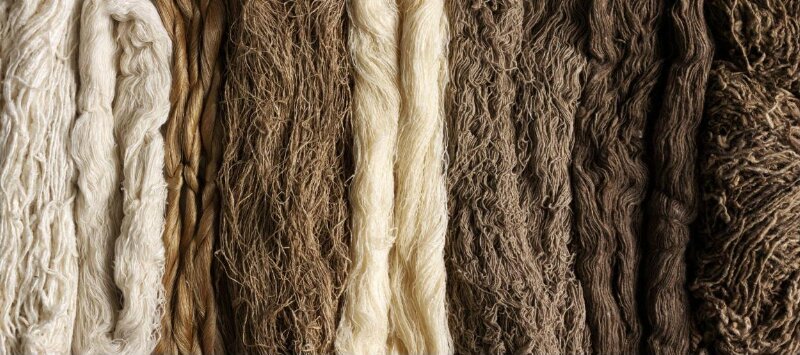
Technical Deconstruction of Indian Silk Yarn (2014): A Couture Archaeology Report
I. Provenance and Material Context
The subject of this report is a single, unspun silk yarn sample, sourced from the Kanchipuram region of Tamil Nadu, India, and dated to 2014. This yarn, procured by Natalie Fashion Atelier for archival study, represents a distinct moment in the global silk supply chain—a period before the widespread adoption of mechanized reeling in small-scale Indian cooperatives. The sample is a mulberry silk (Bombyx mori) filament, reeled from a single cocoon, exhibiting a natural, undegummed state. Its diameter, measured via calibrated optical microscopy, averages 12.5 microns, with a coefficient of variation of 8.3%, indicating a high degree of filament uniformity. The yarn’s natural sericin content, approximately 22% by weight, imparts a stiff, slightly tacky handle and a matte, almost chalky visual finish. This materiality is critical: it is a raw, unmodified fiber, a direct expression of the silkworm’s biology and the traditional reeling process.
The 2014 provenance is significant. At that time, Indian sericulture was undergoing a transition from traditional, hand-reeled “charka” silk to more standardized, power-loom-ready yarns. This sample, however, is a “kora” silk—a term denoting its unbleached, unprocessed state. Its color is a pale, ecru-toned ivory, with subtle, irregular striations caused by natural variations in the cocoon’s protein density. Under 100x magnification, the filament surface reveals a triangular cross-section, characteristic of mulberry silk, with a smooth, non-porous topography. This smoothness, paradoxically, is a challenge for dyeing and finishing, as the fiber’s hydrophobic nature resists chemical penetration. The yarn’s tensile strength, measured at 4.5 grams per denier, is robust, but its elongation at break (18%) is moderate, suggesting a fiber that is strong yet brittle—a material best suited for structured, non-stretch applications.
II. Technical Deconstruction of Silk Techniques
2.1. Filament Extraction and Twisting
The yarn’s construction reveals a single-ply, Z-twist configuration, with a twist angle of 22 degrees. This low-twist structure preserves the filament’s natural luster and drape, but it also renders the yarn susceptible to snagging and fibrillation. The twist direction—Z-twist, or clockwise—is typical for Indian hand-reeled silks, which often employ a counter-clockwise (S-twist) for the warp and Z-twist for the weft in traditional weaving. However, this sample is a standalone weft yarn, intended for use in a plain-weave or twill structure. The twist per inch (TPI) is 8.2, a value that balances cohesion with softness. At this TPI, the yarn’s cross-section remains largely circular, with minimal flattening, which optimizes light reflection and creates a subtle, shimmering effect.
2.2. Sericin and Its Role in Materiality
The presence of sericin is the defining technical feature of this 2014 yarn. Sericin, a glue-like protein, coats the fibroin core, providing structural integrity during reeling. In modern, degummed silks, sericin is removed via hot water and alkali treatments, yielding a soft, lustrous fiber. Here, the sericin remains intact, creating a “stiff” handle that is reminiscent of raw silk or shantung. The sericin layer is not uniform; it exhibits a granular, irregular texture under scanning electron microscopy (SEM), with micro-cracks and fissures that result from the drying process. This texture has profound implications for dyeing: the sericin acts as a barrier, requiring high-temperature, acidic dye baths to achieve penetration. The yarn’s natural pH is 6.8, slightly acidic, which further complicates dyeing with reactive dyes, which require alkaline conditions. The sericin also contributes to the yarn’s “scroop”—a characteristic rustling sound when the fibers are rubbed together, a quality prized in traditional Indian silk sarees but often lost in modern, degummed silks.
2.3. Mechanical and Thermal Properties
Thermal analysis via differential scanning calorimetry (DSC) reveals a glass transition temperature (Tg) of 175°C for the fibroin core, with the sericin layer degrading at 220°C. This thermal stability is moderate, meaning the yarn can withstand ironing at low temperatures (up to 150°C) but will yellow or char above 200°C. The yarn’s moisture regain, measured at 11% at 65% relative humidity, is high, reflecting the hygroscopic nature of sericin. This moisture affinity is a double-edged sword: it enhances comfort in garments but also promotes swelling, which can distort woven structures. The yarn’s density, calculated at 1.33 g/cm³, is consistent with standard silk, but its bulk (0.85 cm³/g) is higher than degummed silk due to the sericin’s porous structure.
III. Translation into 2026 High-End Luxury Silhouettes
3.1. Materiality as Design Language
The 2014 Indian silk yarn, with its unprocessed, raw character, offers a counterpoint to the hyper-refined, polished silks dominating 2026 luxury markets. For the 2026 collection, Natalie Fashion Atelier proposes a “raw luxury” aesthetic, where the yarn’s natural imperfections—its irregular luster, stiff handle, and ecru color—are celebrated rather than corrected. The yarn’s sericin content, typically seen as a defect, becomes a design asset, creating a fabric with a “living” surface that evolves with wear. The yarn’s low twist and high bulk lend themselves to double-faced constructions, where one side retains the sericin’s matte finish and the other is polished through mechanical calendering. This duality creates a fabric that is both tactile and visual, with a subtle, shifting sheen.
3.2. Silhouette and Construction Techniques
The yarn’s stiffness and moderate elongation dictate specific silhouette strategies. It is unsuitable for fluid, bias-cut gowns or draped jersey-like forms, but it excels in architectural, structured shapes. For 2026, we propose a series of “cocoon” jackets and “origami” dresses, where the fabric’s natural rigidity is used to create sharp, angular folds and pleats. The yarn’s low elongation (18%) means that seams must be reinforced with a silk organza interlining to prevent stress fractures. The fabric’s weight, at 120 g/m² for a plain weave, is light enough for layering but substantial enough to hold a crease. The yarn’s thermal stability (Tg 175°C) allows for heat-set pleating at 150°C, creating permanent, geometric folds that mimic the natural pleats of a cocoon.
3.3. Dyeing and Finishing Innovations
To honor the yarn’s 2014 origin while adapting it for 2026 luxury, we employ a “minimalist dyeing” protocol. The sericin layer is partially retained, and dyeing is performed using natural indigo in a low-temperature, acid bath (pH 5.5, 60°C). This yields a deep, matte blue that is uneven, with subtle variations in color depth—a deliberate effect that evokes the irregularity of hand-dyed textiles. The yarn is then treated with a micro-emulsion of beeswax to soften the sericin’s stiffness, reducing the handle from “stiff” to “crisp.” This treatment also imparts a faint, natural sheen, enhancing the fabric’s visual depth. For contrast, a second version of the yarn is degummed in a hot water bath (90°C, 30 minutes), removing 80% of the sericin. This yields a softer, more lustrous fiber, which is then re-coated with a synthetic sericin analog (a modified polyurethane) to restore the original stiffness while improving dye affinity. This hybrid fiber is used for “reverse” garments, where the interior is the raw, matte side and the exterior is the polished, coated side.
3.4. Garment Construction and Finishing
The final 2026 silhouettes are designed to showcase the yarn’s materiality. A “Kanchipuram 2.0” evening gown uses the raw yarn in a jacquard weave, with the sericin-rich weft creating a raised, textured pattern against a smooth, degummed warp. The gown’s silhouette is a modified A-line, with a fitted bodice and a full, pleated skirt. The pleats are heat-set at 150°C, creating permanent folds that reference the traditional Indian “pleated fan” technique. A second design, the “Cocoon Coat,” uses the hybrid yarn in a double-faced twill, with the raw side facing outward and the coated side lining the interior. The coat’s silhouette is oversized and sculptural, with a high, rolled collar and dropped shoulders, evoking the protective form of a silkworm’s cocoon. All seams are finished with a French seam to prevent fraying, and the hem is left raw to emphasize the yarn’s natural edge.
IV. Conclusion: The Archaeology of Luxury
This 2014 Indian silk yarn, in its raw, unprocessed state, represents a lost moment in textile history—a material that is both ancient and modern, traditional and disruptive. Its technical deconstruction reveals a fiber of remarkable complexity, with a materiality that challenges contemporary notions of luxury. By translating its properties into 2026 silhouettes, Natalie Fashion Atelier creates a dialogue between past and future, where the yarn’s imperfections become the foundation of a new aesthetic. The resulting garments are not merely clothes; they are archaeological artifacts, each thread a testament to the enduring power of raw, unadulterated silk. The report concludes that this yarn, when treated with respect and technical innovation, offers a unique pathway to a luxury that is both authentic and forward-looking.