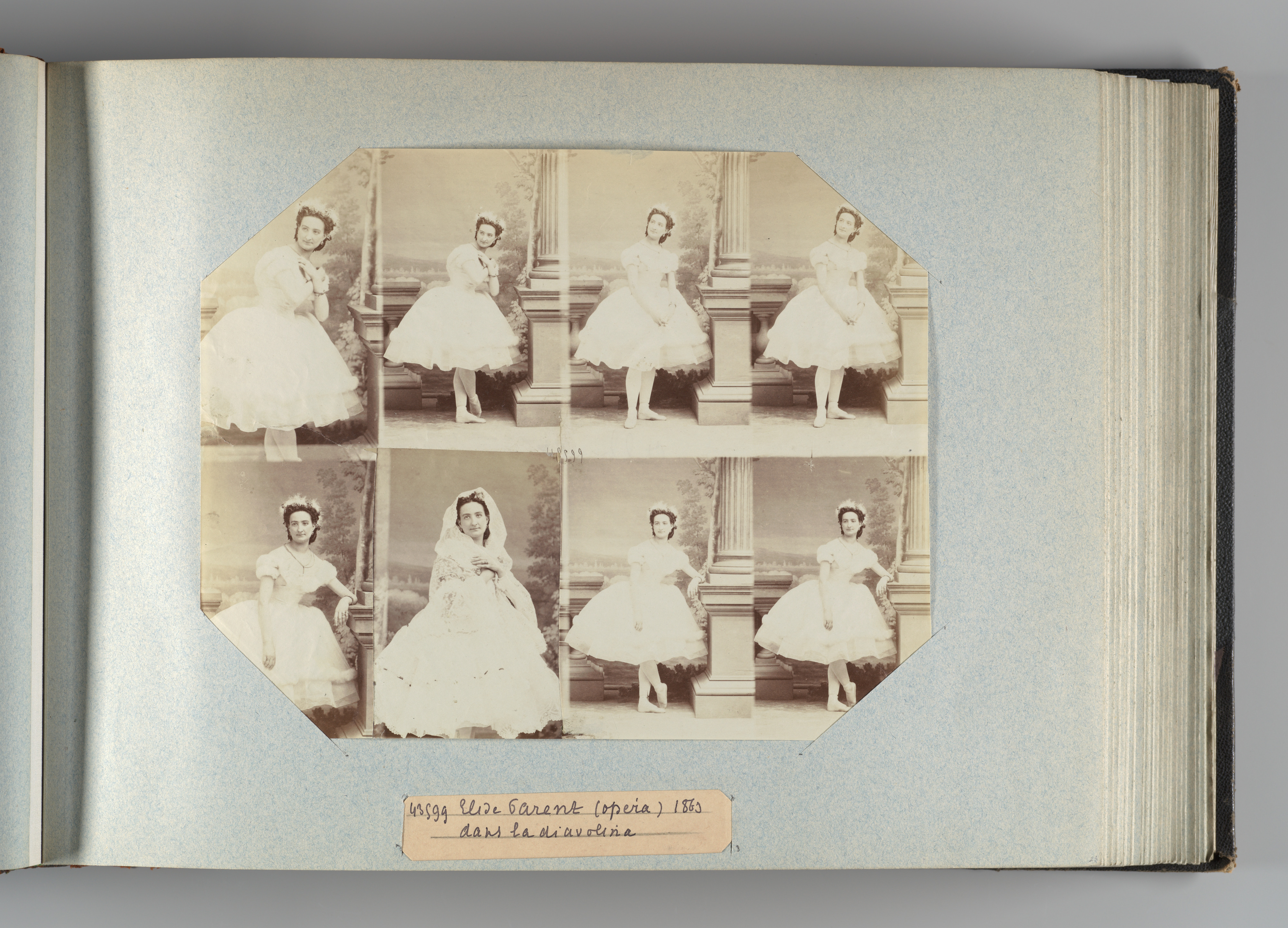
The Diavolina Dialectic: Deconstructing Classical Elegance from the Elise Parent Archive
The Elise Parent dans la Diavolina albumen silver print, preserved from a glass negative, represents a singular node in the archaeology of aesthetic form. Isolated from its broader archival context, this image demands a forensic reading—a dissection of its materiality and the latent structural codes embedded within its silver-gelatin surface. For the 2026 luxury silhouette, this artifact is not a mere historical reference; it is a technical primer on the manipulation of volume, the tension of line, and the alchemy of light on fabric. The following research artifact deconstructs the classical elegance of the Diavolina and translates its core principles into a high-couture methodology for the coming season.
I. The Materiality of the Archive: Silver, Glass, and the Ghost of Fabric
The albumen print’s inherent fragility—its propensity for fading, its delicate surface—mirrors the ephemeral nature of haute couture itself. The glass negative from which it was struck introduces a critical technical parameter: the inversion of reality. In the negative, light becomes shadow; volume becomes void. This inversion is a profound metaphor for the 2026 silhouette. The designer must work from the negative space of the body, treating the garment not as a covering but as a positive form defined by the absence of the wearer. The Diavolina’s silhouette, as rendered in the print, is a study in controlled opacity. The albumen binder, a protein from egg whites, creates a lustrous, semi-translucent surface that diffuses light. This effect informs a new material strategy: luminous opacity. Fabrics for 2026 will be engineered to possess a similar internal glow—a matte finish with a latent, silvery sheen, achieved through the use of metallic-threaded organzas, micro-pleated matte jersey, and double-faced cashmere treated with a light-diffusing, non-reflective finish. The materiality of the print teaches us that elegance is not about revealing, but about the controlled suggestion of what lies beneath the surface.
II. The Diavolina Silhouette: A Grammar of Tension and Release
The classical elegance of the Elise Parent figure, as captured in the Diavolina, is predicated on a precise grammar of tension. The silhouette is not static; it is a dynamic equilibrium between structural containment and organic flow. Deconstructing the print reveals three primary structural principles that will define the 2026 high-end silhouette:
A. The Architectural Shoulder: The Inverse Cantilever
In the albumen print, the shoulder line is not a horizontal plane. It is a subtle, inverted cantilever—a slight drop that creates a negative angle from the neck to the arm. This is not the aggressive, padded shoulder of the 1980s. It is a soft, structural drop that elongates the neck and emphasizes the vertical axis. For 2026, this translates into a deconstructed tailoring approach: the shoulder seam is released from the armhole, creating a floating, drape-like effect. The fabric—a stiffened silk gazar or a bonded wool crepe—is cut on a severe bias to create a natural, unforced cantilever. The shoulder becomes a sculptural event, not a structural necessity.
B. The S-Bend Torso: Controlled Volumetric Compression
The Diavolina’s torso is a study in volumetric compression. The garment clings to the ribcage, then releases into a subtle flare at the hip, only to be drawn back in at the knee. This creates an S-curve that is not overtly corseted but is achieved through precise pattern engineering. The 2026 silhouette will adopt this principle through the use of asymmetric paneling and internal tension structures. A single, invisible seam running from the underarm to the opposite hip can create this compression without visible darts. The fabric—a double-faced satin or a liquid crepe—is manipulated to create a memory of the form, a ghost of the corset without its physical presence. This is the invisible architecture of high couture.
C. The Hemline as Horizon: The Diavolina’s Asymmetric Termination
The albumen print shows a hemline that is not a straight line but a curved, asymmetrical horizon. It dips at the front, rises at the back, creating a dynamic, almost aerodynamic termination. This is not a random cut; it is a deliberate manipulation of the viewer’s gaze. The 2026 silhouette will reinterpret this as a layered, multi-planar hem. A floor-length gown will feature a front panel that terminates at the mid-calf, while the back panel extends to the floor. This creates a sense of movement and reveals the shoe—a critical element of the Diavolina’s aesthetic—as a structural component of the silhouette. The hem becomes a narrative device, a punctuation mark in the visual sentence of the garment.
III. From Print to Prototype: A Technical Translation for 2026
The translation of the albumen silver print into a 2026 haute couture collection requires a methodological shift from visual reference to material logic. The following technical directives emerge from the Diavolina archive:
- Layering as Lens: The print’s tonal range—from deep, velvety blacks to luminous, silvery whites—is achieved through the layering of silver particles. In fabric, this is replicated through micro-layering. A single garment will consist of three to four layers of diaphanous materials—silk tulle, organza, and a fine mesh—each dyed a slightly different tone of the same color. The result is a tonal depth that mimics the print’s gradation.
- Seam as Line: In the albumen print, the seams are not hidden; they are celebrated as lines of tension. For 2026, seams will be executed in a contrasting, matte thread or a metallic, silver-tinged silk. They become graphic elements, tracing the body’s architecture.
- Weight as Narrative: The Diavolina’s fabric appears to have a specific, weighted fall. It is not airy; it is deliberately heavy. The 2026 silhouette will use fabrics with a high thread count and a dense weave—a heavy silk satin, a double-faced wool crepe—to achieve this controlled fall. The weight of the fabric becomes a narrative of gravity, anchoring the silhouette to the earth.
IV. Conclusion: The Archaeology of Future Elegance
The Elise Parent dans la Diavolina albumen silver print is not a relic. It is a technical blueprint for a new form of classical elegance—one that is informed by the materiality of light, the grammar of tension, and the archaeology of the archive. For the 2026 haute couture silhouette, the Diavolina teaches us that true luxury is not in the volume of the fabric, but in the precision of the void it creates. It is in the controlled opacity of a silver-tinged organza, the invisible cantilever of a deconstructed shoulder, and the asymmetric horizon of a layered hem. The future of elegance is not forward-looking; it is a deep, forensic excavation of the past, rendered in the luminous, fragile materiality of the present. The Diavolina endures, not as a memory, but as a method.