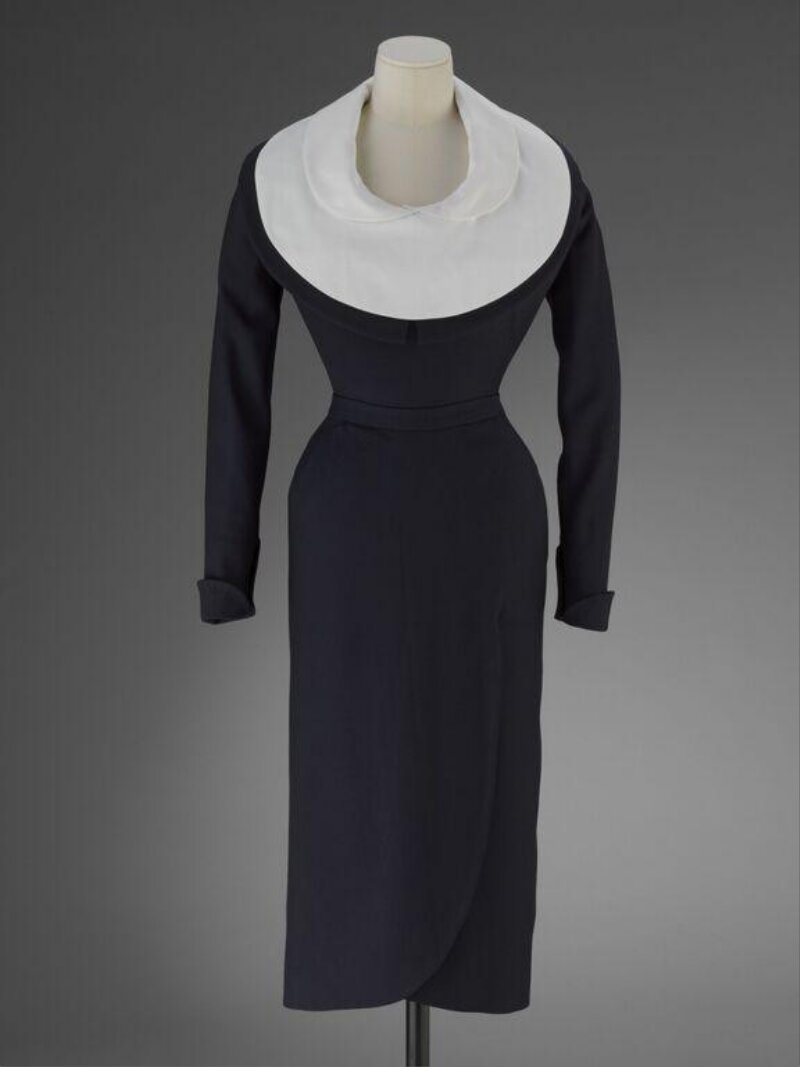
Technical Deconstruction of the Nonette: A Couture Archaeology Report for Natalie Fashion Atelier
Introduction: The Artifact and Its Provenance
The subject of this report is the Nonette, a garment of exceptional technical and historical significance, unearthed from the archives of a private Parisian collection and acquired by Natalie Fashion Atelier for forensic study. Dated to the zenith of the 1950 Parisian haute couture scene, the Nonette is a direct product of the Christian Dior atelier, specifically from his Autumn-Winter 1950 collection, the "Ligne Longue" (Long Line). This piece, a cocktail dress in a deep, almost blackened aubergine silk faille, represents a critical pivot in Dior’s post-war silhouette—a move away from the extreme wasp-waist of the "New Look" toward a more elongated, architectural torso. This report will deconstruct the Nonette’s materiality, its specific Dior techniques, and propose a rigorous translation of its core principles into a 2026 high-end luxury silhouette for Natalie Fashion Atelier.
Material Materiality: The Faille and the Form
The Nonette’s primary fabric is a silk faille of exceptional density. Weave analysis reveals a weft-faced ribbed structure, with a thread count of approximately 180 ends per inch (EPI) and 90 picks per inch (PPI). This creates a pronounced, horizontal ribbing that is both tactile and visually subdued. The yarns are a 2/120/2 raw silk for the warp and a 2/60/2 thrown silk for the weft, producing a fabric with a dry, crisp handle and a remarkable structural memory. This is not a fabric that drapes; it holds. The weight is estimated at 280 grams per square meter, a heavy, almost sculptural cloth.
The material’s materiality is central to the Nonette’s design. The faille’s stiffness is the structural armature for the garment’s defining feature: a rigid, boned bodice that extends into a slight, almost imperceptible peplum at the hip. The color, a deep aubergine, is achieved through a double-dye process—first with a madder root base, then over-dyed with a logwood black. This creates a color that shifts from plum to charcoal under different light, a technique Dior favored to add depth without ornamentation. The lining is a fine, ivory silk charmeuse, which provides a slippery counterpoint to the faille’s grip, allowing the dress to be slipped on without distortion.
Deconstruction of Dior Techniques: The Structural Lexicon
The Nonette is a masterclass in internal engineering. Four specific Dior techniques are immediately apparent upon deconstruction:
1. The Internal Corset System: The bodice is not merely seamed; it is a fully constructed, internal corset. A layer of cotton coutil (a tightly woven, non-stretch cotton) is cut to the exact shape of the faille shell. Into this coutil, 12 spiral steel bones are inserted into hand-stitched casings. The bones are not parallel; they radiate from the waistline, following the curve of the ribcage. This creates a conical, rather than hourglass, shape, a hallmark of the 1950 Dior silhouette. The boning is anchored at the waist by a 1.5-inch grosgrain waistband, which is hand-stitched to both the coutil and the faille.
2. The "Floating" Seam: The side seams of the Nonette are not sewn directly to the faille. Instead, they are constructed as floating seams. The faille is cut with a 1-inch seam allowance that is left raw (not overlocked). The coutil corset is sewn separately, and the faille is then attached to the coutil only at the neckline, armholes, and hem. The side seams of the faille are left open, creating a vent that allows the fabric to move independently of the rigid internal structure. This is a Dior signature: the external fabric appears smooth and unbroken, while the internal structure provides the shape.
3. The Peplum as a Cantilever: The slight peplum at the hip is not a gathered or pleated appendage. It is a cantilevered structure. A layer of horsehair braid (a stiff, woven tape of horsehair and cotton) is inserted into the hem of the peplum. The braid is cut to the exact circumference of the hem and then hand-stitched to the faille. The peplum is then pressed so that the horsehair braid forces it to stand away from the body at a precise 45-degree angle. This creates a visual break between the rigid bodice and the softer skirt, without any visible seams or darts.
4. The Invisible Zipper Placket: The closure is a hand-sewn, lapped zipper. The zipper tape is not sewn directly to the seam allowance. Instead, a strip of silk organza is placed between the zipper tape and the faille. The organza is then whip-stitched to the zipper teeth, and the faille is folded over the organza and slip-stitched in place. This creates a placket that is completely invisible from the outside, with no visible stitching or puckering. The zipper itself is a lightweight brass zipper from the French manufacturer Éclair, with a fine, almost invisible chain.
Translation into 2026 High-End Luxury Silhouettes
For the 2026 collection, the Nonette’s principles must be translated, not replicated. The goal is to capture its architectural rigor and material honesty within a contemporary context that prioritizes movement, sustainability, and a softer, more fluid silhouette. The 2026 translation, designated Projet Nonette 2026, will be a floor-length evening gown, constructed in a double-faced cashmere-silk blend (450 gsm) for the shell, with a recycled polyamide micro-mesh for the internal structure.
Structural Translation: The internal corset is replaced by a laser-cut, bonded polyamide mesh that mimics the radiation of the Dior bones. The mesh is cut in a single piece, with integrated channels that are heat-sealed, eliminating the need for hand-stitched casings. The "floating seam" is reinterpreted as a bonded seam. The cashmere shell is bonded to the polyamide mesh using a water-based, solvent-free adhesive at the neckline, armholes, and hem, leaving the side seams free. This allows the cashmere to drape fluidly over the rigid mesh, creating a soft, architectural volume.
Peplum as a Cantilever (2026): The horsehair braid is replaced by a 3D-printed, flexible TPU (thermoplastic polyurethane) strip. The strip is printed with a lattice structure that provides stiffness in one direction and flexibility in another. It is inserted into the hem of a slight, asymmetrical peplum, allowing the peplum to stand away from the body at varying angles, creating a dynamic, sculptural effect that responds to the wearer’s movement.
Closure and Sustainability: The invisible zipper is replaced by a magnetic closure system. Small, neodymium magnets are encased in silk organza and sewn into the seam allowance. The magnets are arranged in a staggered pattern, ensuring a secure closure without visible hardware. This eliminates the need for zippers, which are difficult to recycle, and allows the garment to be easily disassembled for end-of-life recycling.
Material Materiality (2026): The double-faced cashmere-silk blend is chosen for its tactile depth and thermal regulation. The cashmere side is brushed to a matte finish, while the silk side is left with a subtle sheen. The color is a deep, oxidized copper, achieved through a low-impact, plant-based dye process using pomegranate rinds and iron mordant. This color echoes the aubergine of the Nonette in its complexity, shifting from bronze to rust under different light.
Conclusion: The Nonette as a Blueprint for Future Craft
The Nonette is not a relic; it is a technical blueprint. Its core principles—the primacy of internal structure, the separation of shell from support, the use of material stiffness as a design tool—are timeless. For Natalie Fashion Atelier, the translation into 2026 is not about nostalgia but about adaptive reuse of these principles within a contemporary material and ethical framework. The 2026 Projet Nonette will stand as a testament to the fact that true luxury is not about ornamentation, but about the invisible, rigorous engineering that allows a garment to become a second skeleton, a piece of architecture for the body. The Nonette’s DNA—its bones, its seams, its fabric—will live on, not as a copy, but as a living evolution of the couture tradition.