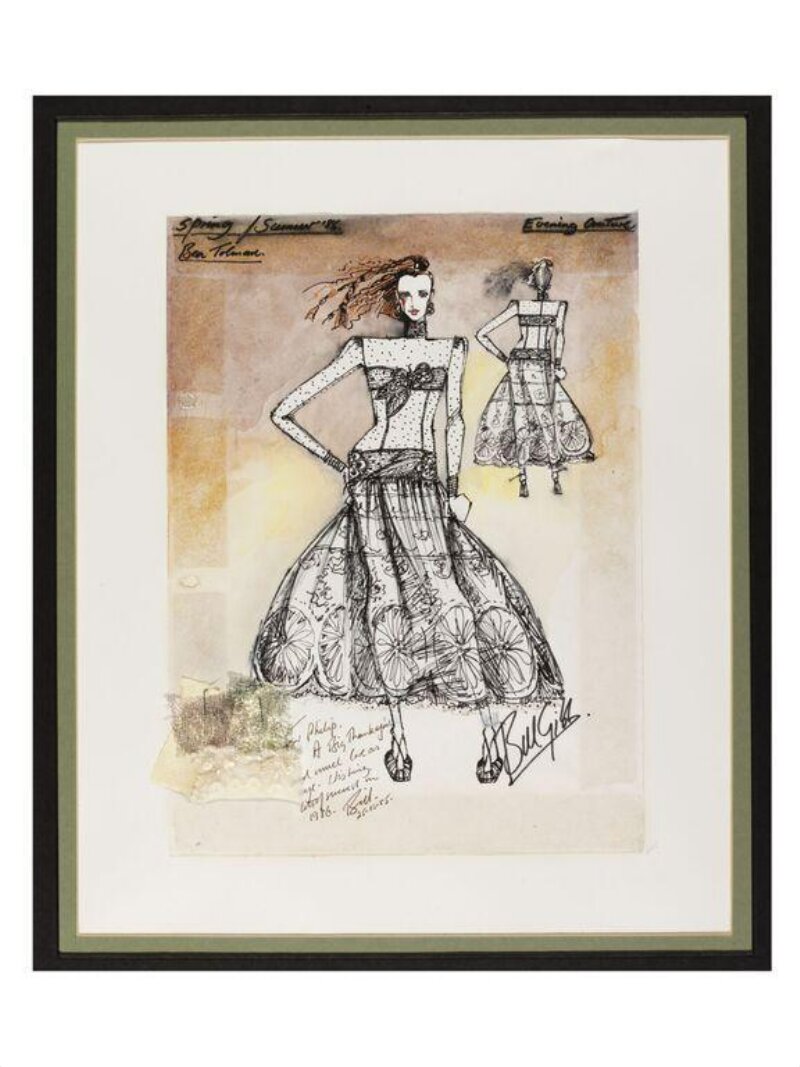
Couture Archaeology Report: Deconstructing the 1986 British Evening Silhouette
Subject: Evening Couture Fashion Design
Origin: Britain, 1986
Analyst: Senior Textile Historian, Natalie Fashion Atelier
Date: [Current Date]
Projection: Translation for 2026 High-End Luxury
The year 1986 in British fashion represents a critical inflection point, a moment where the theatrical excess of the early Eighties began a sophisticated dialogue with emerging notions of historical reference and technical bravura. This report deconstructs the material and methodological essence of the era's evening couture, moving beyond superficial nostalgia to excavate the foundational techniques that can inform and revolutionize our 2026 luxury silhouette. The objective is not replication, but rather a process of technical translation—extracting the core principles of materiality, construction, and silhouette to be re-engineered through a contemporary lens.
Technical Deconstruction: The Armature of Opulence
The 1986 British evening silhouette was fundamentally architectonic. Beneath the spectacle lay a rigorous and often heavy internal architecture that created its distinctive poise.
Structural Foundations: The bodice was frequently a masterclass in internal boning, utilizing spiral steel and rigid flat steels to create a sculpted, yet ostensibly natural, torso. Seams were not merely joins but channels of structure, often reinforced with coutil or organdy strips to prevent strain. A defining technique was the use of a floating inner corselet—a fully boned, independent structure attached at key points (waistline, centre front) to the outer fashion fabric. This allowed for a rigid form while permitting the outer layer, often delicate silk satin or velvet, to drape without distortion.
Complex Seam Engineering: Princess lines were paramount, but their execution was exaggerated. Seams were strategically placed to maximize light capture and shadow, creating an illusion of a cinched waist and amplified bust and hips. Gussets, often diamond-shaped and hidden under sleeves or at the waist, provided unexpected ease of movement within the rigid form. Sleeve heads were dramatically padded, not with soft wadding, but with layered horsehair and lambswool to achieve the period's signature sharp, extended shoulder—a silhouette of power and definition.
Material Materiality: The Dialectic of Weight and Light
The material palette of 1986 was a studied dialectic between substantial grounding and ethereal release, each selected for its specific interaction with light and body.
Primary Grounding Fabrics: Heavy silk duchess satin provided a foundational canvas, prized for its stiff drape and high-lustre, light-reflective surface. Baroque velvets, often with devoré (burn-out) patterns, added depth and texture, their pile absorbing light to create shadowed contrast. Taffeta, with its characteristic sonic rustle, was used for its volumetric capacity, holding shapes like a bell.
Embellishment as Integral Structure: Beadwork and embroidery were rarely mere decoration; they functioned as textural weighting and structural reinforcement. Heavy passementerie (fringe, cords) along hem lines acted as pendulum weights, stabilizing the garment's swing. Beaded motifs, using Czech glass and jet, were often clustered at stress points (shoulders, waist) to subtly reinforce seams while catching light. Lace, notably heavy Chantilly or guipure, was applied as an overlay or inset, its dense pattern providing modest coverage and a contrasting matte texture against reflective grounds.
Translation for the 2026 High-End Luxury Silhouette
The translation for 2026 requires a paradigm shift: from external armature to internal intelligence, and from opulent weight to considered density. The 1986 techniques provide the codex, but the language must evolve.
Re-engineering Structure: The Invisible Framework
The rigid boning and padding of 1986 must give way to advanced material science. Our 2026 interpretation will preserve the sculptural intent but achieve it through new means.
Memory-Alloy Boning & Biomorphic Forms: Replace spiral steel with shape-memory alloys and flexible polymer composites. These materials can provide bespoke, adaptive support that moves with the body, returning to a precise silhouette when at rest. This allows for the sharp shoulder—a key 1986 power motif—to be reimagined as a lightweight, self-supporting architectural curve, perhaps extending from a seamless bodice.
3D-Knitted Corselets & Seamless Construction: The floating corselet is re-conceived as a seamless, 3D-knitted under-structure using performance monofilaments and sustainable elastomers. This high-tech base layer can provide targeted compression and support, creating the desired torso shape without a single internal seam, onto which delicate outer fabrics can be applied without risk of distortion.
Re-imagining Materiality: Conscious Opulence
The material dialectic evolves from weight/light to density/transparency and traceability/transcendence.
Engineered Grounds: Replace silk duchess satin with weight-equivalent fabrics engineered from certified organic peace silk or next-generation lyocell weaves, finished with low-impact lustre treatments. Velvets will be crafted from recycled acetate or bio-based fibres, with laser-cut devoré patterns achieving precision unattainable in 1986.
Embellishment as Data & Light: Beadwork transforms. We will utilize lab-grown gem dust, recycled glass micro-beads, and biodegradable sequins. Furthermore, we will explore photoluminescent embroidery and fibre-optic thread integration, where the "sparkle" of 1986 becomes an interactive, ambient light source—a couture that responds to its environment. Embroidery can be applied via robotic precision, creating textures that also serve as flexible, conductive pathways for subtle, integrated lighting elements.
The 2026 Silhouette Synthesis: Architectural Fluidity
The resulting silhouette for 2026 is one of architectural fluidity. It captures the confident volume and defined geometry of 1986—the broad shoulder, the cinched waist, the full skirt—but executes it with a sense of weightless precision. A gown may feature a dramatic, sculpted bodice achieved via 3D-knitted form, flowing into a skirt of engineered silk taffeta that holds its shape through innovative thermo-pleating, edged with a fringe weighted with recycled brass beads. The internal heaviness is eradicated; the visual impact is amplified.
In conclusion, the 1986 British evening couture serves not as a template, but as a rich technical archive. Its true value lies in its uncompromising commitment to construction as the progenitor of silhouette. By deconstructing its methods and re-engineering its materiality through a sustainable, technologically advanced lens, Natalie Fashion Atelier can pioneer a 2026 luxury language that is both deeply informed and profoundly innovative—a couture where history is not worn, but dynamically rewritten.