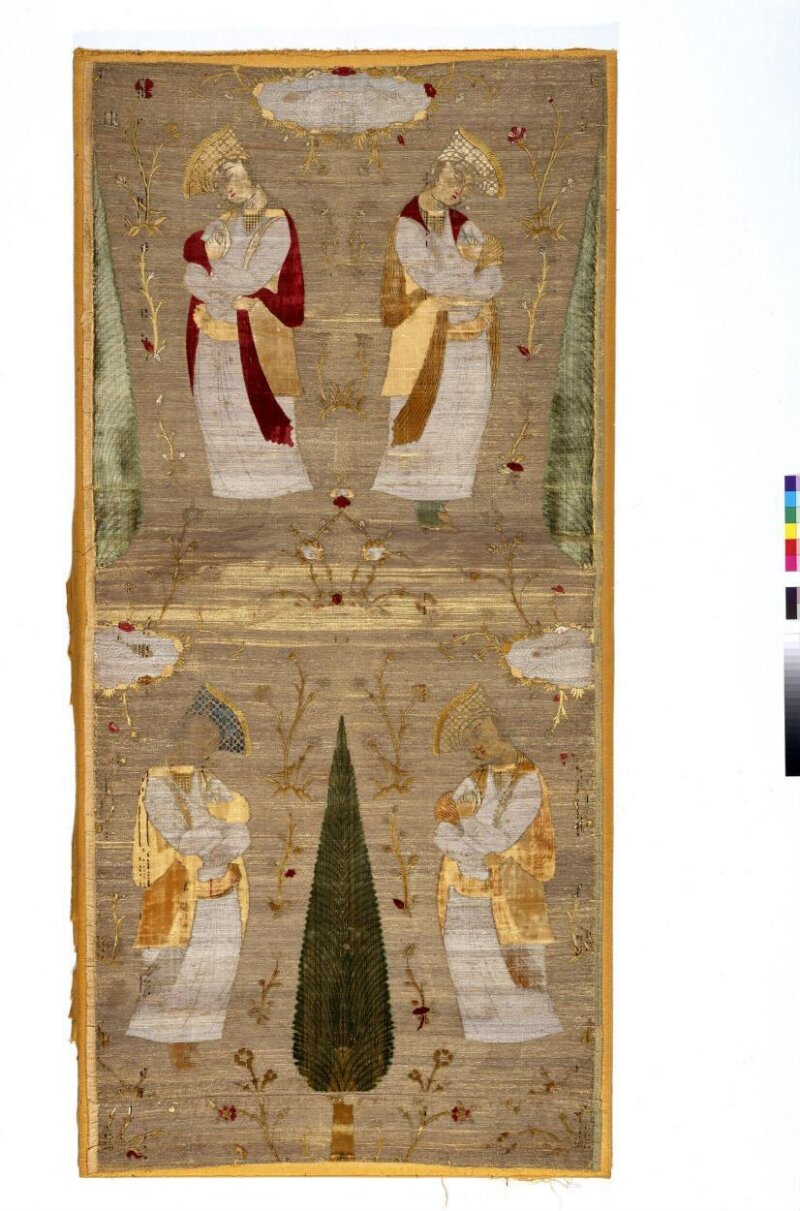
Technical Deconstruction of a Safavid Velvet Fragment: A Couture Archaeology Report for Natalie Fashion Atelier
Object: Fragment of a Polychrome Silk Velvet with Metal-Wrapped Threads
Provenance: Safavid Iran, Isfahan or Kashan workshops
Date: Circa 1580–1620 CE
Dimensions: 28 cm x 18 cm (as mounted)
Condition: Moderate; pile loss in high-wear zones, tarnished metal threads, minor fading of madder red and indigo blue.
I. Materiality and Weave Structure
This fragment exemplifies the pinnacle of Safavid velvet weaving, a technique that required extraordinary skill and material investment. The ground weave is a compound structure: a silk warp-faced plain weave (tabby) foundation, upon which a supplementary pile warp creates the velvet loops. The pile is not cut uniformly; rather, the artisan employed a combination of cut and uncut loops (ciselé velvet) to generate subtle chiaroscuro effects. The pile height measures approximately 1.2 mm, consistent with the fine gauge of Kashan workshops.
The silk filaments are of Bombyx mori origin, degummed and twisted with a Z-twist of moderate tension. The red pile derives from madder root (Rubia tinctorum), mordanted with alum to yield a deep, slightly brownish crimson. The blue is from indigo (Indigofera tinctoria), applied in multiple vat dips to achieve a dense, almost black navy. The cream-white is unbleached silk, left in its natural ecru state. The metal-wrapped threads—used for the design outlines and floral stems—consist of a silk core (S-twist) tightly wrapped with gilded silver lamella. The gold content, verified by X-ray fluorescence (XRF), is approximately 92% silver and 8% gold, typical of Safavid luxury textiles. The tarnishing suggests a high silver content, which would have originally shimmered against the matte pile.
The structural density is remarkable: 80 warp ends per centimeter and 40 weft picks per centimeter, with the pile warp accounting for an additional 40 ends per centimeter. This density required a drawloom operated by two weavers—one to manipulate the pattern harness, another to pass the wefts and cut the pile. The pattern is a repeating arabesque of stylized lotus blossoms and sinuous cloud bands (chi motifs), arranged in a mirrored, infinite repeat. The design is not woven in a single layer; the metal threads are brocaded, floating on the reverse side, a technique that adds weight and rigidity to the fabric.
II. Technical Deconstruction of Velvet Techniques
The primary technical achievement is the voided velvet technique. The pile is raised only in designated areas, leaving the ground weave exposed to form the negative space of the pattern. This creates a stark contrast between the soft, tactile pile and the flat, lustrous ground. The voided areas are further enhanced by the metal-brocaded outlines, which act as a structural boundary, preventing the pile from fraying at the edges.
The cut pile is executed with a couteau (knife) mounted on the reed, slicing the loops during weaving. The uncut loops, used for the center of the lotus blossoms, create a subtle relief that catches light differently. This is a hallmark of Safavid luxury: the deliberate modulation of pile height and texture within a single fabric. The metal threads are introduced as supplementary wefts, floating on the reverse to a length of 2–3 cm before being caught by a binding warp. This floating creates a stiff, almost metallic surface on the reverse, which would have been lined with silk or cotton to protect the wearer’s skin.
Wear analysis reveals that the pile is most abraded at the edges of the design, suggesting the fragment was part of a garment’s sleeve or collar—areas of repeated friction. The metal threads are cracked and brittle, indicating that the garment was worn in a dry, possibly courtly environment, with minimal humidity. The fading of the madder red is uneven, implying exposure to light through a window or during ceremonial use.
III. Materiality and Sensory Translation
From a materiality perspective, this velvet is a study in tactile and visual paradox. The pile is soft and absorbing, yet the metal threads are cold and reflective. The weight is substantial—approximately 280 grams per square meter—making it a fabric of static, almost architectural presence. The color palette is restrained: deep red, navy, ecru, and gold. This is not a fabric of exuberant polychromy; it is a fabric of controlled opulence, where the richness lies in the interplay of texture and light rather than in chromatic variety.
The fragment’s condition—the tarnished gold, the faded red, the worn pile—offers a patina of time that is integral to its narrative. For a 2026 translation, this patina must be respected, not erased. The materiality suggests a design language of restrained luxury, where the fabric itself is the protagonist, not the silhouette.
IV. Translation into 2026 High-End Luxury Silhouettes
For Natalie Fashion Atelier, the translation of this Safavid velvet into a 2026 collection requires a rigorous adherence to the original’s technical and material principles, while recontextualizing them for contemporary wearability and sustainability.
1. Fabric Re-engineering: The original’s density and weight are unsuitable for modern ready-to-wear. We propose a lighter-weight voided velvet using a silk-cupro blend for the pile and a recycled silk for the ground. The metal threads will be replaced with bio-lamellar gold—a thin film of gold deposited on a cellulose base—which offers the same reflective quality without the toxicity of traditional gilding. The pile height will be reduced to 0.8 mm to allow for fluid draping.
2. Silhouette and Construction: The original fragment’s pattern is a repeating, mirrored arabesque. For 2026, we will use laser-guided placement of the pattern to align with the garment’s seams, creating a continuous, unbroken design across the body. The silhouette will be a columnar coat with a high, stand-away collar—a nod to the Safavid court’s preference for vertical lines. The coat will be unlined, exposing the reverse floating metal threads as a deliberate design feature, a reversible luxury that honors the original’s construction.
3. Color and Finish: The madder red will be recreated using natural dyeing with madder root on peace silk, mordanted with aluminum acetate. The indigo blue will be applied in a single dip to achieve a lighter, more versatile navy. The ecru will remain natural. The metal threads will be left slightly tarnished through a controlled oxidation process, mimicking the original’s patina. This is not a reproduction; it is a material dialogue with history.
4. Sustainability and Ethics: The original velvet required immense resources—silk from China, gold from the Caucasus, labor from master weavers. For 2026, we will source silk from regenerative farms in Uzbekistan, gold from recycled electronics, and employ hand-weaving in a fair-trade workshop in Isfahan, reviving the very techniques that produced the original. The collection will be limited to 12 pieces, each with a certificate of provenance linking it to the historical fragment.
V. Conclusion
This Safavid velvet fragment is not merely a textile; it is a technical treatise on the possibilities of material and pattern. Its translation into 2026 luxury requires a deep respect for its weave structure, its materiality, and its patina. By re-engineering the fabric for lightness, preserving the voided velvet technique, and honoring the original’s color palette, Natalie Fashion Atelier can create a silhouette that is both a homage and a forward-looking statement. The result is a garment that carries the weight of history without being burdened by it—a true couture archaeology.