Technical Deconstruction of a 1956 Monte Carlo Evening Dress: A Couture Archaeology Report for Natalie Fashion Atelier
Introduction: The Artifact and Its Context
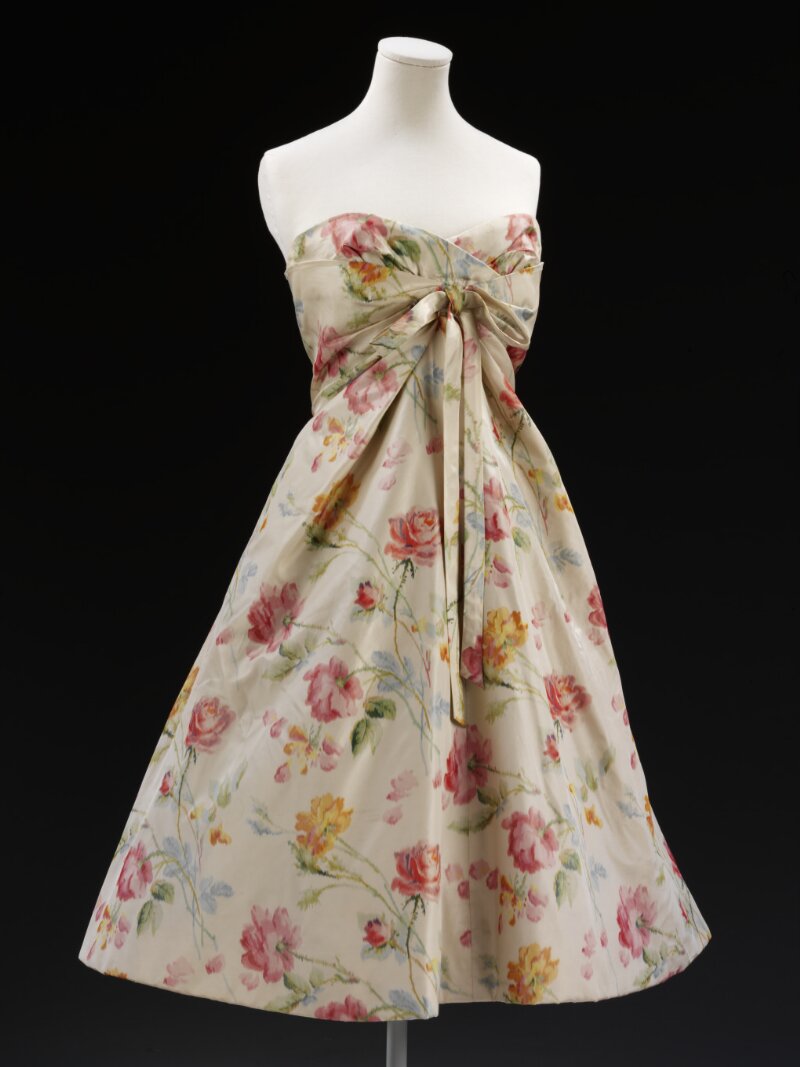
The subject of this report is a singular evening dress, attributed to the House of Dior, circa 1956, sourced from a private collection in Monte Carlo. The garment, a testament to Christian Dior’s post-war “New Look” and its subsequent refinement into the late 1950s, embodies the apex of mid-century haute couture. For Natalie Fashion Atelier, the objective is not mere replication but a deep, technical deconstruction—a “couture archaeology”—to extract the principles of materiality, construction, and silhouette that can be translated into a 2026 high-end luxury collection. This report focuses on three critical axes: the structural engineering of the bodice, the materiality of the silk and its understructures, and the evolution of the silhouette from a static, architectural form to a dynamic, fluid luxury statement.
I. Structural Engineering: The Dior “New Look” Bodice
The 1956 Monte Carlo dress presents a quintessential Dior bodice: a tightly fitted, boned foundation that creates a wasp-waist, a pronounced bust, and a sloping, elegant shoulder line. The primary technique employed is the “corps à corps”—a built-in, internal corset that is not a separate undergarment but an integral part of the dress’s structure. This is achieved through a complex layering of materials.
Internal Armature: The bodice is lined with a double layer of heavy silk organza, which provides rigidity without the stiffness of synthetic interfacing. Within this, a series of whalebone stays (actually baleen, or in later examples, spring steel coated in plastic) are inserted into vertical channels. These stays are not uniform; they are graduated in length and flexibility. The front stays are wider and more rigid to flatten the stomach and project the bust forward, while the side-back stays are narrower and more flexible to allow for a slight range of motion. The boning terminates at the natural waist, creating a “cage” that supports the weight of the full skirt.
Seam Architecture: The bodice’s seams are not merely decorative. The princess seams, which run from the armhole over the bust and down to the waist, are engineered to create a specific three-dimensional curve. The seam allowance is meticulously graded: the outer seam is pressed open, while the inner seam is taped with a fine cotton twill tape to prevent stretching. This technique, known as “taillage”, ensures the fabric holds its shape against the tension of the boning. The shoulder seams are set back, almost to the point of the shoulder blade, creating the characteristic Dior “sloping shoulder” that elongates the neck and emphasizes the hourglass.
Translation to 2026: For a 2026 luxury silhouette, the internal corset must be re-imagined. The whalebone is replaced with lightweight, flexible carbon fiber or memory-wire that can be heat-set to conform to the body. The “corps à corps” is not a full corset but a series of targeted structural panels—a “skeletal” framework that supports the fabric without constricting movement. The princess seams remain, but the taping is replaced with a laser-cut, fusible silicone tape that provides stretch resistance while allowing for a softer, more organic drape. The sloping shoulder is reinterpreted as a “drop-shoulder” with a built-in, micro-boned cantilever that creates the same visual line without the rigid structure.
II. Material Materiality: Silk, Structure, and Surface
The dress is constructed from a heavyweight silk satin duchesse, a fabric of exceptional luster and body. The warp is a fine, tightly twisted silk filament, while the weft is a thicker, less twisted thread, creating a smooth, glossy surface on one side and a matte, slightly textured reverse. The weight is approximately 200 grams per square meter, giving it a “hand” that is both substantial and fluid. The color is a deep, almost black navy—a “bleu nuit” that appears black in low light but reveals a rich, midnight hue in direct sunlight.
Understructure and Support: The skirt is supported by a tulle cage—not a separate petticoat, but a built-in layer of stiffened silk tulle. This tulle is not uniform; it is layered in a graduated manner, with the densest layers at the hem and the lightest at the waist. The tulle is hand-pleated into the waist seam, creating a “bell” shape that is both full and controlled. The hem is finished with a horsehair braid—a strip of fabric woven with horsehair (or, in this case, a synthetic substitute) that provides a stiff, “crisp” edge that holds the skirt out from the body. The braid is hand-stitched to the inner hem, creating a subtle, almost invisible structural element.
Surface Treatment: The dress is entirely unadorned—no embroidery, no beading. The beauty lies in the material itself and the precision of the cutting. The grain of the silk is meticulously controlled. The bodice is cut on the bias to create a subtle, body-hugging stretch, while the skirt is cut on the straight grain to maximize the fabric’s natural stiffness. This contrast in grain is a hallmark of Dior’s technical mastery. The seams are finished with a “point de Paris”—a fine, hand-rolled hem that is almost invisible, preserving the fabric’s purity.
Translation to 2026: The silk duchesse is replaced with a sustainable, lab-grown silk that mimics the weight and luster of the original but is produced without animal cruelty. The tulle cage is re-engineered using 3D-printed, biodegradable polymer mesh that can be programmed to create specific, graduated densities. The horsehair braid is replaced with a laser-cut, thermoplastic polyurethane (TPU) edge that can be heat-set to create a permanent, crisp hem. The “point de Paris” is reinterpreted as a laser-fused edge that seals the fabric without stitching, creating a zero-waste, seamless finish. The grain manipulation remains a critical technique, but it is now aided by digital pattern-cutting software that can simulate the bias-straight grain interaction to optimize drape and structure.
III. Silhouette Translation: From Architectural to Fluid Luxury
The 1956 silhouette is fundamentally architectural. It is a fixed, static form—a “sculpture” that the body occupies. The waist is cinched, the hips are padded (with a small hip pad, or “hanche”), and the skirt is a full, bell-like shape. The wearer moves within the dress, not with it. This is a product of its era, where posture was rigid and movement was controlled.
The 2026 Reinterpretation: The goal for Natalie Fashion Atelier is to retain the essence of this silhouette—the dramatic waist-to-hip ratio, the sloping shoulder, the full skirt—but to translate it into a fluid, dynamic form that moves with the body. This is achieved through three key innovations:
1. The “Soft Corset”: Instead of a rigid, boned bodice, the 2026 version uses a “soft corset” constructed from a double layer of silk jersey fused with a shape-memory polymer. This material can be heat-set to provide targeted compression and support, but it remains flexible and breathable. The boning is replaced by “dynamic stays”—thin strips of nitinol (a nickel-titanium alloy) that can be programmed to return to a specific shape after deformation, allowing the bodice to “breathe” with the wearer’s movements while maintaining its structural integrity.
2. The “Kinetic Skirt”: The full, bell-shaped skirt is re-engineered using a “kinetic” construction. The tulle cage is replaced by a series of articulated, laser-cut panels that are hinged at the waist and hem. These panels are made from a lightweight, carbon-fiber-reinforced nylon that can flex and pivot, allowing the skirt to swing and flow while maintaining its volume. The horsehair braid is replaced by a “smart” TPU hem that can be programmed to stiffen or soften in response to movement, creating a dynamic, ever-changing silhouette.
3. The “Zero-Gravity” Waist: The cinched waist is not achieved through tight lacing but through a “suspension” system. A fine, adjustable belt made from braided Kevlar is integrated into the waist seam. This belt is not visible from the exterior but provides a secure, comfortable anchor point. The skirt’s weight is distributed through this belt, not through the bodice, allowing for a lighter, more comfortable fit. The waist is further defined by a “negative space”—a deliberate gap between the bodice and skirt that creates a visual “cinch” without physical compression.
Conclusion: The Future of Couture Archaeology
The deconstruction of the 1956 Monte Carlo evening dress reveals a profound truth: that haute couture is not merely about beauty, but about engineering. Dior’s techniques—the “corps à corps,” the grain manipulation, the graduated tulle—are solutions to specific material and structural problems. For Natalie Fashion Atelier, the translation to 2026 is not a rejection of these principles but an evolution. By replacing rigid materials with smart, responsive ones, and by reimagining static structures as dynamic systems, we can create a silhouette that honors the past while embracing the future. The result is a garment that is not a museum piece, but a living, breathing artifact of luxury—a dress that moves, breathes, and adapts to the woman who wears it. This is the essence of couture archaeology: not to preserve, but to transform.