Aesthetic Archaeology: The Sutra Cover and the 2026 Silhouette
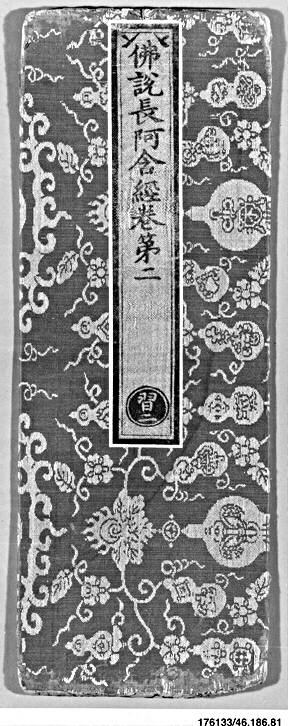
Within the hallowed archives of Natalie Fashion Atelier, the practice of aesthetic archaeology is not a passive study of history; it is a rigorous, technical deconstruction of materiality and form. The artifact in question—a Chinese Sutra Cover featuring Gourds on a Vine Scroll, executed in silk satin with supplementary weft patterning—presents a masterclass in controlled opulence. This piece, isolated from its religious context, reveals a sophisticated dialogue between surface tension and structural volume. For the 2026 season, this artifact does not merely inspire; it dictates a new lexicon of high-end silhouettes, one predicated on the principles of asymmetrical balance, kinetic texture, and architectural draping.
Materiality as a Structural Imperative
The foundational material—silk satin—is characterized by its high lustre and fluid drape. In the original artifact, this base provides a luminous, uninterrupted field. The supplementary weft patterning, however, introduces a critical variable: a secondary, discontinuous thread that creates raised, textured motifs. This is not mere decoration; it is a deliberate manipulation of the fabric’s weight and tension. The weft creates localized areas of increased density, which in turn alters the fabric’s natural fall. For 2026, the Atelier reinterprets this as a tension-gradient construction. The satin base becomes the primary, fluid body of the garment, while the supplementary weft—now reimagined as embroidered or bonded micro-panels—acts as a structural corsetry system, dictating where a silhouette cinches, flares, or floats.
Deconstructing the Gourd and Vine Motif
The iconography of the gourd and vine scroll is not arbitrary. In Chinese aesthetic philosophy, the gourd represents a contained volume—a perfect, organic ovoid form. The vine, conversely, is a line of continuous, asymmetrical growth. This duality is the core design thesis for the 2026 collection. The gourd motif informs the volumetric shoulder and hip. Specifically, the silhouette borrows the gourd’s tapered neck and bulbous base. A tailored jacket, for instance, will feature a sharply defined, high neckline (the gourd’s stem) that expands into a pronounced, rounded shoulder—a “gourd balloon” sleeve. The lower half of the garment, whether a skirt or wide-leg trouser, mirrors the gourd’s fuller base, creating a dramatic, sculptural hourglass that is both modern and historically resonant.
The vine scroll, with its undulating, asymmetrical path, directly informs the asymmetric hemline and draped side-panels. The 2026 silhouette rejects symmetrical rigidity. Instead, a gown’s hem will follow a vine-like trajectory, dipping lower on one side and rising sharply on the other. This is achieved through a bias-cut engineering that mimics the scroll’s organic flow. The supplementary weft patterning, when applied to these vine-like panels, creates a tactile gradient—dense at the hip, sparse at the hem—guiding the eye along the garment’s narrative line.
From Flat Weave to Three-Dimensional Sculpture
The technical brilliance of the original artifact lies in its flat, two-dimensional surface that, through patterning, implies volume. The gourds appear to bulge; the vines appear to twist. For 2026, the Atelier translates this illusion into physical, three-dimensional architecture. The supplementary weft technique is evolved into a structural quilting and trapunto method. Areas of the garment corresponding to the gourd motifs are padded from within, creating a bas-relief effect on the body. This is not padding for warmth; it is padding for silhouette. A bodice will feature raised, padded gourd shapes that contour the torso, creating a sculpted, armor-like carapace over the soft satin base. This juxtaposition of hard and soft, of structured and fluid, is the hallmark of the 2026 luxury silhouette.
The 2026 Silhouette: A Technical Blueprint
Silhouette A: The Gourd Balloon
A high-neck, long-sleeved top in heavy silk satin. The sleeves are cut with extreme volume at the bicep and forearm, tapering to a tight cuff at the wrist. The body of the top is fitted, with supplementary weft-inspired embroidery creating a vertical, vine-like pattern that visually elongates the torso. The hem is asymmetrical, echoing the scroll’s movement. This is paired with a gourd-shaped pencil skirt—narrow at the waist, dramatically flaring at the mid-thigh, and then tapering again at the knee. The effect is a controlled, explosive volume that references the gourd’s organic containment.
Silhouette B: The Vine Drape
A floor-length gown constructed from a single, continuous piece of satin with a bonded supplementary weft. The weft is applied in a gradient density—dense at the left shoulder, sparse at the right hip. This creates an inherent asymmetry in the fabric’s weight, causing the gown to drape naturally into a spiral, vine-like cascade. The garment requires no darts or seams; the silhouette is entirely dictated by the material’s engineered tension. The result is a gown that appears to grow organically on the body, a living scroll of silk and thread.
Silhouette C: The Architectural Carapace
A cropped jacket and high-waisted trouser ensemble. The jacket is constructed with internal, padded gourd motifs that create a raised, sculptural surface. The satin base is left smooth, allowing the raised gourds to catch light and shadow. The trousers are wide, with a vine-scroll hem that is longer at the back, creating a train-like effect. The overall silhouette is one of controlled power—the structured top anchors the fluid bottom, a direct reference to the sutra cover’s interplay of rigid pattern and soft ground.
Conclusion: The Archive as a Living System
The Sutra Cover with Gourds on a Vine Scroll is not a relic; it is a technical blueprint for the future. By deconstructing its materiality—the tension between satin and weft, the organic geometry of gourd and vine—Natalie Fashion Atelier has extracted a set of silhouette principles for 2026. These principles reject the static in favor of the kinetic, the symmetrical in favor of the organic, and the flat in favor of the sculptural. The 2026 collection will not merely reference Chinese heritage; it will re-engineer its structural logic for the contemporary body, proving that the most profound innovations in haute couture are often found in the quiet, meticulous craftsmanship of the past.