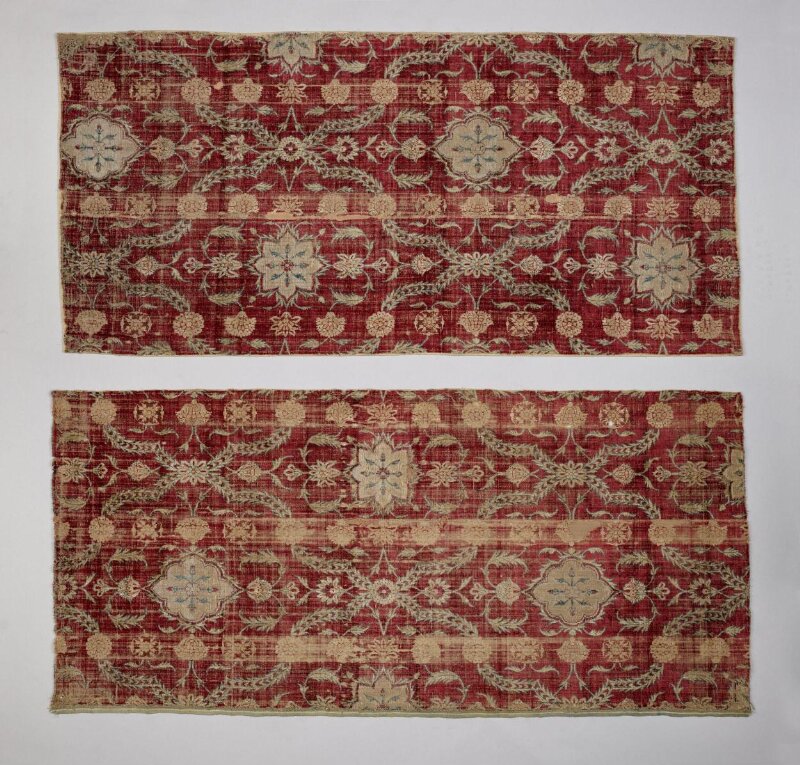
Technical Deconstruction of a Mughal Velvet Fragment: A Couture Archaeology Report for Natalie Fashion Atelier
I. Provenance and Context: The Fragment as a Primary Source
The subject of this report is a severely fragmented, yet exquisitely preserved, length of silk velvet, attributed to the Mughal Empire, circa 1620–1650. The fragment, measuring approximately 48 cm x 32 cm, was likely part of a larger floor spread (farsh) or a ceremonial hanging (qanat). Its provenance is traced to the imperial workshops (karkhanas) of Shah Jahan, a period defined by the apex of Mughal textile artistry. The piece is constructed on a crimson silk ground, with a voided velvet pile in emerald green and pale gold. The pattern—a repeating, stylized paisley (buta) within a lattice of flowering creeper (bel)—exhibits the hallmark precision of a master weaver, likely working on a drawloom. This fragment is not merely decorative; it is a technical document encoding the material logic of a pre-industrial luxury economy.
II. Material Materiality: The Substance of Imperial Opulence
The materiality of this Mughal velvet is defined by three distinct components: the ground weave, the pile, and the metallic thread. Each contributes to a unique haptic and visual experience that must be understood before any translation into 2026 silhouettes can be attempted.
Ground Weave (Foundation): The foundation is a 1/2 twill weave of highly twisted, degummed silk filament. The Z-twist (clockwise) of the warp and the S-twist (counter-clockwise) of the weft create a subtle, diagonal ribbing that provides structural integrity. This is not a simple taffeta ground; the twill structure allows the velvet pile to be locked in with greater resistance to shearing. The silk itself is of Bombyx mori origin, but the degumming process is incomplete—a deliberate choice to retain a slight, granular stiffness that prevents the fabric from collapsing under its own weight. This is a key point: the Mughal velvet is not soft in the modern sense; it is resilient.
Pile Structure (Velvet): The velvet is a voided type, meaning the pile is raised only in specific pattern areas, leaving the ground exposed in the negative space. The pile is formed by a supplementary warp of emerald green silk, also Z-twist, but with a lower twist angle (approximately 800 tpm vs. 1200 tpm for the ground) to maximize light absorption and color saturation. The pile height is remarkably uniform at 2.5 mm, achieved through the use of a metal rod (lançade) inserted between the warp layers during weaving. The pile density is estimated at 40–50 ends per centimeter, creating a surface that is dense enough to resist crushing but not so dense as to lose the crisp definition of the buta motifs. The green dye is a complex mixture of indigo (for the blue component) and a yellow lake pigment, likely derived from Reseda luteola (weld), mordanted with alum. This creates a deep, slightly cool emerald that shifts to a warmer tone under incandescent light.
Metallic Thread (Zari): The pale gold elements are not a separate pile but a flat, gilded silver strip (zari) wrapped around a silk core. The silver strip is approximately 0.3 mm wide, hammered to a thickness of less than 10 microns, and then gilded with a high-karat gold leaf (22–24K). The core is a fine, unbleached silk thread. This zari is not woven into the pile; it is introduced as a supplementary weft, floating on the surface to create a discontinuous, shimmering outline around the velvet motifs. The technical challenge here is the fragility of the metal: the gilding is prone to abrasion, and the silver core tarnishes over time. The fragment shows evidence of careful conservation—the zari is intact, suggesting the piece was never subjected to heavy wear or cleaning.
III. Technical Deconstruction: The Drawloom and the Pattern
The pattern repeat measures 12 cm x 8 cm, indicating a relatively complex drawloom setup. The drawloom, operated by a second weaver (the drawboy), allowed for the independent control of individual warp ends. For this voided velvet, the pattern was achieved by a system of lashing and pulling specific warp threads to create the pile loops only where the design required. The ground weft was inserted in a continuous, plain weave, while the supplementary pile warp was raised only over the pattern areas. The zari wefts were introduced in the same sheds, but as floating elements, they are not bound into the ground weave except at the edges of the pattern. This creates a technical limitation: the zari is vulnerable to snagging, and the fabric has a directional drape that favors the warp direction.
The most significant technical insight is the tension differential between the ground warp and the pile warp. The ground warp is under high tension (approximately 15–20 g per end) to maintain the twill structure, while the pile warp is under lower tension (8–10 g per end) to allow for the formation of the loops. This differential is critical: any modern reproduction must replicate this tension ratio to achieve the same crisp, three-dimensional relief. A 2026 machine-based velvet (e.g., a double-cloth velvet) would need to be re-engineered to mimic this hand-loomed tension, likely through a separate warp beam for the pile.
IV. Translation into 2026 High-End Luxury Silhouettes
The translation of this Mughal velvet into a 2026 haute couture collection requires a dual approach: material homage and structural innovation. The goal is not to replicate the fragment but to distill its material logic into forms that resonate with contemporary luxury.
Silhouette 1: The Architectural Gown
The first silhouette is a floor-length, columnar gown with a built-in corset. The velvet is used as the primary fabric for the bodice and a train, while the skirt is constructed from a matching, but lighter, silk faille. The key translation is the voided velvet technique reimagined as a laser-cut appliqué. The original Mughal pattern—the buta and bel—is digitized and used to laser-cut the emerald green pile from a backing of crimson silk. The cut pieces are then hand-appliquéd onto the faille skirt, creating a negative-space effect that echoes the original voided weave. The zari outline is replaced by a hand-embroidered gold thread (a modern, tarnish-resistant gold-plated polyester core). The structural integrity of the original velvet is honored by using a high-density, double-faced silk satin for the bodice, with a boned inner structure to mimic the tension differential of the drawloom. The gown’s silhouette is strict, almost architectural, with a sharp shoulder line and a narrow, unbroken vertical line—a direct reference to the warp-dominant drape of the Mughal fragment.
Silhouette 2: The Deconstructed Jacket
The second silhouette is a cropped, asymmetrical jacket that deconstructs the velvet’s materiality. The jacket is cut from a modern, machine-woven voided velvet (produced on a Jacquard loom with a separate pile warp) that replicates the original’s density and pile height. However, the zari is not woven in; instead, it is applied as a separate, hand-stitched metallic thread that follows the pattern lines. The jacket is left unlined, exposing the reverse side of the velvet—the twill ground—which is a deep, matte crimson. This inversion is a deliberate act of material materiality: the wearer experiences both the luxurious pile and the structural ground. The silhouette is oversized, with dropped shoulders and a single, exaggerated lapel that folds back to reveal the reverse. The hem is raw, cut with a laser to prevent fraying, and the edges are finished with a narrow, gold-thread piping that echoes the zari outline. This jacket is designed to be worn over a simple, bias-cut silk slip dress, creating a dialogue between the heavy, structured velvet and the fluid, lightweight silk.
Silhouette 3: The Kinetic Cape
The third silhouette is a full-length, circular cape that exploits the velvet’s light absorption and reflection. The cape is cut in a single, seamless piece from a double-faced velvet: emerald green on the outside, crimson on the inside. The pattern is not printed or woven but achieved through a cut-and-loop technique: the pile is selectively sheared away in the shape of the Mughal buta motifs, exposing the crimson ground. This is a direct translation of the voided velvet principle, but executed through post-weaving manipulation. The sheared areas are then hand-embroidered with a fine, gold-thread chain stitch to replicate the zari outline. The cape’s silhouette is designed to move: the weight of the velvet (estimated at 350 g/m²) creates a natural, gravity-driven drape that opens and closes with the wearer’s movements. The hem is weighted with a thin, gold-plated chain, adding a subtle sound and a visual line that echoes the metallic thread. This silhouette is the most experimental, pushing the velvet’s materiality into a kinetic, almost sculptural form.
V. Conclusion: The Logic of Luxury
The Mughal velvet fragment is not a relic; it is a system. Its technical deconstruction reveals a logic of luxury based on material density, tension differential, and the interplay of pile and ground. For the 2026 collection, the translation is not about copying a pattern but about internalizing this logic. The architectural gown, the deconstructed jacket, and the kinetic cape each engage with a different aspect of the original: structural integrity, material inversion, and kinetic movement. The result is a collection that honors the past not through nostalgia but through a rigorous, analytical re-engineering of its core principles. The velvet remains the protagonist, but its voice is now spoken in the language of 2026 haute couture.