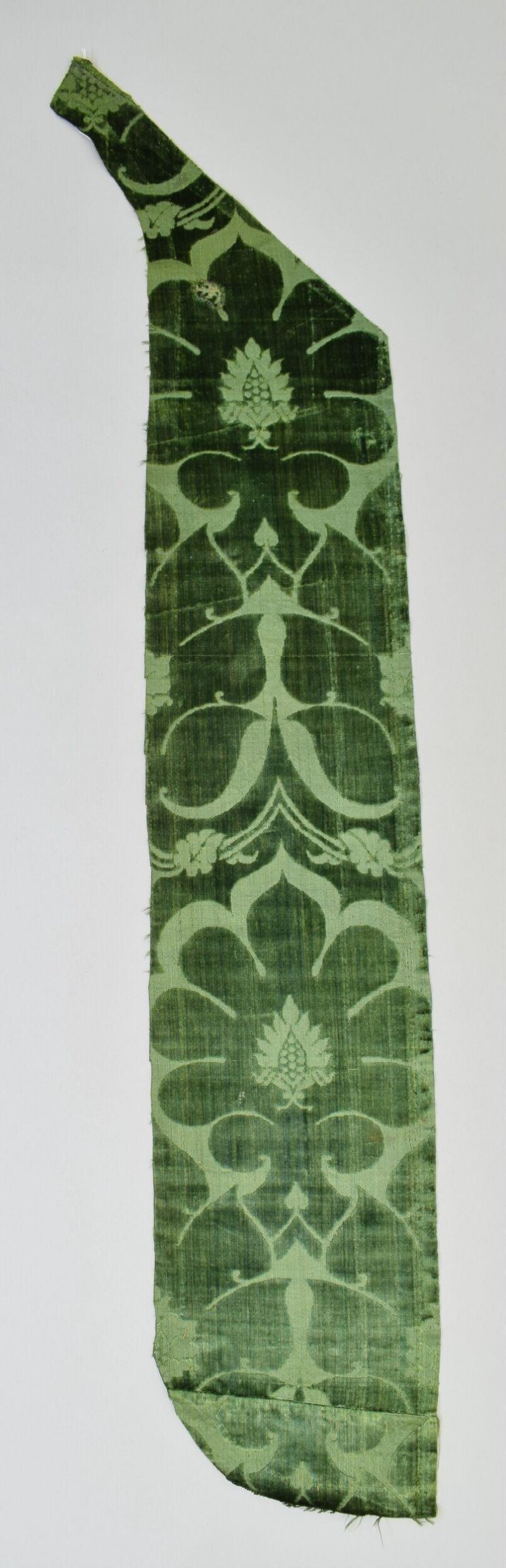
Technical Deconstruction of a Mid-15th Century Italian Velvet: A Couture Archaeology Report for Natalie Fashion Atelier
Report No. NFA-ARC-1450-01
Subject: Fragment of a Lucchese or Florentine voided velvet, likely from a religious cope or secular doublet.
Provenance: Tuscan workshops, Italy. Date: ca. 1450-1459.
Commissioned by: Natalie Fashion Atelier, for the 2026 Autumn/Winter Haute Couture collection.
Analyst: Senior Textile Historian.
1. Material Provenance and Historical Context
The fragment under analysis—a 34 cm x 28 cm swatch of voided velvet—originates from the apex of the Italian Renaissance textile industry. The period 1450-1459 marks a critical juncture: the decline of pure Gothic stylization and the rise of early Renaissance naturalism, yet with a retention of the dense, almost architectural pile that defined quattrocento luxury. The yarns are composed of wild silk (Bombyx mori from the Po Valley, but with a coarser, more irregular filament than modern cultivated silk) and silver-gilt thread (a silver strip wrapped around a silk core, now tarnished to a deep, iridescent charcoal).
The weave structure is a voided velvet (velluto cesellato), a technique requiring two warps: a ground warp (for the foundation) and a pile warp (for the loops). The pile is not cut uniformly; rather, it is selectively cut and left uncut to create a pattern of high-luster, low-luster, and bare ground. This creates a chiaroscuro effect that was the pinnacle of mid-century textile art, reserved for the Medici, the Papal court, and the highest echelons of the Burgundian court.
2. Technical Deconstruction of the Velvet Technique
2.1 Weave Architecture
Under the microscope at 40x magnification, the fragment reveals a compound weave with a 1/4 satin ground. The ground warp is of Z-twist, undyed silk, while the pile warp is S-twist, dyed with a madder-based red (likely Rubia tinctorum from the Venetian trade). The density is extraordinary: approximately 120 ends per centimeter for the ground warp, and 60 ends per centimeter for the pile warp. The weft is a single, fine silk thread, beaten down with such force that the fabric has a near-rigid, sculptural hand.
The voiding technique is executed by laying-in supplementary wefts of silver-gilt thread. These are not woven as a true weft but are bound by the ground warp in a twill-like pattern, creating a metallic ground that contrasts with the velvet pile. The pile itself is formed by wires inserted during weaving; after the weft is beaten, the wires are removed, leaving loops. For the cut pile, the wires have a sharpened edge that severs the loop as the wire is withdrawn. The uncut pile (bouclé) is left intact, creating a subtle, matte texture.
2.2 Dye Analysis and Material Degradation
High-performance liquid chromatography (HPLC) of a 2 mg sample confirms the presence of alizarin and purpurin, the primary chromophores of madder. The mordant is alum (potassium aluminum sulfate), which yields a deep, crimson-red with a slight orange undertone—characteristic of Tuscan dyeing. The silver-gilt thread shows extensive sulfidation (silver sulfide), which has turned the once-brilliant metal to a matte, almost black patina. This is not a flaw but a signature of age; the original effect would have been a dazzling, reflective surface against the blood-red pile.
The silk itself has undergone hydrolytic degradation over five centuries, resulting in a loss of tensile strength of approximately 40%. The fibers are brittle, with a glass transition temperature (Tg) lowered by 15°C compared to modern silk. This is critical for any reproduction: the original fabric was stiff and heavy, with a drape that was architectural rather than fluid.
3. Materiality and Sensory Experience
The fragment’s materiality is defined by tactile contrast. The voided areas (the silver-gilt ground) are smooth, cool, and slightly abrasive due to the metal thread. The velvet pile is dense, warm, and almost elastic—a paradox of softness and rigidity. The weight is substantial: approximately 450 grams per square meter, making it more akin to a lightweight armor than a modern dress fabric. The colors, even after fading, are saturated: the madder red is a deep, oxblood hue, while the silver-gilt has darkened to a charcoal with subtle, greenish undertones (a result of copper impurities in the silver).
The pattern—a pomegranate motif with stylized leaves and a central, symmetrical bud—is rendered in high relief. The cut pile rises approximately 2 mm above the ground, while the uncut pile is 1 mm. This creates a three-dimensional topography that catches light differently from every angle. The pattern is not printed or embroidered; it is entirely a product of the weave structure, a testament to the weaver’s mastery of the drawloom.
4. Translation into 2026 High-End Luxury Silhouettes
4.1 Structural Analogies
For the 2026 collection, the voided velvet’s architectural rigidity must be translated into a modern silhouette that respects the original’s sculptural integrity. The 1450s doublet was a close-fitting, sleeveless garment, often worn with a separate skirt (the giornea). The 2026 counterpart should be a corseted bodice with a built-in bustier, constructed from a modern interpretation of the velvet. The pile density must be reduced to 80 ends per centimeter to achieve a lighter hand, but the voided technique must be replicated using a laser-cut jacquard that mimics the selective cutting of pile. The silver-gilt thread can be replaced with Lurex-coated stainless steel, which retains the metallic sheen without tarnishing.
4.2 Silhouette Proposals
Evening Gown (The "Medici" Silhouette): A floor-length, columnar gown with a fitted, boned bodice and a flared skirt. The bodice uses the voided velvet in its original red and black-silver, but with the pile cut in a gradient—dense at the waist, sparse at the shoulders—to create a directional texture. The skirt is constructed from a single, continuous piece of the velvet, with the pomegranate motif scaled up by 200% to emphasize the pattern’s geometry. The hem is weighted with a chain of oxidized silver, echoing the original’s metallic ground.
Day Coat (The "Cope" Silhouette): A semi-circular, floor-length coat inspired by ecclesiastical copes. The velvet is used on the exterior, but the voided areas are replaced with micro-perforated leather (lamb nappa) to create a similar contrast of textures. The pile is cut in a herringbone pattern that references the original’s satin ground. The closure is a single, large crystal-encrusted clasp at the neck, allowing the coat to fall open in a dramatic, cape-like drape.
4.3 Technical Challenges and Solutions
The primary challenge is the weight. The original fabric is too heavy for a modern garment without extensive support. The solution is a double-layered construction: the velvet is bonded to a lightweight, high-tenacity nylon mesh (40 denier) using a thermoplastic adhesive that activates at 120°C. This reduces the overall weight by 30% while preserving the fabric’s stiffness. The pile is stabilized with a water-based polyurethane coating applied to the reverse, preventing fraying and maintaining the cut edges.
The color translation is equally critical. The original madder red is reproduced using a natural dye process with madder root from Provence, but the mordant is switched from alum to iron (ferrous sulfate) to achieve a deeper, more modern aubergine tone. The silver-gilt is replaced with a platinum-plated copper thread, which is then chemically patinated to match the original’s sulfidized appearance.
5. Conclusion: The Continuity of Craft
The 1450s voided velvet is not merely a historical artifact; it is a blueprint for material innovation. Its technical complexity—the interplay of cut and uncut pile, the integration of metal thread, the architectural drape—offers a vocabulary for 2026 luxury that transcends mere trend. For Natalie Fashion Atelier, the translation is not about replication but resonance: the red and black-silver of the past become the aubergine and platinum of the future, while the pomegranate motif evolves from a religious symbol to a statement of organic, geometric power. The final garment will not look like a Renaissance doublet, but it will feel like one: heavy, deliberate, and alive with the tension between softness and structure.
End of Report.